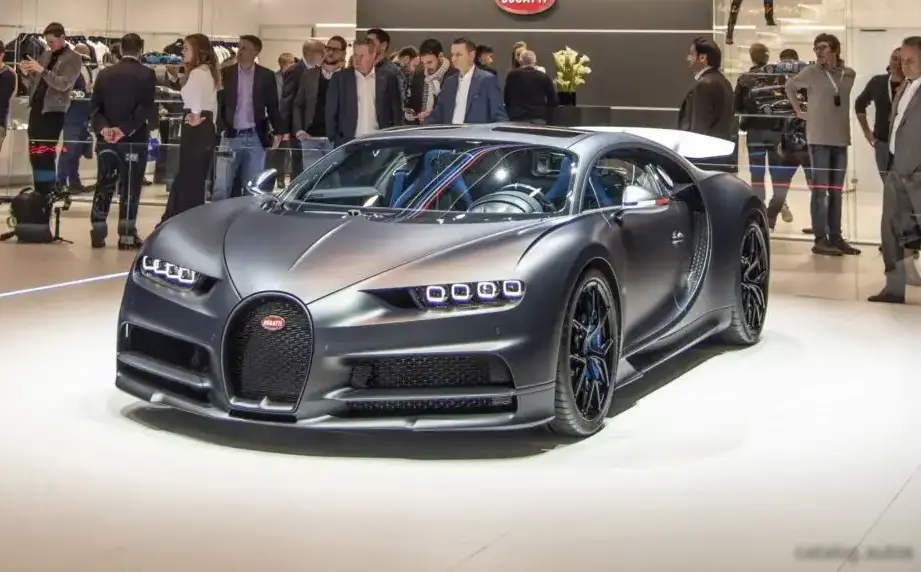
The Bugatti Chiron Sport 8.0 W16 (1500 Hp) AWD DSG represents a pinnacle of automotive engineering, a hypercar that pushes the boundaries of performance, design, and exclusivity. Introduced in 2018, the Chiron Sport is a more agile and driver-focused iteration of the already formidable Bugatti Chiron. It retains the monstrous powertrain of its sibling while incorporating significant chassis and aerodynamic enhancements aimed at improving handling dynamics without sacrificing the brand’s signature blend of extreme speed and opulent luxury. This vehicle is not merely a mode of transport; it is a definitive statement on the capabilities of the internal combustion engine, a masterpiece of craftsmanship built for those who demand the absolute apex of performance.
Development and Introduction
The standard Bugatti Chiron, successor to the legendary Veyron, was unveiled in 2016 and immediately set new benchmarks for a production road car. However, Bugatti’s engineers and designers saw an opportunity to cater to a clientele that desired a more visceral and corner-carving driving experience. The result was the Chiron Sport, which made its debut at the 2018 Geneva Motor Show.
The core philosophy behind the Sport variant was to enhance handling and agility through strategic weight reduction and suspension stiffening. While the colossal power output of the W16 engine remained unchanged, the focus shifted to how that power was translated to the road, particularly through a twisting-back country road or a demanding racetrack. Bugatti announced that the Chiron Sport was able to complete a lap of the Nardò handling circuit in Italy a full five seconds faster than the standard Chiron, a testament to the success of its dynamic upgrades. This was achieved not through an increase in power, but through a more responsive and communicative chassis, lighter components, and refined aerodynamics, making the Chiron Sport a sharper instrument for the discerning driver.
Powertrain and Drivetrain
At the heart of the Bugatti Chiron Sport lies one of the most complex and powerful engines ever fitted to a production car: an 8.0-liter (7993 cm³) quad-turbocharged W16 engine. This unique W-configuration engine is essentially two narrow-angle V8 engines joined on a common crankshaft. It features 64 valves (four per cylinder) and a sophisticated multi-port manifold fuel injection system.
The most critical element of its power delivery is the sequential quad-turbocharger system. At lower RPMs, only two turbochargers are active to provide sharp throttle response and minimize turbo lag. As the engine speed climbs past approximately 3,800 rpm, valves open to activate the remaining two turbochargers, delivering a seamless and relentless wave of power up to the redline. This results in a staggering peak output of 1,500 horsepower (1,103 kW) at 6,700 rpm and a monumental torque figure of 1,600 Nm (1,180.1 lb.-ft.), which is available across a broad plateau from 2,000 to 6,000 rpm. This flat torque curve ensures that acceleration is brutal and instantaneous at almost any speed.
Mated to this engine is a Ricardo-developed 7-speed dual-clutch automatic gearbox (DSG). This transmission is engineered to withstand the immense torque of the W16 and provides exceptionally fast gear changes. Power is sent to the road through a sophisticated, permanent all-wheel-drive (AWD) system featuring an electronically controlled multi-plate center differential and an active rear differential. This system is crucial for managing the engine’s output, ensuring maximum traction during acceleration and stability through high-speed corners.
Astonishing Acceleration and Top Speed of the Bugatti Chiron Sport 8.0 W16 (1500 Hp) AWD DSG
The combination of extreme power, rapid-shifting transmission, and all-wheel-drive traction results in performance figures that are difficult to comprehend. The Bugatti Chiron Sport can accelerate from a standstill to 100 km/h (62 mph) in a mere 2.4 seconds. The ferocity continues unabated, with 200 km/h (124 mph) reached in just 6.1 seconds and 300 km/h (186 mph) in a breathtaking 13.1 seconds.
For road use, the Chiron Sport’s maximum speed is electronically limited to 420 km/h (261 mph). This limitation is primarily due to the constraints of current tire technology, as sustaining speeds beyond this would risk catastrophic tire failure. To achieve this top speed, the driver must use a special Top Speed Key, which retracts the rear wing and lowers the car’s ride height to reduce aerodynamic drag. Without the key, the car is limited to a still-stratospheric 380 km/h (236 mph). These figures firmly place the Chiron Sport in the uppermost echelon of hypercar performance.
Chassis, Handling, and Aerodynamics
The primary distinction of the Chiron Sport lies in its enhanced handling characteristics. The car is built around a lightweight and incredibly rigid carbon fiber monocoque chassis, which provides a stable platform for the advanced suspension system. Both the front and rear feature a double-wishbone suspension setup, a design favored in motorsport for its superior control over wheel geometry. For the Sport model, Bugatti engineers stiffened the shock absorbers by 10 percent compared to the standard Chiron.
A key enhancement is the new Dynamic Torque Vectoring function, which works in conjunction with the Electronic Stability Control (ESC) and the all-wheel-drive system. It can individually brake the inside wheels during a corner, helping the car pivot more sharply and improving turn-in response and agility. The steering was also recalibrated to provide more direct feedback.
Significant effort was invested in reducing weight. The Chiron Sport is 18 kg (40 lbs) lighter than the standard model, with a curb weight of 1,977 kg (4,359 lbs). This was achieved through the extensive use of carbon fiber for components such as the intercooler cover, wiper arms, and, for the first time on a production vehicle, the stabilizer bar. Lighter wheels and lighter rear-window glass also contribute to the weight savings. While 18 kg may seem modest, this reduction in unsprung and rotating mass has a tangible effect on the car’s responsiveness and handling feel.
Bringing the Chiron Sport to a halt from its incredible speeds is a set of massive carbon-ceramic disc brakes. The front rotors measure 420 mm in diameter and are clamped by eight-piston calipers, while the rear features 400 mm discs with six-piston calipers. These are complemented by an active rear wing that can pivot into an air brake position, dramatically increasing downforce and aerodynamic drag to aid in high-speed deceleration. The car rides on specially developed Michelin Pilot Sport Cup 2 tires (285/30 R20 at the front and 355/25 R21 at the rear) designed to withstand the immense forces generated by the car’s speed and weight.
Exterior and Interior Design
Visually, the Chiron Sport maintains the iconic Bugatti design language, dominated by the signature C-line that sweeps around the passenger cabin. Specific design elements that distinguish the Sport include a new four-pipe round exhaust deflector at the rear and special Sport logos on the door sills. The model is often showcased with optional color splits and exposed carbon fiber finishes that emphasize its performance-oriented nature.
The interior is a masterful blend of minimalist luxury and driver-focused ergonomics. Anodized black finishes for the engine-start button and driving mode selector, along with Chiron Sport embroidery on the center console, differentiate the model. The cabin is trimmed in a mix of leather, Alcantara, and exposed carbon fiber, with every element crafted to the highest possible standard. The focus remains on the driving experience, with a clean dashboard layout that avoids large central infotainment screens, instead integrating essential information into the driver’s instrument cluster.
Fuel Consumption and Emissions
As expected from a 1,500-horsepower, 8.0-liter quad-turbocharged engine, fuel efficiency is not a primary concern. The Bugatti Chiron Sport 8.0 W16 (1500 Hp) AWD DSG is a vehicle of extremes, and its fuel consumption reflects this. According to the WLTP (Worldwide Harmonised Light Vehicle Test Procedure) cycle, the combined fuel consumption is 22.3 liters per 100 kilometers. This can rise to as much as 43.3 l/100 km during low-speed, urban-style driving. Correspondingly, CO₂ emissions are rated at a high 506 g/km under the WLTP standard, complying with the Euro 6 emissions standard prevalent at the time of its release. The vehicle is equipped with a 100-liter fuel tank to provide a reasonable cruising range.
The Bugatti Chiron Sport exists as a testament to the outer limits of internal combustion technology. It successfully builds upon the foundation of the standard Chiron by introducing a suite of dynamic enhancements that sharpen its handling and elevate the driving experience. By strategically reducing weight and recalibrating the chassis and drivetrain systems, Bugatti created a hypercar that is not only capable of breathtaking straight-line speed but also possesses a newfound agility and responsiveness in the corners. The Bugatti Chiron Sport 8.0 W16 (1500 Hp) AWD DSG stands as a modern icon, a fusion of immense power, technical sophistication, and unparalleled craftsmanship.
Bugatti Chiron Sport 8.0 W16 (1500 Hp) AWD DSG Full Specifications
| Category | Specification |
| ————————— | ————————————————————————————————————————– |
| General Information | |
| Brand | Bugatti |
| Model | Chiron |
| Generation | Chiron Sport |
| Production Start | 2018 |
| Body Type | Coupe |
| Seats | 2 |
| Doors | 2 |
| Engine Specifications | |
| Engine Type | 8.0 W16 Quad-Turbocharged |
| Power Output | 1500 Hp @ 6700 rpm |
| Torque | 1600 Nm @ 2000-6000 rpm (1180.1 lb.-ft.) |
| Engine Displacement | 7993 cm³ (487.76 cu. in.) |
| Engine Configuration | W-engine, Longitudinal