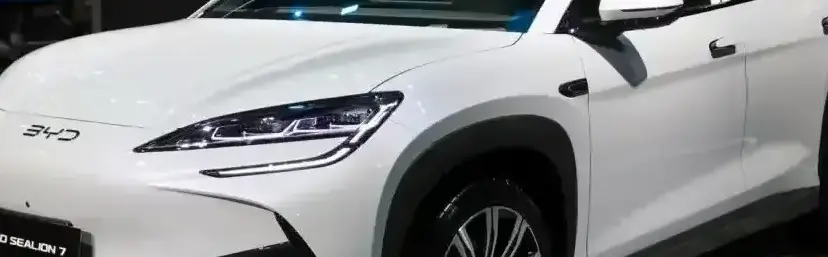
The BYD Sealion 7 82.5 kWh AWD Electric is a battery electric SUV produced by the Chinese manufacturer BYD (Build Your Dreams), entering production in November 2024. Positioned as a mid-range offering within BYD’s expanding electric vehicle lineup, the Sealion 7 aims to compete in the increasingly popular compact SUV segment. It represents BYD’s commitment to providing technologically advanced and efficient electric vehicles to a global market, with initial focus on the Chinese domestic market and subsequent expansion to other regions. This particular variant, boasting 530 horsepower and all-wheel drive, is intended to deliver a balance of performance, range, and practicality for families and commuters.
Technical Specifications
| Brand | BYD |
| Model | Sealion 7 |
| Generation | Sealion 7 |
| Type (Engine) | 82.5 kWh (530 Hp) AWD Electric |
| Start of production | November, 2024 |
| Powertrain Architecture | BEV (Electric Vehicle) |
| Body type | SUV |
| Seats | 5 |
| Doors | 5 |
| Fuel Type | Electricity |
| Acceleration 0 – 100 km/h | 4.5 sec |
| Acceleration 0 – 62 mph | 4.5 sec |
| Acceleration 0 – 60 mph | 4.3 sec |
| Maximum speed | 215 km/h (133.59 mph) |
| Weight-to-power ratio | 4.4 kg/Hp, 226.5 Hp/tonne |
| Weight-to-torque ratio | 3.4 kg/Nm, 294.9 Nm/tonne |
| Gross battery capacity | 82.5 kWh |
| Battery voltage | 550 V |
| Battery technology | Lithium iron phosphate (LiFePO4) |
| Battery location | Below the floor |
| All-electric range (WLTP) | 456 km (283.35 mi) |
| Average Energy consumption (WLTP) | 21.4 kWh/100 km (34.44 kWh/100 mi) |
| MPGe | 98 |
| km/kWh | 4.7 |
| mi/kWh | 2.9 |
| Electric motor 1 model/code | TZ200XYT |
| Electric motor 1 location | Rear axle, Transverse |
| Electric motor 1 type | Synchronous |
| Electric motor 2 model/code | YS210XYA |
| Electric motor 2 location | Front axle, Transverse |
| Electric motor 2 type | Asynchronous |
| System power | 530 Hp |
| System torque | 690 Nm (508.92 lb.-ft.) |
| Kerb Weight | 2340 kg (5158.82 lbs.) |
| Max. weight | 2750 kg (6062.71 lbs.) |
| Max load | 410 kg (903.9 lbs.) |
| Trunk (boot) space – minimum | 520 l (18.36 cu. ft.) |
| Trunk (boot) space – maximum | 1789 l (63.18 cu. ft.) |
| Max. roof load | 75 kg (165.35 lbs.) |
| Permitted trailer load with brakes (12%) | 1500 kg (3306.93 lbs.) |
| Permitted trailer load without brakes | 750 kg (1653.47 lbs.) |
| Length | 4830 mm (190.16 in.) |
| Width | 1925 mm (75.79 in.) |
| Width including mirrors | 2189 mm (86.18 in.) |
| Height | 1620 mm (63.78 in.) |
| Wheelbase | 2930 mm (115.35 in.) |
| Front track | 1660 mm (65.35 in.) |
| Rear (Back) track | 1660 mm (65.35 in.) |
| Ride height (ground clearance) | 140-163 mm (5.51 – 6.42 in.) |
| Minimum turning circle | 11.7 m (38.39 ft.) |
| Number of gears and type of gearbox | 1 gears, automatic transmission |
| Front suspension | Spring Strut, Double wishbone |
| Rear suspension | Spring Strut, Independent multi-link suspension |
| Front brakes | Ventilated discs |
| Rear brakes | Ventilated discs |
| Assisting systems | ABS (Anti-lock braking system) |
| Steering type | Steering rack and pinion |
| Power steering | Electric Steering |
| Tires size | 245/45 R20 |
| Wheel rims size | 20 |
INTRODUCTION
The BYD Sealion 7 82.5 kWh AWD Electric represents a significant step forward for BYD in the competitive electric SUV market. Launched in November 2024, it builds upon the company’s established expertise in battery technology and electric powertrain development. The Sealion 7 is based on BYD’s e-Platform 3.0, designed specifically for electric vehicles, offering optimized space, efficiency, and safety. This model is positioned as a versatile family vehicle, offering a compelling combination of range, performance, and modern features. The “82.5 kWh AWD Electric” designation specifically refers to the battery capacity and the dual-motor all-wheel-drive configuration, which is a key selling point for this variant.
Powertrain & Engine Architecture
The Sealion 7 utilizes a dual-motor all-wheel-drive (AWD) powertrain. The front axle is driven by an asynchronous electric motor (YS210XYA), while the rear axle employs a synchronous electric motor (TZ200XYT). This configuration allows for intelligent torque distribution, enhancing traction and stability, particularly in adverse weather conditions. The combined system output is a substantial 530 horsepower and 690 Nm (508.92 lb.-ft.) of torque. The 82.5 kWh battery pack utilizes Lithium Iron Phosphate (LiFePO4) chemistry, known for its thermal stability and longevity. The battery is mounted under the floor, contributing to a low center of gravity and improved handling. The vehicle features a single-speed automatic transmission, typical of electric vehicles, providing seamless acceleration. BYD’s battery management system (BMS) is crucial for optimizing battery performance, extending range, and ensuring safety.
Driving Characteristics
The Sealion 7 82.5 kWh AWD Electric delivers brisk acceleration, achieving 0-60 mph in approximately 4.3 seconds. The dual-motor AWD system provides excellent grip and responsiveness, making it feel planted and secure during cornering. The instant torque characteristic of electric motors results in strong off-the-line acceleration. Compared to potential future variants with smaller battery packs or rear-wheel-drive configurations, this AWD version prioritizes performance and all-weather capability. The single-speed transmission offers a smooth and linear power delivery, without the gear changes associated with internal combustion engines. Regenerative braking is also present, allowing for energy recovery and contributing to increased range.
Equipment & Trim Levels
While specific trim levels and standard equipment may vary depending on the market, the Sealion 7 82.5 kWh AWD Electric generally comes well-equipped. Standard features typically include a large touchscreen infotainment system, a digital instrument cluster, leatherette upholstery, automatic climate control, and a comprehensive suite of advanced driver-assistance systems (ADAS). These ADAS features often include adaptive cruise control, lane keeping assist, automatic emergency braking, and blind-spot monitoring. Optional extras may include a panoramic sunroof, premium audio system, ventilated front seats, and a 360-degree camera system. The interior design emphasizes a modern and minimalist aesthetic, with high-quality materials and a focus on user-friendliness.
Chassis & Braking
The Sealion 7 features a robust chassis designed to accommodate the weight of the battery pack and provide a comfortable ride. The front suspension utilizes a spring strut and double wishbone configuration, while the rear suspension employs a spring strut and independent multi-link setup. This combination aims to balance ride comfort with handling precision. The braking system consists of ventilated discs on all four wheels, providing ample stopping power. ABS (Anti-lock Braking System) is standard, enhancing safety during emergency braking situations. The electric steering system offers precise and responsive steering feel, contributing to a confident driving experience.
Market Reception & Comparison
The BYD Sealion 7 has been generally well-received by automotive critics, particularly for its impressive range, strong performance, and competitive pricing. Compared to other electric SUVs in its class, such as the Tesla Model Y and the Hyundai IONIQ 5, the Sealion 7 offers a compelling value proposition. Its LiFePO4 battery chemistry is seen as a positive attribute, offering enhanced safety and longevity. However, some reviewers have noted that the interior design, while modern, may not be as visually striking as some of its competitors. Fuel economy, expressed as energy consumption, is rated at 21.4 kWh/100 km (34.44 kWh/100 mi), translating to approximately 98 MPGe.
Legacy
The BYD Sealion 7 82.5 kWh AWD Electric is poised to become a significant player in the rapidly growing electric SUV market. Its combination of performance, range, and affordability makes it an attractive option for consumers seeking a practical and environmentally friendly vehicle. The long-term reliability of the LiFePO4 battery pack is expected to be a key selling point, as this technology is known for its durability. As BYD continues to expand its global presence, the Sealion 7 is likely to play a crucial role in establishing the brand as a leader in the electric vehicle revolution. The vehicle’s success will depend on BYD’s ability to maintain competitive pricing, expand its charging infrastructure, and continue to innovate in battery technology.