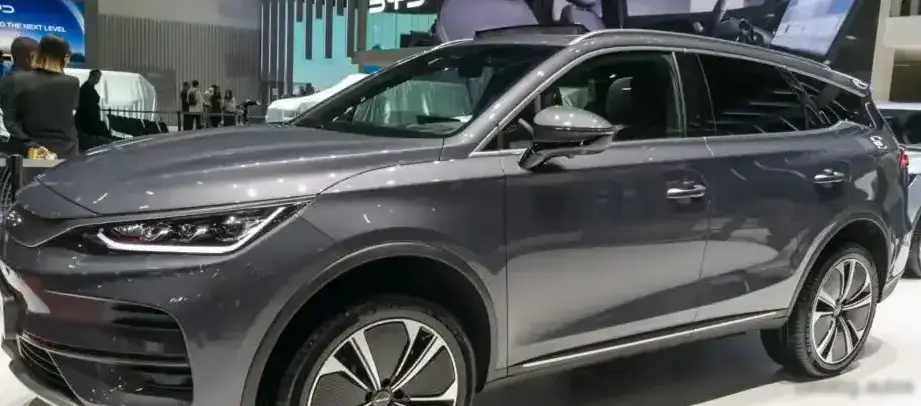
The BYD Tang II EV 82.8 kWh (490 Hp) AWD is a fully electric, seven-seat sport utility vehicle (SUV) produced by the Chinese manufacturer BYD from March 2019 to April 2021. Representing a significant upgrade over the first-generation Tang, the Tang II was positioned as a flagship model in BYD’s expanding electric vehicle lineup, primarily targeting the Chinese domestic market but with increasing export ambitions. It showcased BYD’s advancements in battery technology, electric powertrain design, and vehicle integration. The Tang II aimed to provide a compelling alternative to established electric SUVs, offering a combination of performance, range, and practicality.
Technical Specifications
| Brand | BYD |
| Model | Tang |
| Generation | Tang II |
| Type (Engine) | EV 82.8 kWh (490 Hp) AWD |
| Start of production | March, 2019 |
| End of production | April, 2021 |
| Powertrain Architecture | BEV (Electric Vehicle) |
| Body type | SUV, Crossover |
| Seats | 7 |
| Doors | 5 |
| Fuel Type | Electricity |
| Acceleration 0 – 100 km/h | 4.6 sec |
| Acceleration 0 – 62 mph | 4.6 sec |
| Acceleration 0 – 60 mph | 4.4 sec |
| Maximum speed | 180 km/h (111.85 mph) |
| Weight-to-power ratio | 4.7 kg/Hp, 213.5 Hp/tonne |
| Gross battery capacity | 82.8 kWh |
| Battery technology | Lithium-ion (Li-Ion) |
| Battery location | Below the floor |
| All-electric range | 500 km (310.69 mi) |
| Electric motor 1 power | 245 Hp |
| Electric motor 1 Torque | 330 Nm (243.4 lb.-ft.) |
| Electric motor 1 location | Front axle, Transverse |
| Electric motor 2 power | 245 Hp |
| Electric motor 2 Torque | 330 Nm (243.4 lb.-ft.) |
| Electric motor 2 location | Rear axle, Transverse |
| System power | 490 Hp |
| Kerb Weight | 2295 kg (5059.61 lbs.) |
| Max. weight | 2820 kg (6217.04 lbs.) |
| Max load | 525 kg (1157.43 lbs.) |
| Trunk (boot) space – minimum | 940 l (33.2 cu. ft.) |
| Trunk (boot) space – maximum | 1655 l (58.45 cu. ft.) |
| Length | 4870 mm (191.73 in.) |
| Width | 1950 mm (76.77 in.) |
| Height | 1725 mm (67.91 in.) |
| Ride height (ground clearance) | 170 mm (6.69 in.) |
| Minimum turning circle | 11.8 m (38.71 ft.) |
| Drivetrain Architecture | One electric motor drives the front wheels, one electric motor drives the rear wheels. |
| Drive wheel | All wheel drive (4×4) |
| Number of gears | 1 |
| Gearbox type | Automatic transmission |
| Front suspension | Independent type McPherson |
| Rear suspension | Independent multi-link suspension |
| Front brakes | Ventilated discs |
| Rear brakes | Ventilated discs |
| Assisting systems | ABS (Anti-lock braking system) |
| Steering type | Steering rack and pinion |
| Power steering | Electric Steering |
| Tires size | 265/40 R22 |
| Wheel rims size | 22 |
Powertrain & Engine Architecture
The Tang II EV utilizes a dual-motor, all-wheel-drive (AWD) configuration. Each axle is powered by a permanent magnet synchronous motor producing 245 horsepower and 330 Nm (243.4 lb.-ft.) of torque. Combined, the system delivers a total output of 490 horsepower. The powertrain is powered by an 82.8 kWh lithium-ion battery pack located under the vehicle floor, contributing to a low center of gravity and improved handling. BYD’s Blade Battery technology, known for its enhanced safety and energy density, is employed in the Tang II. The single-speed automatic transmission is a direct-drive system, typical of electric vehicles, providing seamless acceleration. The vehicle supports fast charging capabilities, allowing for a significant range boost in a relatively short period.
Driving Characteristics
The dual-motor AWD system provides brisk acceleration, with a 0-60 mph time of approximately 4.4 seconds. The instant torque delivery characteristic of electric motors results in responsive performance in various driving situations. The Tang II offers a comfortable ride quality, thanks to its independent suspension setup. The low center of gravity contributes to stable handling, and the AWD system provides enhanced traction in adverse weather conditions. Compared to potential single-motor versions (not widely available), the dual-motor configuration offers significantly improved acceleration and all-weather capability. The single-speed transmission provides a linear power delivery, without the gear changes associated with internal combustion engines.
Equipment & Trim Levels
The Tang II EV was generally well-equipped, even in its base configuration. Standard features typically included a large touchscreen infotainment system, a digital instrument cluster, leather upholstery, automatic climate control, and a comprehensive suite of advanced driver-assistance systems (ADAS). These systems often included adaptive cruise control, lane keeping assist, automatic emergency braking, and blind-spot monitoring. Higher trim levels added features such as a panoramic sunroof, premium audio system, ventilated front seats, and a 360-degree camera system. The interior design emphasized a modern and spacious feel, with seating for up to seven passengers.
Chassis & Braking
The Tang II features an independent McPherson strut suspension at the front and an independent multi-link suspension at the rear, providing a balance of ride comfort and handling performance. Ventilated disc brakes are used on all four wheels, offering strong stopping power. The electronic stability control (ESC) system and anti-lock braking system (ABS) work in conjunction to enhance safety and control. The steering system is an electric power-assisted rack and pinion setup, providing precise and responsive steering feel. The vehicle rides on large 22-inch alloy wheels with 265/40 R22 tires, contributing to its sporty appearance and grip.
Market Reception & Comparison
The BYD Tang II EV was generally well-received by critics, particularly for its performance, range, and spacious interior. Its acceleration was praised, and the 500 km (310.69 mi) range was considered competitive within its segment. However, some reviewers noted that the interior materials, while well-designed, didn’t quite match the quality of some established European and American competitors. Compared to other electric SUVs available at the time, the Tang II offered a compelling value proposition, particularly in the Chinese market. Its pricing was competitive, and it provided a generous level of equipment for the money.
Legacy
The BYD Tang II EV played a crucial role in establishing BYD as a major player in the global electric vehicle market. It demonstrated BYD’s technological capabilities and its commitment to producing high-quality electric vehicles. While production of the Tang II ended in 2021, it paved the way for the newer Tang EV model. The powertrain components, particularly the Blade Battery technology and dual-motor AWD system, have been incorporated into other BYD vehicles. On the used car market, the Tang II EV remains a relatively sought-after vehicle, particularly among those looking for a spacious, well-equipped, and high-performing electric SUV. Long-term reliability appears to be generally good, with reports of minimal issues related to the electric powertrain.