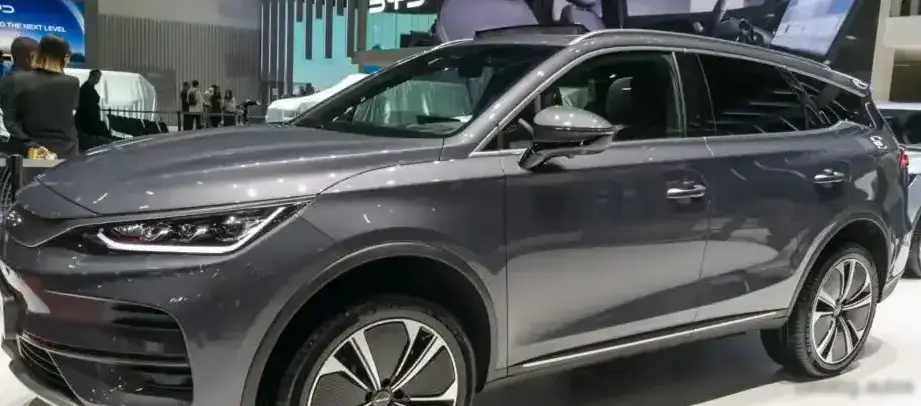
Technical Specifications
| Brand | BYD |
| Model | Tang |
| Generation | Tang II (facelift 2021) |
| Type (Engine) | DM-i 1.5Ti (218 Hp) Plug-in Hybrid E-CVT |
| Start of production | April, 2021 |
| End of production | October, 2024 |
| Powertrain Architecture | PHEV (Plug-in Hybrid Electric Vehicle) |
| Body type | SUV, Crossover |
| Seats | 6-7 |
| Doors | 5 |
| Fuel consumption (economy) – combined (NEDC) | 5.5 l/100 km (42.8 US mpg, 51.4 UK mpg, 18.2 km/l) |
| Fuel Type | Petrol / electricity |
| Acceleration 0 – 100 km/h | 8.5 sec |
| Acceleration 0 – 62 mph | 8.5 sec |
| Acceleration 0 – 60 mph | 8.1 sec |
| Gross battery capacity | 21.5 kWh |
| Battery technology | Lithium iron phosphate (LiFePO4) |
| Battery location | Below the floor |
| All-electric range (NEDC) | 112 km (69.59 mi) |
| Electric motor power | 218 Hp |
| Electric motor Torque | 325 Nm (239.71 lb.-ft.) |
| Electric motor location | Integrated into the transmission |
| System power | 218 Hp |
| Power | 139 Hp |
| Power per litre | 92.9 Hp/l |
| Torque | 231 Nm (170.38 lb.-ft.) |
| Engine layout | Front, Transverse |
| Engine Model/Code | Xiaoyun / BYD476ZQC |
| Engine displacement | 1497 cm3 (91.35 cu. in.) |
| Number of cylinders | 4 |
| Engine configuration | Inline |
| Number of valves per cylinder | 4 |
| Fuel injection system | Direct injection |
| Engine aspiration | Turbocharger |
| Valvetrain | VVT |
| Engine oil capacity | 3.7 l (3.91 US qt | 3.26 UK qt) |
| Coolant | 8.5 l (8.98 US qt | 7.48 UK qt) |
| Fuel tank capacity | 53 l (14 US gal | 11.66 UK gal) |
| Length | 4870 mm (191.73 in.) |
| Width | 1950 mm (76.77 in.) |
| Height | 1725 mm (67.91 in.) |
| Wheelbase | 2820 mm (111.02 in.) |
| Front track | 1650 mm (64.96 in.) |
| Rear (Back) track | 1630 mm (64.17 in.) |
| Minimum turning circle | 11.8 m (38.71 ft.) |
| Drivetrain Architecture | Front wheel drive. PHEV. ICE and electric motor drive the front wheels. |
| Number of gears and type of gearbox | automatic transmission CVT |
| Front suspension | Independent type McPherson |
| Rear suspension | Independent multi-link suspension |
| Front brakes | Ventilated discs |
| Rear brakes | Disc |
| Assisting systems | ABS (Anti-lock braking system) |
| Steering type | Steering rack and pinion |
| Power steering | Electric Steering |
| Tires size | 245/45 R20 |
| Wheel rims size | 20 |
The BYD Tang II DM-i 1.5Ti represents a key component of BYD’s strategy to electrify its SUV offerings. Introduced in 2021 as part of the Tang II facelift, this plug-in hybrid variant leverages BYD’s DM-i (Dual Mode – intelligent) technology. The DM-i system prioritizes electric driving for daily commutes, switching to the 1.5-liter turbocharged engine when the battery is depleted or when extra power is needed. This model is built on the Tang platform, offering seating for up to seven passengers, making it a practical choice for families. The Tang II DM-i aimed to provide a balance between environmental responsibility, driving range, and affordability within the growing Chinese PHEV market.
Powertrain & Engine Architecture
At the heart of the Tang II DM-i is a 1.5-liter turbocharged four-cylinder gasoline engine, designated the Xiaoyun / BYD476ZQC. This engine produces 139 horsepower and 231 Nm (170.38 lb.-ft.) of torque. It utilizes direct fuel injection and variable valve timing (VVT) to optimize efficiency and performance. However, the engine’s role is often secondary, acting primarily as a generator to charge the 21.5 kWh lithium iron phosphate (LiFePO4) battery pack. The electric motor, integrated with the E-CVT (electronically controlled continuously variable transmission), delivers a combined system output of 218 horsepower and 325 Nm (239.71 lb.-ft.) of torque. The E-CVT isn’t a traditional CVT; it’s a single-speed transmission optimized for seamless transitions between electric and gasoline power. The DM-i system is designed to maximize the use of the electric motor, resulting in significantly improved fuel economy compared to conventional gasoline-powered SUVs.
Driving Characteristics
The driving experience in the Tang II DM-i is heavily influenced by the DM-i system. In typical driving scenarios, the vehicle operates in EV mode, providing near-silent acceleration and instant torque from the electric motor. The 0-60 mph acceleration time of around 8.1 seconds is respectable for a mid-size SUV, but not particularly sporty. When the battery is depleted or under heavy acceleration, the gasoline engine kicks in to provide additional power and charge the battery. The transition between electric and gasoline power is generally smooth and unobtrusive. The E-CVT provides a linear power delivery, lacking the stepped gear changes of a traditional automatic transmission. Compared to other Tang II variants, such as those with larger gasoline engines, the DM-i prioritizes efficiency over outright performance. The focus is on providing a comfortable and economical driving experience, particularly in urban environments.
Equipment & Trim Levels
The Tang II DM-i typically came well-equipped, reflecting its position as a technologically advanced model. Standard features often included a large touchscreen infotainment system, a digital instrument cluster, leather upholstery, automatic climate control, and a suite of advanced driver-assistance systems (ADAS) such as adaptive cruise control, lane keeping assist, and automatic emergency braking. Higher trim levels added features like a panoramic sunroof, premium audio system, and ventilated front seats. Interior design emphasized a modern aesthetic with a focus on user-friendly controls and ample space for passengers and cargo. The availability of six or seven seats depended on the specific configuration chosen by the buyer.
Chassis & Braking
The Tang II DM-i features a front-wheel-drive layout. The suspension system consists of independent McPherson struts at the front and an independent multi-link setup at the rear, providing a comfortable ride quality. Ventilated disc brakes are used at the front, while solid discs are found at the rear. The braking system is assisted by ABS (Anti-lock Braking System) and electronic brake-force distribution (EBD). The steering is a rack-and-pinion system with electric power steering, offering light and precise steering feel. The vehicle rides on 20-inch alloy wheels with 245/45 R20 tires.
Market Reception & Comparison
The BYD Tang II DM-i was generally well-received in the Chinese market, where it competed with other plug-in hybrid SUVs from both domestic and international manufacturers. Critics praised its fuel efficiency, comfortable ride, and spacious interior. However, some reviewers noted that the gasoline engine could be somewhat noisy under heavy load. Compared to the standard gasoline-powered Tang II models, the DM-i offered significantly better fuel economy and lower emissions. Compared to other PHEV SUVs, the Tang II DM-i offered a competitive range and a relatively affordable price point. Its LiFePO4 battery technology was also seen as a positive, as it is known for its safety and longevity.
Legacy
The BYD Tang II DM-i 1.5Ti has established itself as a reliable and efficient plug-in hybrid SUV. The DM-i technology has become a cornerstone of BYD’s electrification strategy, and the Tang II DM-i paved the way for future generations of BYD PHEVs. In the used car market, these models are generally sought after for their fuel economy and relatively low running costs. The LiFePO4 battery pack is known for its durability, contributing to the long-term reliability of the powertrain. As the demand for electric and hybrid vehicles continues to grow, the Tang II DM-i remains a relevant and appealing option for consumers seeking a practical and environmentally friendly SUV.