
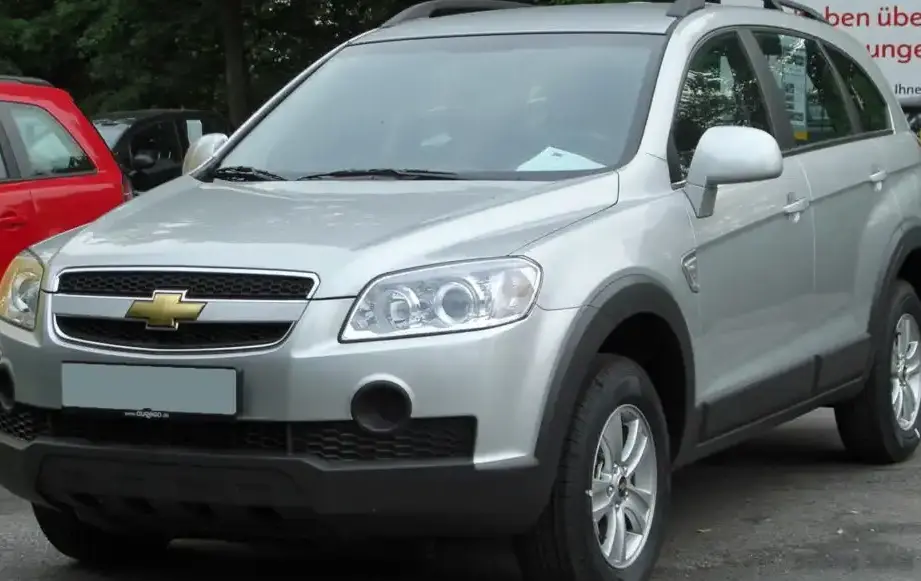
The Chevrolet Captiva I 2.4i 16V AWD 7 Seat, produced from 2006 to 2009, represented Chevrolet’s entry into the increasingly popular compact SUV segment. Built upon the GM Theta platform (shared with the Opel Antara and Suzuki Grand Vitara), the Captiva aimed to provide a versatile and affordable family vehicle with available all-wheel drive and seating for up to seven passengers. This particular variant, equipped with the 2.4-liter inline-four engine and a five-speed manual transmission, occupied a mid-range position within the Captiva lineup, offering a balance between performance, fuel economy, and price. It was positioned below the more powerful V6 models and above the base 2.0-liter engine options.
Technical Specifications
| Brand | Chevrolet |
| Model | Captiva |
| Generation | Captiva I |
| Type | 2.4i 16V (136 Hp) AWD 7 Seat |
| Start of production | 2006 |
| End of production | 2009 |
| Powertrain Architecture | Internal Combustion engine |
| Body type | SUV |
| Seats | 7 |
| Doors | 5 |
| Fuel consumption (urban) | 12.6 l/100 km (18.7 US mpg, 22.4 UK mpg, 7.9 km/l) |
| Fuel consumption (extra urban) | 7.3 l/100 km (32.2 US mpg, 38.7 UK mpg, 13.7 km/l) |
| Fuel consumption (combined) | 9.3 l/100 km (25.3 US mpg, 30.4 UK mpg, 10.8 km/l) |
| CO2 emissions | 222 g/km |
| Fuel Type | Petrol (Gasoline) |
| Acceleration 0 – 100 km/h | 11.5 sec |
| Acceleration 0 – 62 mph | 11.5 sec |
| Acceleration 0 – 60 mph | 10.9 sec |
| Maximum speed | 183 km/h (113.71 mph) |
| Emission standard | Euro 4 |
| Weight-to-power ratio | 12.9 kg/Hp, 77.3 Hp/tonne |
| Weight-to-torque ratio | 8 kg/Nm, 125 Nm/tonne |
| Power | 136 Hp @ 5000 rpm |
| Power per litre | 56.5 Hp/l |
| Torque | 220 Nm @ 2200 rpm (162.26 lb.-ft. @ 2200 rpm) |
| Engine layout | Front, Transverse |
| Engine Model/Code | LD9 |
| Engine displacement | 2405 cm3 (146.76 cu. in.) |
| Number of cylinders | 4 |
| Engine configuration | Inline |
| Cylinder Bore | 87.5 mm (3.44 in.) |
| Piston Stroke | 100 mm (3.94 in.) |
| Compression ratio | 9.6:1 |
| Number of valves per cylinder | 4 |
| Fuel injection system | Multi-port manifold injection |
| Engine aspiration | Naturally aspirated engine |
| Valvetrain | DOHC |
| Engine oil capacity | 4.7 l (4.97 US qt | 4.14 UK qt) |
| Coolant | 9 l (9.51 US qt | 7.92 UK qt) |
| Kerb Weight | 1760 kg (3880.14 lbs.) |
| Max. weight | 2395 kg (5280.07 lbs.) |
| Max load | 635 kg (1399.94 lbs.) |
| Trunk (boot) space – minimum | 465 l (16.42 cu. ft.) |
| Trunk (boot) space – maximum | 930 l (32.84 cu. ft.) |
| Fuel tank capacity | 65 l (17.17 US gal | 14.3 UK gal) |
| Max. roof load | 100 kg (220.46 lbs.) |
| Permitted trailer load with brakes (12%) | 1500 kg (3306.93 lbs.) |
| Permitted trailer load without brakes | 750 kg (1653.47 lbs.) |
| Permitted towbar download | 80 kg (176.37 lbs.) |
| Length | 4635 mm (182.48 in.) |
| Width | 1850-1870 mm (72.83 – 73.62 in.) |
| Height | 1720-1755 mm (67.72 – 69.09 in.) |
| Wheelbase | 2705 mm (106.5 in.) |
| Front track | 1562 mm (61.5 in.) |
| Rear (Back) track | 1572 mm (61.89 in.) |
| Front overhang | 920 mm (36.22 in.) |
| Rear overhang | 1010 mm (39.76 in.) |
| Ride height (ground clearance) | 200 mm (7.87 in.) |
| Drag coefficient (Cd) | 0.38 |
| Minimum turning circle (turning diameter) | 12.1 m (39.7 ft.) |
| Drive wheel | All wheel drive (4×4) |
| Number of gears and type of gearbox | 5 gears, manual transmission |
| Front suspension | Independent, type McPherson with coil spring and anti-roll bar |
| Rear suspension | Independent multi-link suspension |
| Front brakes | Ventilated discs, 296 mm |
| Rear brakes | Ventilated discs, 303 mm |
| Assisting systems | ABS (Anti-lock braking system) |
| Steering type | Steering rack and pinion |
| Power steering | Hydraulic Steering |
| Tires size | 215/70 R16; 235/60 R17; 235/55 R18 |
| Wheel rims size | 6.5J x 16 ET46; 7J x 17 ET46; 7J x 18 |
Powertrain & Engine Architecture
The Chevrolet Captiva 2.4i utilized the GM Family II engine, specifically the LD9 code. This 2.4-liter inline-four engine featured a cast iron block and an aluminum cylinder head, incorporating dual overhead camshafts (DOHC) and four valves per cylinder. The engine employed multi-port fuel injection, delivering fuel directly into the intake ports. The LD9 engine was known for its relatively simple design and reasonable reliability. The five-speed manual transmission provided a fairly conventional gear ratio spread, prioritizing fuel efficiency over outright acceleration. The all-wheel-drive system was typically an on-demand system, engaging the rear wheels when slippage was detected at the front, enhancing traction in adverse conditions.
Driving Characteristics
The 136 horsepower and 220 Nm (162 lb-ft) of torque produced by the 2.4-liter engine provided adequate, but not exhilarating, performance. Acceleration from 0-60 mph took around 10.9 seconds, making it competitive with other similarly sized SUVs of the era. The manual transmission allowed for greater driver control, but the engine lacked the low-end grunt of turbocharged alternatives. The all-wheel-drive system provided enhanced stability and grip, particularly on slippery surfaces, but added to the vehicle’s overall weight. Compared to the V6 Captiva models, the 2.4i offered a more economical driving experience, but at the expense of outright power and towing capacity.
Equipment & Trim Levels
The 2.4i AWD 7 Seat Captiva typically came standard with features such as air conditioning, power windows and locks, and an AM/FM radio with CD player. Higher trim levels offered options like alloy wheels, a sunroof, upgraded audio systems, and leather upholstery. The seven-seat configuration provided versatility for families, although the third-row seats were best suited for children. Safety features included ABS brakes and front airbags, although side and curtain airbags were often optional extras.
Chassis & Braking
The Captiva I featured an independent suspension system, with McPherson struts at the front and a multi-link setup at the rear. This configuration aimed to provide a comfortable ride and reasonable handling. The braking system consisted of ventilated disc brakes on all four wheels, providing adequate stopping power for the vehicle’s weight. The all-wheel-drive system added to the vehicle’s overall weight, which could slightly impact braking distances.
Market Reception & Comparison
The Chevrolet Captiva I 2.4i 16V AWD 7 Seat was generally well-received as a practical and affordable family SUV. Critics praised its spacious interior, versatile seating configuration, and available all-wheel drive. However, some reviewers noted that the 2.4-liter engine lacked the power of its competitors, and the interior materials were not as refined as those found in some European rivals. Fuel economy was considered average for the class. Compared to the V6 Captiva models, the 2.4i offered a more economical option, but with a noticeable reduction in performance.
Legacy
The Chevrolet Captiva I, while not a groundbreaking vehicle, established Chevrolet as a player in the compact SUV market. The 2.4-liter LD9 engine proved to be reasonably reliable, although regular maintenance is crucial to prevent issues such as oil leaks and timing chain wear. On the used car market, the Captiva I 2.4i represents a relatively affordable option for those seeking a spacious and versatile family vehicle with all-wheel drive. However, potential buyers should be aware of the vehicle’s age and potential maintenance needs.
