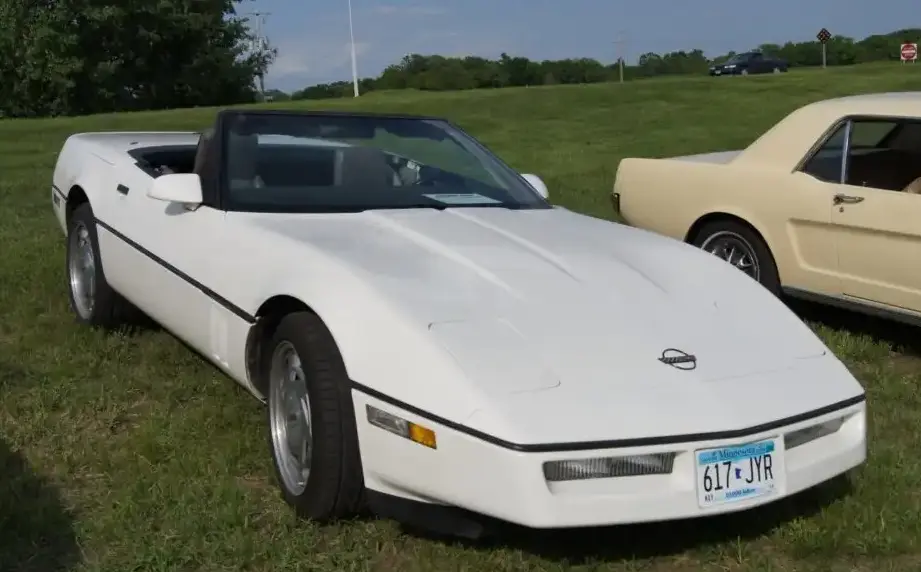
The Chevrolet Corvette Coupe (C4) facelift of 1990, specifically equipped with the 5.7-liter V8 engine producing 245 horsepower, represents a significant evolution in the fourth generation of Chevrolet’s iconic sports car. Produced from 1990 through 1991, this variant occupied a premium position within the C4 lineup, offering a substantial performance upgrade over the base model. It was a key component of the C4’s attempt to modernize the Corvette image and compete with increasingly sophisticated sports cars from Europe and Japan. The C4 generation, spanning 1984-1996, aimed to deliver a more refined and technologically advanced Corvette experience, and the 1990-1991 facelift further enhanced its appeal.
Technical Specifications
| Brand | Chevrolet |
| Model | Corvette |
| Generation | Corvette Coupe (C4, facelift 1990) |
| Type (Engine) | 5.7 V8 (245 Hp) |
| Start of production | 1990 |
| End of production | 1991 |
| Powertrain Architecture | Internal Combustion engine |
| Body type | Targa |
| Seats | 2 |
| Doors | 2 |
| Fuel consumption (economy) – urban (EPA) | 14.7 l/100 km (16 US mpg, 19.2 UK mpg, 6.8 km/l) |
| Fuel consumption (economy) – extra urban (EPA) | 9 l/100 km (26.1 US mpg, 31.4 UK mpg, 11.1 km/l) |
| Fuel consumption (economy) – combined (EPA) | 11.8 l/100 km (19.9 US mpg, 23.9 UK mpg, 8.5 km/l) |
| Fuel Type | Petrol (Gasoline) |
| Power | 245 Hp @ 4000 rpm |
| Power per litre | 42.7 Hp/l |
| Torque | 468 Nm @ 3200 rpm (345.18 lb.-ft. @ 3200 rpm) |
| Engine layout | Front, Longitudinal |
| Engine Model/Code | L98 |
| Engine displacement | 5733 cm3 (349.85 cu. in.) |
| Number of cylinders | 8 |
| Engine configuration | V-engine |
| Cylinder Bore | 101.6 mm (4 in.) |
| Piston Stroke | 88.4 mm (3.48 in.) |
| Number of valves per cylinder | 2 |
| Fuel injection system | Multi-port manifold injection |
| Engine aspiration | Naturally aspirated engine |
| Valvetrain | OHV |
| Engine oil capacity | 4.7 l (4.97 US qt | 4.14 UK qt) |
| Trunk (boot) space – minimum | 357 l (12.61 cu. ft.) |
| Fuel tank capacity | 76 l (20.08 US gal | 16.72 UK gal) |
| Length | 4536 mm (178.58 in.) |
| Width | 1803 mm (70.98 in.) |
| Height | 1186 mm (46.69 in.) |
| Wheelbase | 2443 mm (96.18 in.) |
| Front track | 1514 mm (59.61 in.) |
| Rear (Back) track | 1534 mm (60.39 in.) |
| Ride height (ground clearance) | 119 mm (4.69 in.) |
| Drivetrain Architecture | The Internal combustion engine (ICE) drives the rear wheels of the vehicle. |
| Drive wheel | Rear wheel drive |
| Number of gears and type of gearbox | 6 gears, manual transmission |
| Front suspension | Double wishbone, Transverse stabilizer, Leaf spring |
| Rear suspension | Independent multi-link suspension, Transverse stabilizer, Leaf spring |
| Front brakes | Ventilated discs |
| Rear brakes | Ventilated discs |
| Assisting systems | ABS (Anti-lock braking system) |
| Steering type | Steering rack and pinion |
| Power steering | Hydraulic Steering |
| Tires size | 275/40 ZR17 |
| Wheel rims size | 9.5J x 17 |
Powertrain & Engine Architecture
The heart of this Corvette variant is the 5.7-liter (349.85 cubic inch) L98 V8 engine. This engine, a staple of the C4 Corvette, utilized a cast iron block with aluminum cylinder heads. The L98 featured multi-port fuel injection, a significant upgrade over the throttle-body injection systems used in earlier C4 models. This system, combined with a revised intake manifold and cylinder heads, contributed to the increased horsepower and torque output. The engine employed a traditional overhead valve (OHV) valvetrain with two valves per cylinder. The 6-speed manual transmission was standard, providing precise control and enhancing the driving experience. The engine’s longitudinal front-engine layout contributed to a balanced weight distribution, improving handling characteristics.
Driving Characteristics
The 245 horsepower and 345 lb-ft of torque delivered by the L98 engine, coupled with the 6-speed manual transmission, provided a noticeably more engaging driving experience compared to the base model Corvette. Acceleration was brisk, with 0-60 mph times typically falling in the 5.5 to 6.0 second range. The manual transmission allowed for precise gear selection, maximizing the engine’s power band. While not as raw or visceral as some European sports cars, the C4 Corvette offered a comfortable yet capable grand touring experience. The suspension, tuned for both comfort and handling, provided a relatively smooth ride on most road surfaces. The rear-wheel drive configuration ensured responsive handling and predictable cornering behavior.
Equipment & Trim Levels
The 1990-1991 Corvette with the 5.7L engine was generally well-equipped, reflecting its position as a premium trim. Standard features included leather upholstery, air conditioning, power windows and locks, and a Delco Bose sound system. The interior featured a driver-focused cockpit with analog gauges and a leather-wrapped steering wheel. Optional extras included a removable roof panel (Targa top), sport seats, and various cosmetic enhancements. The exterior typically featured a sleek, aerodynamic design with a distinctive rear spoiler. Paint options were plentiful, allowing buyers to personalize their vehicles.
Chassis & Braking
The C4 Corvette utilized a space frame chassis constructed from aluminum, contributing to its relatively lightweight construction. The suspension system consisted of independent front and rear suspension, with transverse stabilizers to reduce body roll. The front suspension employed a double wishbone design, while the rear utilized a multi-link setup. Braking duties were handled by ventilated disc brakes on all four wheels, providing ample stopping power. An anti-lock braking system (ABS) was standard, enhancing safety and control during hard braking maneuvers. The steering system was a rack-and-pinion setup with hydraulic power assist, offering precise and responsive steering feel.
Market Reception & Comparison
The 1990-1991 Corvette with the 5.7L engine was generally well-received by automotive critics. It was praised for its improved performance, refined interior, and comfortable ride. Compared to the base model Corvette, the 5.7L variant offered a significant performance advantage. It also provided a more compelling alternative to other sports cars in its price range, such as the Porsche 944 and Mazda RX-7. Fuel economy, while not exceptional, was reasonable for a V8-powered sports car, averaging around 19.9 US mpg combined. Reliability was generally good, although some owners reported minor issues with the electronic components.
Legacy
The 1990-1991 Corvette 5.7L continues to be a popular choice among Corvette enthusiasts. The L98 engine is known for its durability and relatively simple maintenance requirements. These cars are readily available on the used car market, with prices varying depending on condition and mileage. While not as collectible as some of the earlier or later C4 models, the 1990-1991 variant represents a sweet spot in the C4 lineup, offering a good balance of performance, comfort, and affordability. The L98 engine’s robust design and readily available parts ensure that these Corvettes will continue to provide driving enjoyment for years to come. The C4 generation, and this variant in particular, helped to solidify the Corvette’s reputation as America’s iconic sports car.