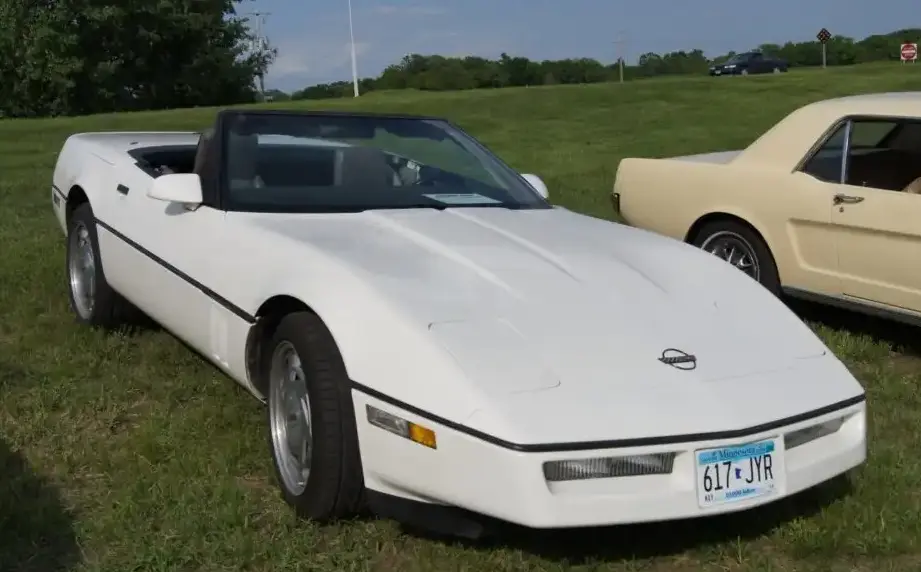
The Chevrolet Corvette ZR-1, produced from 1992 to 1995, represented a significant departure for the C4 Corvette generation. While the standard C4 aimed for a balance of performance and affordability, the ZR-1 was a focused, high-performance machine designed to compete with established sports car icons like Porsche 911 and Lamborghini Countach. It was a halo car for Chevrolet, showcasing American engineering prowess and a commitment to pushing the boundaries of performance. The ZR-1 was only available as a Targa top coupe during its production run.
Technical Specifications
| Brand | Chevrolet |
| Model | Corvette |
| Generation | Corvette Coupe (C4, facelift 1990) |
| Type (Engine) | ZR-1 5.7 V8 (405 Hp) |
| Start of production | 1992 |
| End of production | 1995 |
| Powertrain Architecture | Internal Combustion engine |
| Body type | Targa |
| Seats | 2 |
| Doors | 2 |
| Fuel Type | Petrol (Gasoline) |
| Power | 405 Hp @ 5800 rpm |
| Power per litre | 70.6 Hp/l |
| Torque | 522 Nm @ 5200 rpm / 385.01 lb.-ft. @ 5200 rpm |
| Maximum engine speed | 7200 rpm |
| Engine layout | Front, Longitudinal |
| Engine Model/Code | LT5 |
| Engine displacement | 5733 cm3 / 349.85 cu. in. |
| Number of cylinders | 8 |
| Engine configuration | V-engine |
| Cylinder Bore | 99 mm / 3.9 in. |
| Piston Stroke | 93 mm / 3.66 in. |
| Compression ratio | 11:1 |
| Number of valves per cylinder | 4 |
| Fuel injection system | Multi-port manifold injection |
| Engine aspiration | Naturally aspirated engine |
| Valvetrain | DOHC |
| Engine oil capacity | 8.1 l / 8.56 US qt | 7.13 UK qt |
| Coolant | 13.9 l / 14.69 US qt | 12.23 UK qt |
| Trunk (boot) space – minimum | 357 l / 12.61 cu. ft. |
| Fuel tank capacity | 76 l / 20.08 US gal | 16.72 UK gal |
| Length | 4535 mm / 178.54 in. |
| Width | 1856 mm / 73.07 in. |
| Height | 1177 mm / 46.34 in. |
| Wheelbase | 2444 mm / 96.22 in. |
| Front track | 1466 mm / 57.72 in. |
| Rear (Back) track | 1539 mm / 60.59 in. |
| Drivetrain Architecture | The Internal combustion engine (ICE) drives the rear wheels of the vehicle. |
| Drive wheel | Rear wheel drive |
| Number of gears and type of gearbox | 6 gears, manual transmission |
| Front suspension | Double wishbone, Transverse stabilizer, Leaf spring |
| Rear suspension | Independent multi-link suspension, Transverse stabilizer, Leaf spring |
| Front brakes | Ventilated discs |
| Rear brakes | Ventilated discs |
| Assisting systems | ABS (Anti-lock braking system) |
| Steering type | Steering rack and pinion |
| Power steering | Hydraulic Steering |
| Front wheel tires | 275/40 ZR17 |
| Rear wheel tires | 315/35 ZR17 |
| Front wheel rims | 9.5J x 17 |
| Rear wheel rims | 11J x 17 |
Powertrain & Engine Architecture
The heart of the ZR-1 was the LT5 engine, a 350 cubic inch (5.7L) V8 developed jointly by Chevrolet and Lotus. This wasn’t a typical Chevrolet small-block; it was a clean-sheet design featuring a DOHC (Dual Overhead Camshaft) cylinder head, a significant departure from the traditional pushrod V8s used in other Corvettes. The LT5 utilized a cast iron block with aluminum cylinder heads, contributing to its robust construction and relatively lightweight design. Fuel delivery was handled by a multi-port fuel injection system, ensuring precise fuel metering for optimal performance. The engine produced 405 horsepower at 5800 rpm and 385 lb-ft of torque at 5200 rpm. The only transmission offered was a ZF-sourced 6-speed manual, chosen for its durability and ability to handle the engine’s substantial power output.
Driving Characteristics
The ZR-1 offered a dramatically different driving experience compared to the standard C4 Corvette. The LT5 engine delivered a smooth, linear powerband with a willingness to rev. The 6-speed manual transmission provided precise gear changes, allowing drivers to fully exploit the engine’s capabilities. While not as raw or visceral as some European sports cars, the ZR-1 offered a refined and capable performance. Acceleration was brisk, with 0-60 mph times in the low 4-second range. Handling was improved over the standard C4 thanks to a stiffer chassis and upgraded suspension components. The ZR-1 felt planted and stable at high speeds, making it a confident grand tourer.
Equipment & Trim Levels
The ZR-1 came standard with a comprehensive list of features, befitting its flagship status. Leather sport seats, air conditioning, power windows and locks, and a premium sound system were all included. The interior featured unique ZR-1 badging and trim. Optional extras included a Bose audio system, and various cosmetic enhancements. The ZR-1 was not offered with many options, as Chevrolet aimed to maintain the car’s focus on performance. The interior was relatively spartan, prioritizing function over luxury.
Chassis & Braking
The ZR-1 utilized the C4 Corvette’s space frame chassis, but with several key reinforcements to handle the increased power and stress. The suspension featured upgraded shocks and springs, along with a thicker stabilizer bar. Braking duties were handled by ventilated disc brakes at all four corners, equipped with ABS (Anti-lock Braking System). The ZR-1’s tires were wider than those found on the standard C4, providing increased grip. The suspension was tuned for a balance of ride comfort and handling performance.
Market Reception & Comparison
The ZR-1 was generally well-received by automotive critics, who praised its performance and refinement. It was seen as a legitimate competitor to European sports cars, offering a unique blend of American muscle and sophisticated engineering. However, the ZR-1’s high price tag – significantly more than the standard C4 – limited its appeal. Compared to the base C4, the ZR-1 offered a substantial performance upgrade, but at a considerable cost. It also differed significantly from other C4 variants like the L98, which focused on more accessible performance. The ZR-1’s complex LT5 engine also proved to be more expensive to maintain than the simpler pushrod V8s found in other Corvettes.
Legacy
The ZR-1 marked a turning point for the Corvette, demonstrating Chevrolet’s ability to build a world-class sports car. While production numbers were relatively low, the ZR-1 has become a highly sought-after collectible. The LT5 engine, despite its complexity, proved to be a durable and reliable powerplant when properly maintained. Today, well-preserved ZR-1s command premium prices in the used car market. The ZR-1’s legacy extends beyond its performance; it paved the way for future generations of high-performance Corvettes, solidifying the Corvette’s position as an American automotive icon.