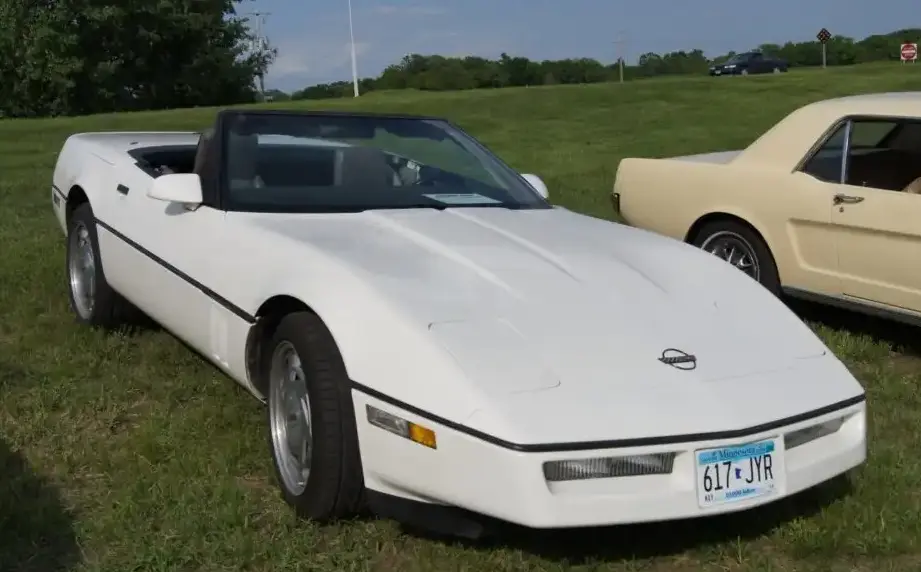
The Chevrolet Corvette C6, produced from 2005 to 2013, represented a significant departure from its predecessors, moving to a hydroformed box frame chassis and exposed headlights. Within the C6 generation, the 6.0L LS2 V8 engine paired with a six-speed automatic transmission, available from 2005 to 2007, occupied a sweet spot in the lineup. This combination offered a compelling blend of performance and relative affordability, making it a popular choice for enthusiasts seeking a capable grand tourer. It served as the base engine option for the coupe and convertible models during those years, positioned below the higher-performance LS3 engine introduced in 2008.
Technical Specifications
| Brand | Chevrolet |
| Model | Corvette |
| Generation | Corvette Coupe (C6) |
| Type (Engine) | 6.0L i V8 (405 Hp) Automatic |
| Start of production | 2005 year |
| End of production | 2007 year |
| Powertrain Architecture | Internal Combustion engine |
| Body type | Coupe |
| Seats | 2 |
| Doors | 2 |
| Fuel consumption (urban) | 18 l/100 km (13.1 US mpg) |
| Fuel consumption (extra urban) | 9 l/100 km (26.1 US mpg) |
| Fuel Type | Petrol (Gasoline) |
| Acceleration 0 – 100 km/h | 4.5 sec |
| Acceleration 0 – 62 mph | 4.5 sec |
| Acceleration 0 – 60 mph | 4.3 sec |
| Maximum speed | 290 km/h (180.2 mph) |
| Weight-to-power ratio | 3.6 kg/Hp |
| Weight-to-torque ratio | 2.7 kg/Nm |
| Power | 405 Hp @ 6000 rpm |
| Torque | 543 Nm @ 4400 rpm (400.5 lb.-ft. @ 4400 rpm) |
| Engine layout | Front, Longitudinal |
| Engine Model/Code | LS2 |
| Engine displacement | 5967 cm3 (364.13 cu. in.) |
| Number of cylinders | 8 |
| Engine configuration | V-engine |
| Cylinder Bore | 101.6 mm (4 in.) |
| Piston Stroke | 92 mm (3.62 in.) |
| Compression ratio | 10.9:1 |
| Number of valves per cylinder | 2 |
| Fuel injection system | Multi-port manifold injection |
| Engine aspiration | Naturally aspirated |
| Engine oil capacity | 5.2 l (5.49 US qt | 4.58 UK qt) |
| Coolant capacity | 11.9 l (12.57 US qt | 10.47 UK qt) |
| Kerb Weight | 1470 kg (3240.8 lbs.) |
| Max. weight | 1750 kg (3858.09 lbs.) |
| Max load | 280 kg (617.29 lbs.) |
| Trunk (boot) space – maximum | 635 l (22.42 cu. ft.) |
| Fuel tank capacity | 68 l (17.96 US gal | 14.96 UK gal) |
| Length | 4435 mm (174.61 in.) |
| Width | 1845 mm (72.64 in.) |
| Height | 1245 mm (49.02 in.) |
| Wheelbase | 2685 mm (105.71 in.) |
| Front track | 1575 mm (62.01 in.) |
| Rear track | 1545 mm (60.83 in.) |
| Drivetrain | Rear wheel drive |
| Number of gears | 6 |
| Gearbox type | Automatic transmission |
| Front suspension | Double wishbone |
| Rear suspension | Transverse stabilizer |
| Front brakes | Ventilated discs |
| Rear brakes | Ventilated discs |
| Assisting systems | ABS (Anti-lock braking system) |
| Steering type | Steering rack and pinion |
| Tires size | 245/40 R18; 285/35 R19 |
| Wheel rims size | 8.5J x 19; 10J x 19 |
Powertrain & Engine Architecture
The heart of this Corvette variant is the 6.0-liter LS2 V8 engine. This engine, part of General Motors’ Small-Block family, utilizes an aluminum block and cylinder heads, contributing to a relatively lightweight construction. The LS2 features a cast iron crankshaft, connecting rods, and hypereutectic pistons. Fuel delivery is managed by a multi-port fuel injection system, and the engine employs two valves per cylinder. The 6L80E six-speed automatic transmission, a robust and electronically controlled unit, was specifically paired with the LS2. This transmission offered smooth shifts and the ability to manually select gears, providing drivers with a degree of control. The transmission’s gear ratios were tuned for a balance between acceleration and highway cruising efficiency.
Driving Characteristics
The 405 horsepower and 400 lb-ft of torque produced by the LS2/6L80E combination delivered strong acceleration. While not as brutally quick as the later LS3-equipped models, the 0-60 mph time of around 4.3 seconds was still impressive for the era. The automatic transmission, while convenient, did result in a slight performance deficit compared to the six-speed manual transmission available on other C6 models. The automatic’s shift points, while generally well-programmed, could sometimes feel less precise during spirited driving. However, for everyday driving and comfortable long-distance cruising, the automatic provided a refined and effortless experience. The Corvette’s well-tuned suspension provided a good balance between ride comfort and handling, making it a capable performer on both winding roads and open highways.
Equipment & Trim Levels
The 2005-2007 Corvette with the 6.0L/automatic configuration typically came standard with features such as leather upholstery, dual-zone automatic climate control, power-adjustable seats, and a Bose premium sound system. Common options included the Z51 Performance Package (which added stiffer suspension, larger brakes, and a more aggressive axle ratio), a heads-up display, and various interior trim upgrades. The base coupe offered a relatively spartan interior, focusing on functionality and performance. Buyers could opt for more luxurious appointments, such as heated seats and navigation, to enhance the comfort and convenience of their Corvette.
Chassis & Braking
The C6 Corvette’s chassis was a major advancement over previous generations. The hydroformed box frame provided significantly improved structural rigidity, resulting in better handling and reduced body flex. The suspension utilized independent double wishbones at all four corners, with transverse stabilizer bars to minimize body roll. Braking duties were handled by ventilated disc brakes at all four wheels, providing ample stopping power. ABS was standard equipment. The base model typically featured smaller brake rotors compared to the Z51 package, but still offered excellent braking performance for everyday driving and spirited road use.
Market Reception & Comparison
The 6.0L/automatic Corvette was generally well-received by automotive critics. It was praised for its strong performance, comfortable ride, and relatively affordable price point. Compared to the manual transmission version, the automatic was often seen as a more practical choice for daily driving. Fuel economy was reasonable for a V8 sports car, averaging around 18 mpg in the city and 26 mpg on the highway. Compared to other sports cars in its class, such as the Porsche 911, the Corvette offered a significant amount of performance for the money. However, some critics noted that the interior materials were not quite as refined as those found in European competitors.
Legacy
The LS2 engine and 6L80E transmission proved to be a reliable and durable combination. While some minor issues, such as oil consumption, have been reported, these are generally not major concerns. Today, the 2005-2007 Corvette with this powertrain represents a good value on the used car market. It offers a compelling blend of performance, comfort, and affordability, making it an attractive option for enthusiasts looking for a classic American sports car. The LS2 engine remains a popular choice for engine swaps and modifications, further cementing its legacy as a capable and versatile powerplant.