
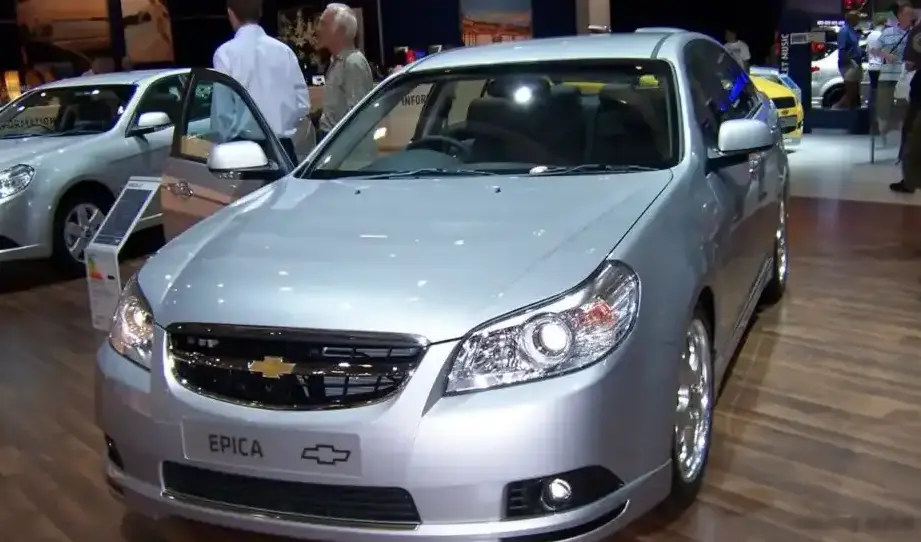
The Chevrolet Epica 2.0 D (150 hp) was a mid-size sedan produced by Chevrolet from 2006 to 2010. Positioned as a more affordable and spacious alternative to some of its competitors, the Epica aimed to provide comfortable transportation with reasonable fuel efficiency. This diesel variant, powered by the LLW engine, represented a key offering in markets where diesel fuel was prevalent, particularly in Europe and other regions outside of North America. The Epica was built upon the GM Daewoo Magnus platform, and shared many components with other vehicles within the General Motors portfolio. It served as Chevrolet’s D-segment offering, competing with vehicles like the Ford Mondeo, Volkswagen Passat, and Opel Vectra.
Technical Specifications
| Brand | Chevrolet |
| Model | Epica |
| Generation | Epica |
| Type (Engine) | 2.0 D (150 Hp) |
| Start of production | 2006 year |
| End of production | 2010 year |
| Powertrain Architecture | Internal Combustion engine |
| Body type | Sedan |
| Seats | 5 |
| Doors | 4 |
| Fuel consumption (economy) – urban | 7.5 l/100 km (31.4 US mpg, 37.7 UK mpg, 13.3 km/l) |
| Fuel consumption (economy) – extra urban | 5.3 l/100 km (44.4 US mpg, 53.3 UK mpg, 18.9 km/l) |
| Fuel consumption (economy) – combined | 6.1 l/100 km (38.6 US mpg, 46.3 UK mpg, 16.4 km/l) |
| CO2 emissions | 164 g/km |
| Fuel Type | Diesel |
| Acceleration 0 – 100 km/h | 9.7 sec |
| Acceleration 0 – 62 mph | 9.7 sec |
| Acceleration 0 – 60 mph | 9.2 sec |
| Maximum speed | 200 km/h (124.27 mph) |
| Emission standard | Euro 4 |
| Weight-to-power ratio | 10.4 kg/Hp, 96.2 Hp/tonne |
| Weight-to-torque ratio | 4.9 kg/Nm, 205.1 Nm/tonne |
| Power | 150 Hp @ 4000 rpm |
| Power per litre | 75.3 Hp/l |
| Torque | 320 Nm @ 2000 rpm (236.02 lb.-ft. @ 2000 rpm) |
| Engine layout | Front, Transverse |
| Engine Model/Code | LLW |
| Engine displacement | 1991 cm3 (121.5 cu. in.) |
| Number of cylinders | 4 |
| Engine configuration | Inline |
| Cylinder Bore | 83 mm (3.27 in.) |
| Piston Stroke | 92 mm (3.62 in.) |
| Compression ratio | 17.5:1 |
| Number of valves per cylinder | 4 |
| Fuel injection system | Diesel Commonrail |
| Engine aspiration | Turbocharger, Intercooler |
| Valvetrain | SOHC |
| Engine oil capacity | 6.5 l (6.87 US qt | 5.72 UK qt) |
| Coolant | 8 l (8.45 US qt | 7.04 UK qt) |
| Kerb Weight | 1560-1615 kg (3439.21 – 3560.47 lbs.) |
| Max. weight | 2045 kg (4508.45 lbs.) |
| Max load | 430-485 kg (947.99 – 1069.24 lbs.) |
| Trunk (boot) space – minimum | 480 l (16.95 cu. ft.) |
| Fuel tank capacity | 65 l (17.17 US gal | 14.3 UK gal) |
| Permitted trailer load with brakes (12%) | 1700 kg (3747.86 lbs.) |
| Permitted trailer load without brakes | 700 kg (1543.24 lbs.) |
| Permitted towbar download | 75 kg (165.35 lbs.) |
| Length | 4805 mm (189.17 in.) |
| Width | 1810 mm (71.26 in.) |
| Height | 1450 mm (57.09 in.) |
| Wheelbase | 2700 mm (106.3 in.) |
| Front track | 1550 mm (61.02 in.) |
| Rear (Back) track | 1545 mm (60.83 in.) |
| Drag coefficient (Cd) | 0.318 |
| Minimum turning circle (turning diameter) | 10.78 m (35.37 ft.) |
| Drivetrain Architecture | The Internal combustion engine (ICE) drives the front wheels of the vehicle. |
| Drive wheel | Front wheel drive |
| Number of gears and type of gearbox | 5 gears, manual transmission |
| Front suspension | Independent, type McPherson with coil spring and anti-roll bar |
| Rear suspension | Independent multi-link spring suspension with stabilizer |
| Front brakes | Ventilated discs, 278 mm |
| Rear brakes | Disc, 276 mm |
| Assisting systems | ABS (Anti-lock braking system) |
| Steering type | Steering rack and pinion |
| Power steering | Hydraulic Steering |
| Tires size | 205/65 R15; 205/60 R16; 215/50 R17; 215/45 R18 |
| Wheel rims size | 6J x 15; 6J x 16; 7J x 17; 7J x 18 |
Powertrain & Engine Architecture
The Chevrolet Epica 2.0 D was powered by the LLW engine, a 1.991-liter inline-four cylinder diesel engine. This engine utilized a common rail direct injection system, which allowed for precise fuel delivery and improved combustion efficiency. The LLW engine featured a single overhead camshaft (SOHC) valvetrain operating four valves per cylinder. A turbocharger with an intercooler was employed to boost power output and improve torque across the engine’s operating range. The engine’s 17.5:1 compression ratio was typical for a diesel engine, contributing to its thermal efficiency. The 5-speed manual transmission was the standard offering, designed to efficiently transfer the engine’s power to the front wheels.
Driving Characteristics
The 150 hp and 320 Nm (236 lb-ft) of torque provided by the 2.0 D engine offered a balance between performance and fuel economy. Acceleration from 0 to 60 mph took approximately 9.2 seconds, and the car had a top speed of 200 km/h (124 mph). While not a particularly sporty vehicle, the diesel engine provided ample torque for everyday driving and overtaking maneuvers. The 5-speed manual transmission offered a reasonable spread of gears, but some drivers found the shift quality to be somewhat notchy. Compared to higher-output gasoline versions of the Epica, the 2.0 D prioritized fuel efficiency and low-end torque over outright acceleration.
Equipment & Trim Levels
The Chevrolet Epica 2.0 D typically came equipped with a reasonable level of standard features. These included air conditioning, power windows, power door locks, and a basic audio system. Higher trim levels offered upgrades such as alloy wheels, a sunroof, leather upholstery, and a more advanced audio system with CD changer. Safety features included ABS brakes and dual front airbags. The interior design was functional and straightforward, with a focus on providing a comfortable and spacious cabin.
Chassis & Braking
The Epica 2.0 D featured an independent suspension system at all four wheels. The front suspension utilized a McPherson strut design with coil springs and an anti-roll bar, while the rear suspension employed a multi-link setup with a stabilizer bar. This suspension configuration aimed to provide a comfortable ride and stable handling. The braking system consisted of ventilated discs at the front and solid discs at the rear. ABS (Anti-lock Braking System) was standard, enhancing braking performance and safety.
Market Reception & Comparison
The Chevrolet Epica 2.0 D was generally well-received in markets where diesel engines were popular. Critics praised its spacious interior, comfortable ride, and fuel efficiency. However, some reviewers noted that the engine could be somewhat noisy and that the interior materials were not as refined as those found in some of its competitors. Compared to the gasoline-powered Epica models, the 2.0 D offered significantly better fuel economy but slightly less performance. It competed directly with other mid-size diesel sedans, such as the Ford Mondeo TDCi and Volkswagen Passat TDI.
Legacy
The Chevrolet Epica 2.0 D, while not a groundbreaking vehicle, provided a practical and affordable option for buyers seeking a spacious and fuel-efficient sedan. The LLW diesel engine proved to be relatively reliable, although regular maintenance is crucial for any diesel engine. On the used car market, the Epica 2.0 D represents a budget-friendly option, but potential buyers should be aware of the typical maintenance requirements of a diesel vehicle, including regular servicing of the fuel injection system and particulate filter (if equipped). Its simplicity and relatively low running costs continue to appeal to those seeking a dependable and economical mode of transportation.
