
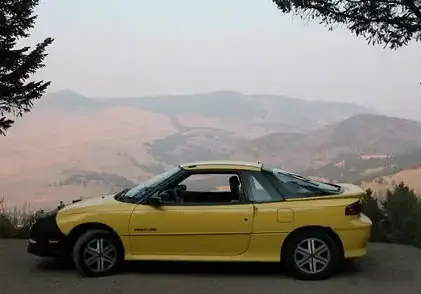
The Chevrolet Geo Storm 1.6, producing 95 horsepower, was a compact hatchback marketed primarily in the United States and Canada between 1990 and 1991. It represented Chevrolet’s entry into the sporty, affordable compact car segment, leveraging a partnership with Isuzu, who originally manufactured the vehicle as the Impulse. The Geo Storm was part of the broader Geo brand, created by General Motors to compete with Japanese imports, offering value and fuel efficiency. The 1.6-liter variant occupied the base trim level of the Storm lineup, positioned below the more powerful 1.8-liter and turbocharged models.
Technical Specifications
| Brand | Chevrolet |
| Model | Geo Storm |
| Generation | Geo Storm |
| Type (Engine) | 1.6 (95 Hp) |
| Start of production | 1990 |
| End of production | 1991 |
| Powertrain Architecture | Internal Combustion engine |
| Body type | Hatchback |
| Fuel Type | Petrol (Gasoline) |
| Power | 95 Hp @ 5800 rpm |
| Power per litre | 59.8 Hp/l |
| Torque | 131 Nm @ 4800 rpm |
| Torque (lb-ft) | 96.62 lb.-ft. @ 4800 rpm |
| Engine layout | Front, Transverse |
| Engine displacement | 1588 cm3 |
| Engine displacement (cu. in.) | 96.91 cu. in. |
| Number of cylinders | 4 |
| Engine configuration | Inline |
| Cylinder Bore | 80 mm |
| Cylinder Bore (in.) | 3.15 in. |
| Piston Stroke | 79 mm |
| Piston Stroke (in.) | 3.11 in. |
| Compression ratio | 9.8:1 |
| Fuel injection system | Multi-port manifold injection |
| Engine aspiration | Naturally aspirated engine |
| Trunk (boot) space – minimum | 310 l |
| Trunk (boot) space – minimum (cu. ft.) | 10.95 cu. ft. |
| Trunk (boot) space – maximum | 620 l |
| Trunk (boot) space – maximum (cu. ft.) | 21.9 cu. ft. |
| Length | 4150 mm |
| Length (in.) | 163.39 in. |
| Width | 1695 mm |
| Width (in.) | 66.73 in. |
| Height | 1300 mm |
| Height (in.) | 51.18 in. |
| Wheelbase | 2450 mm |
| Wheelbase (in.) | 96.46 in. |
| Front track | 1430 mm |
| Front track (in.) | 56.3 in. |
| Rear (Back) track | 1400 mm |
| Rear (Back) track (in.) | 55.12 in. |
Powertrain & Engine Architecture
The Geo Storm 1.6 was powered by a 1.6-liter (1588 cc) inline four-cylinder engine. This engine, designated as the 882, was a naturally aspirated unit featuring multi-port fuel injection. The engine utilized a single overhead camshaft (SOHC) valvetrain, operating with two valves per cylinder. The 9.8:1 compression ratio was typical for the era, balancing performance and fuel efficiency. The engine’s output of 95 horsepower at 5800 rpm and 131 Nm (96.62 lb-ft) of torque at 4800 rpm was considered adequate for the vehicle’s weight class. The engine was transversely mounted in the front of the vehicle, driving the front wheels. The transmission offered was a four-speed automatic, designed for smooth and comfortable operation. This automatic transmission was a common unit used in other GM vehicles of the time, known for its reliability, though not particularly sporty shift characteristics.
Driving Characteristics
The 1.6-liter engine and four-speed automatic transmission combination in the Geo Storm provided a comfortable, but not particularly exhilarating, driving experience. Acceleration was adequate for everyday driving, but the car lacked the punch of the higher-powered 1.8-liter or turbocharged variants. The automatic transmission’s gear ratios were geared towards fuel economy rather than performance. The car felt somewhat sluggish during overtaking maneuvers, requiring careful planning. Compared to the five-speed manual transmission available on other Storm models, the automatic resulted in a noticeable reduction in responsiveness. The suspension was tuned for comfort, providing a relatively smooth ride over most road surfaces, but at the expense of sharp handling. Steering was light and easy, making it suitable for city driving.
Equipment & Trim Levels
The base Geo Storm 1.6 typically came with a fairly basic level of equipment. Standard features included cloth upholstery, a basic AM/FM radio, and manual windows and door locks. Air conditioning was often an optional extra. The interior was functional and straightforward in its design, prioritizing practicality over luxury. Available options included a cassette player, upgraded sound system, and power windows. The exterior featured steel wheels with wheel covers, and a relatively simple body kit. The overall trim level was aimed at budget-conscious buyers seeking a reliable and affordable compact car.
Chassis & Braking
The Geo Storm 1.6 utilized a MacPherson strut front suspension and a torsion beam rear suspension. This setup provided a reasonable balance between ride comfort and handling. The front brakes were ventilated discs, while the rear brakes were drums. This configuration was common for vehicles in this price range during the early 1990s. The steering was a rack-and-pinion system, providing relatively precise steering feel. Stabilizer bars were included at both the front and rear to reduce body roll during cornering, though their effectiveness was limited by the car’s overall weight and suspension tuning.
Market Reception & Comparison
The Geo Storm 1.6 received mixed reviews from automotive critics. While praised for its affordability and fuel efficiency, it was often criticized for its lack of performance and somewhat bland styling. Compared to its siblings, the 1.8-liter and turbocharged models offered significantly more power and a more engaging driving experience, but at a higher price point. The 1.6-liter version was primarily targeted at buyers who prioritized economy and practicality over performance. Fuel economy was a strong point, with the 1.6-liter engine achieving around 26 mpg city and 34 mpg highway. Reliability was generally good, though some owners reported minor issues with the fuel injection system and automatic transmission.
Legacy
The Geo Storm 1.6, while not a particularly memorable vehicle, played a role in establishing the Geo brand as a competitor in the compact car market. The 1.6-liter engine proved to be reasonably durable, and many examples remain on the road today. However, due to its age and relatively low resale value, the Geo Storm 1.6 is not a particularly sought-after classic car. Parts availability can be a challenge, as many components are now discontinued. The car’s legacy lies in its affordability and its contribution to the growing popularity of Japanese-inspired compact cars in the United States. The Storm, in all its trims, offered a relatively inexpensive and reliable transportation option for a generation of drivers.
