
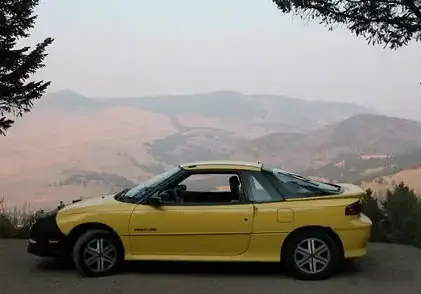
The Chevrolet Geo Storm GSI, specifically the 1.8-liter 140 horsepower variant, represented a performance-oriented offering within the Geo Storm lineup during its brief production run from 1992 to 1993. Positioned as the top-tier trim, the GSI aimed to provide a more engaging driving experience than the base models, appealing to buyers seeking a sporty and affordable compact hatchback. The Geo Storm itself was a rebadged Isuzu Impulse, a result of GM’s partnership with Isuzu, and was sold through Geo dealerships as part of GM’s strategy to target a younger demographic. This particular GSI model was a key component of that strategy, offering a relatively potent engine for its class and price point.
Technical Specifications
| Brand | Chevrolet |
| Model | Geo Storm |
| Generation | Geo Storm |
| Type (Engine) | 1.8 (140 Hp) GSI |
| Start of production | 1992 |
| End of production | 1993 |
| Powertrain Architecture | Internal Combustion engine |
| Body type | Hatchback |
| Fuel Type | Petrol (Gasoline) |
| Acceleration 0 – 100 km/h | 7.1 sec |
| Acceleration 0 – 62 mph | 7.1 sec |
| Acceleration 0 – 60 mph | 6.7 sec |
| Maximum speed | 210 km/h (130.49 mph) |
| Power | 140 Hp @ 6400 rpm |
| Power per litre | 77.4 Hp/l |
| Torque | 120 Nm @ 4600 rpm (88.51 lb.-ft. @ 4600 rpm) |
| Engine layout | Front, Longitudinal |
| Engine displacement | 1809 cm3 (110.39 cu. in.) |
| Number of cylinders | 4 |
| Engine configuration | Inline |
| Cylinder Bore | 80 mm (3.15 in.) |
| Piston Stroke | 90 mm (3.54 in.) |
| Compression ratio | 9.7:1 |
| Number of valves per cylinder | 4 |
| Fuel injection system | Multi-port manifold injection |
| Engine aspiration | Naturally aspirated engine |
| Valvetrain | DOHC |
| Fuel tank capacity | 47 l (12.42 US gal | 10.34 UK gal) |
| Wheelbase | 2450 mm (96.46 in.) |
| Front track | 1430 mm (56.3 in.) |
| Rear (Back) track | 1401 mm (55.16 in.) |
| Drivetrain Architecture | The Internal combustion engine (ICE) drives the front wheels of the vehicle. |
| Drive wheel | Front wheel drive |
| Number of gears and type of gearbox | 5 gears, manual transmission |
| Front brakes | Disc |
| Rear brakes | Drum |
| Steering type | Steering rack and pinion |
| Tires size | 205/50 VR15 |
| Wheel rims size | 6J x 15 |
Powertrain & Engine Architecture
The heart of the Geo Storm GSI was the 1.8-liter inline four-cylinder engine, designated as the 4G63. This engine, sourced from Mitsubishi as part of the GM-Isuzu partnership, was a robust and relatively sophisticated design for its time. It featured a double overhead camshaft (DOHC) valvetrain operating four valves per cylinder, contributing to its respectable power output. The multi-port fuel injection system ensured precise fuel delivery, optimizing combustion efficiency and performance. The engine’s longitudinal mounting within the front-wheel-drive chassis was somewhat unusual for American compact cars, reflecting its Japanese origins. The 5-speed manual transmission was the only transmission option available for the GSI, providing drivers with full control over the engine’s power band. This transmission was chosen to maximize the sporty driving experience.
Driving Characteristics
The 140 horsepower and 120 Nm (88.51 lb-ft) of torque provided by the 1.8-liter engine gave the Geo Storm GSI a noticeably quicker acceleration than the base model Storms. The 0-60 mph time of around 6.7 seconds was competitive for a compact hatchback in the early 1990s. The engine felt responsive throughout the rev range, with peak power arriving at 6400 rpm. The 5-speed manual transmission allowed drivers to keep the engine in its optimal power band during spirited driving. While not a corner-carving sports car, the GSI offered a balanced and engaging driving experience, with predictable handling and decent grip thanks to the 205/50 VR15 tires. The relatively light weight of the vehicle further enhanced its agility.
Equipment & Trim Levels
The GSI trim level was the most well-equipped in the Geo Storm lineup. Standard features included power windows, power door locks, and a basic sound system. The interior typically featured sport seats with a patterned cloth upholstery. Air conditioning was often included, though not always standard. Optional extras included a sunroof, upgraded audio systems, and alloy wheels. The dashboard layout was functional and straightforward, prioritizing usability over luxury. The GSI also featured a unique front grille and rear spoiler, differentiating it visually from the lower trim levels.
Chassis & Braking
The Geo Storm GSI utilized a MacPherson strut front suspension and a torsion beam rear suspension. This setup provided a reasonable balance between ride comfort and handling. The front brakes were ventilated discs, offering adequate stopping power, while the rear brakes were drums. The steering was rack and pinion, providing precise and responsive steering feel. The suspension was tuned to be slightly firmer than the base models, contributing to the GSI’s more sporty character. Stabilizer bars were included at both the front and rear to reduce body roll during cornering.
Market Reception & Comparison
The Geo Storm GSI was generally well-received by automotive critics, who praised its performance and handling. It was often compared to other sporty compact hatchbacks of the era, such as the Honda Civic Si and the Toyota Corolla GT. While the GSI offered comparable performance to these rivals, it was often priced lower, making it an attractive value proposition. However, some critics noted the interior quality was not as refined as some of its competitors. Fuel economy was reasonable for a performance-oriented vehicle, averaging around 24 mpg city and 32 mpg highway.
Legacy
The Geo Storm GSI, despite its short production run, has gained a following among enthusiasts. The 4G63 engine is known for its durability and potential for modification. The GSI’s relatively simple mechanical design makes it relatively easy to maintain and repair. Today, well-maintained examples are becoming increasingly collectible. While rust can be a concern, particularly in areas with harsh winters, the Geo Storm GSI remains a fun and affordable option for those seeking a sporty and unique compact hatchback from the early 1990s. The availability of aftermarket parts and a dedicated online community further contribute to its enduring appeal.
