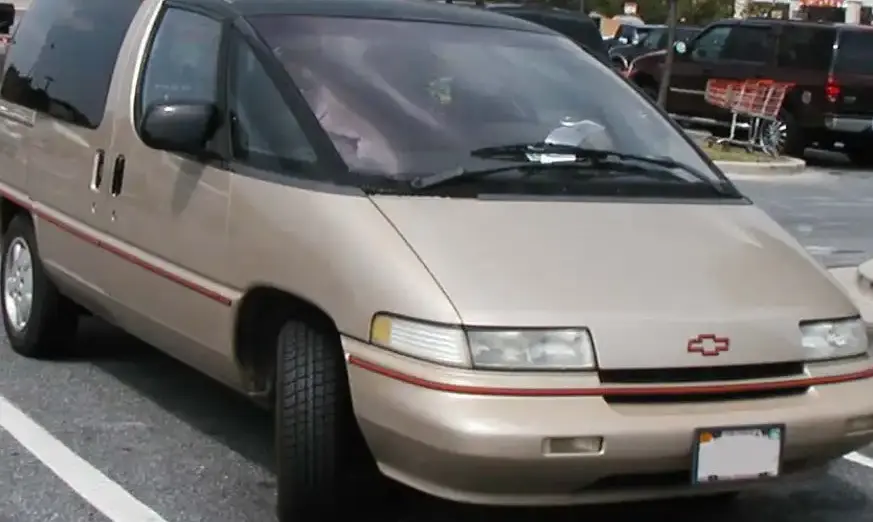
The Chevrolet Lumina APV 3.8i, produced from 1992 to 1996, represented Chevrolet’s entry into the increasingly popular minivan segment. Part of the broader Lumina line, the APV (All-Purpose Vehicle) was designed to compete with established players like the Dodge Caravan and Ford Windstar. The 3.8i variant, equipped with a 3.8-liter V6 engine producing 175 horsepower, occupied a mid-range position within the APV lineup, offering a balance between performance and affordability. It was positioned above the base models and below any potential future, higher-performance trims. The Lumina APV was a key part of Chevrolet’s strategy to broaden its appeal to families seeking versatile and spacious transportation.
Technical Specifications
| Brand | Chevrolet |
| Model | Lumina |
| Generation | Lumina APV |
| Type (Engine) | 3.8 i (175 Hp) |
| Start of production | 1992 |
| End of production | 1996 |
| Powertrain Architecture | Internal Combustion engine |
| Body type | Minivan |
| Seats | 5 |
| Doors | 4 |
| Fuel consumption (combined) | 11.8 l/100 km |
| Fuel consumption (US mpg) | 19.9 US mpg |
| Fuel consumption (UK mpg) | 23.9 UK mpg |
| Fuel consumption (km/l) | 8.5 km/l |
| Fuel Type | Petrol (Gasoline) |
| Weight-to-power ratio | 9.6 kg/Hp |
| Hp/tonne | 103.9 Hp/tonne |
| Weight-to-torque ratio | 5.5 kg/Nm |
| Nm/tonne | 181 Nm/tonne |
| Power | 175 Hp @ 4700 rpm |
| Power per litre | 46.2 Hp/l |
| Torque | 305 Nm @ 3200 rpm |
| Torque (lb.-ft.) | 224.96 lb.-ft. @ 3200 rpm |
| Engine layout | Front, Transverse |
| Engine displacement | 3791 cm3 |
| Engine displacement (cu. in.) | 231.34 cu. in. |
| Number of cylinders | 6 |
| Engine configuration | V-engine |
| Cylinder Bore | 96.5 mm |
| Cylinder Bore (in.) | 3.8 in. |
| Piston Stroke | 86.4 mm |
| Piston Stroke (in.) | 3.4 in. |
| Compression ratio | 9:1 |
| Number of valves per cylinder | 2 |
| Fuel injection system | Multi-port manifold injection |
| Engine aspiration | Naturally aspirated engine |
| Kerb Weight | 1685 kg |
| Kerb Weight (lbs.) | 3714.79 lbs. |
| Fuel tank capacity | 77 l |
| Fuel tank capacity (US gal) | 20.34 US gal |
| Fuel tank capacity (UK gal) | 16.94 UK gal |
| Length | 4844 mm |
| Length (in.) | 190.71 in. |
| Width | 1877 mm |
| Width (in.) | 73.9 in. |
| Height | 1669 mm |
| Height (in.) | 65.71 in. |
| Wheelbase | 2788 mm |
| Wheelbase (in.) | 109.76 in. |
| Front track | 1504 mm |
| Front track (in.) | 59.21 in. |
| Rear track | 1560 mm |
| Rear track (in.) | 61.42 in. |
| Drivetrain Architecture | The Internal combustion engine (ICE) drives the front wheels of the vehicle. |
| Drive wheel | Front wheel drive |
| Number of gears | 4 |
| Gearbox type | automatic transmission |
| Front suspension | Spring Strut |
| Rear suspension | Coil spring |
| Front brakes | Ventilated discs |
| Rear brakes | Drum |
| Assisting systems | ABS (Anti-lock braking system) |
| Power steering | Hydraulic Steering |
| Tires size | 205/70 R15 S |
Powertrain & Engine Architecture
The heart of the Lumina APV 3.8i was the 3800 Series II V6 engine. This engine, designated with GM engine codes like L26, was a 3.8-liter (3791 cc) naturally aspirated powerplant. It featured a 90-degree V-configuration, two valves per cylinder, and a cast iron block with aluminum cylinder heads. The engine utilized a multi-port fuel injection system, delivering fuel directly to each cylinder for improved efficiency and performance. The 3800 V6 was known for its relatively smooth operation and decent power output for its displacement. Paired with the engine was a 4-speed automatic transmission, a common choice for family-oriented vehicles prioritizing ease of use over outright performance. This transmission was designed for smooth shifts and reliable operation, though it wasn’t known for particularly quick acceleration.
Driving Characteristics
The 175 horsepower and 305 Nm (225 lb-ft) of torque delivered by the 3.8L V6 and automatic transmission combination provided adequate, but not exhilarating, performance. Acceleration was reasonable for everyday driving, but passing maneuvers required planning. The automatic transmission, while smooth, had relatively conservative gear ratios, prioritizing fuel economy over rapid acceleration. Compared to the base 3.1L V6 models, the 3.8i offered a noticeable improvement in power, making it more capable of handling a fully loaded vehicle or navigating hilly terrain. However, it lagged behind any potential future performance-oriented trims that might have featured a more powerful engine or a sport-tuned suspension. The front-wheel-drive configuration provided predictable handling, but lacked the dynamic capabilities of rear-wheel-drive or all-wheel-drive systems.
Equipment & Trim Levels
The Lumina APV 3.8i typically came standard with features expected of a mid-range minivan in the early 1990s. These included air conditioning, power windows and locks, an AM/FM stereo, and cloth upholstery. Optional extras included a cassette player, upgraded sound systems, alloy wheels, and a rear entertainment system. Interior trim levels varied, with some models offering upgraded cloth or even leather upholstery. The dashboard layout was functional and straightforward, prioritizing ease of use over aesthetic flair. Safety features were relatively basic for the time, typically including only ABS (Anti-lock Braking System) as a significant safety aid.
Chassis & Braking
The Lumina APV utilized a fairly conventional chassis design for a front-wheel-drive minivan. The front suspension employed a MacPherson strut setup, while the rear suspension featured a coil spring arrangement. This configuration provided a comfortable ride, but wasn’t particularly sporty. Braking duties were handled by ventilated discs at the front and drum brakes at the rear. The ABS system helped to maintain steering control during hard braking. The suspension was tuned for comfort and ride quality, rather than aggressive handling. Stabilizer bars were included to reduce body roll, but the overall handling characteristics were geared towards providing a smooth and predictable driving experience.
Market Reception & Comparison
The Lumina APV 3.8i received mixed reviews from automotive critics. While the spacious interior and comfortable ride were praised, the minivan was often criticized for its somewhat bland styling and unremarkable performance. Compared to the base 3.1L models, the 3.8i offered a significant improvement in power and drivability, making it a more appealing option for those who frequently carried passengers or cargo. However, it didn’t quite match the refinement or performance of some of its European and Japanese competitors. Fuel economy was average for the class, around 19.9 US mpg in combined driving. Reliability was generally considered good, with the 3800 V6 engine being known for its durability.
Legacy
The Chevrolet Lumina APV, including the 3.8i variant, played a role in establishing Chevrolet as a competitor in the minivan market. While it didn’t achieve the same level of success as some of its rivals, it provided a practical and affordable transportation option for families. The 3800 V6 engine proved to be a reliable and durable powerplant, and many examples of the Lumina APV 3.8i remain on the road today. In the used car market, these vans are often sought after for their affordability and spaciousness, though maintenance costs can increase with age. The Lumina APV paved the way for future Chevrolet minivans, contributing to the brand’s ongoing presence in this important segment.