
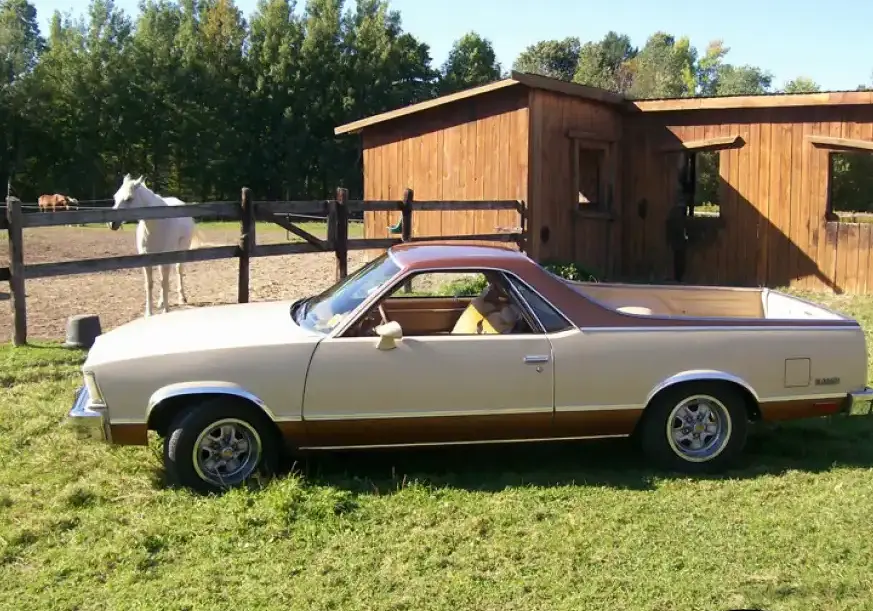
The Chevrolet Malibu El Camino, specifically the 5.7 V8 (165 hp) variant with a catalytic converter and automatic transmission, represents a unique and relatively short-lived chapter in Chevrolet’s history. Produced for the 1978 and 1979 model years, this vehicle combined the traditional car-based styling of the Malibu with the utility of a pickup truck bed, creating a “sedan pickup” or “muscle car with a bed” niche. It was built on the A-body platform, shared with other GM vehicles of the era, and aimed to offer a blend of performance and practicality. This particular engine and transmission combination occupied a mid-range position within the El Camino lineup, offering a step up in power from the smaller six-cylinder options but falling short of the higher-performance V8s available.
Technical Specifications
| Brand | Chevrolet |
| Model | Malibu |
| Generation | Malibu El Camino (Sedan Pickup) |
| Type (Engine) | 5.7 V8 (165 Hp) CAT Automatic |
| Start of production | 1978 |
| End of production | 1979 |
| Powertrain Architecture | Internal Combustion engine |
| Body type | Pick-up |
| Seats | 3 |
| Doors | 2 |
| Fuel Type | Petrol (Gasoline) |
| Power | 165 Hp @ 3800 rpm |
| Power per litre | 28.8 Hp/l |
| Torque | 353 Nm @ 2400 rpm / 260.36 lb.-ft. @ 2400 rpm |
| Engine layout | Front, Longitudinal |
| Engine displacement | 5733 cm3 / 349.85 cu. in. |
| Number of cylinders | 8 |
| Engine configuration | V-engine |
| Cylinder Bore | 101.6 mm / 4 in. |
| Piston Stroke | 88.39 mm / 3.48 in. |
| Compression ratio | 8.2:1 |
| Number of valves per cylinder | 2 |
| Fuel injection system | Carburettor |
| Engine aspiration | Naturally aspirated engine |
| Valvetrain | OHV |
| Engine oil capacity | 4 l / 4.23 US qt | 3.52 UK qt |
| Trunk (boot) space – maximum | 2033 l / 71.79 cu. ft. |
| Fuel tank capacity | 66 l / 17.44 US gal | 14.52 UK gal |
| Length | 5121 mm / 201.61 in. |
| Width | 1826 mm / 71.89 in. |
| Height | 1366 mm / 53.78 in. |
| Wheelbase | 2974 mm / 117.09 in. |
| Front track | 1486 mm / 58.5 in. |
| Rear (Back) track | 1467 mm / 57.76 in. |
| Front overhang | 915 mm / 36.02 in. |
| Rear overhang | 1232 mm / 48.5 in. |
| Ride height (ground clearance) | 147 mm / 5.79 in. |
| Approach angle | 20° |
| Departure angle | 15° |
| Ramp-over (brakeover) angle | 13° |
| Drivetrain Architecture | The Internal combustion engine (ICE) drives the rear wheels of the vehicle. |
| Drive wheel | Rear wheel drive |
| Number of gears and type of gearbox | 3 gears, automatic transmission |
| Front suspension | Independent, type McPherson with coil spring and anti-roll bar |
| Rear suspension | dependent spring suspension, Transverse stabilizer, Trailing arm |
| Front brakes | Ventilated discs |
| Rear brakes | Drum |
| Steering type | Steering rack and pinion |
| Tires size | 205/75 R14 |
| Wheel rims size | 6.0J x 14 |
Powertrain & Engine Architecture
The heart of this El Camino variant was the Chevrolet 350 cubic inch (5.7L) small-block V8 engine. Designated with the engine code “L48”, this version was equipped with a two-barrel carburetor and a catalytic converter, making it compliant with increasingly stringent emissions regulations of the late 1970s. The engine featured a traditional overhead valve (OHV) valvetrain with two valves per cylinder. While the 165 horsepower output was a reduction compared to earlier, higher-compression versions of the 350, it still provided respectable performance for the time. The three-speed Turbo-Hydramatic automatic transmission was the sole transmission option for this configuration. This transmission was known for its durability and smooth shifting, but its three-speed design meant that the engine often operated at higher RPMs during highway cruising, impacting fuel economy.
Driving Characteristics
The 165 hp, automatic transmission El Camino offered a comfortable, if not particularly sporty, driving experience. Acceleration was adequate, but not brisk, with a 0-60 mph time estimated to be around 10-11 seconds. The automatic transmission’s gear ratios were geared more towards cruising than outright acceleration. Compared to the available four-speed manual transmission or the higher-output V8 options, this combination felt less responsive. However, the automatic transmission made it a more accessible and user-friendly vehicle for a wider range of drivers. The rear-wheel-drive layout provided a traditional driving feel, and the relatively short wheelbase contributed to a nimble handling characteristic, though the suspension was tuned more for comfort than cornering precision.
Equipment & Trim Levels
The 1978-1979 Malibu El Camino 5.7 V8 Automatic typically came standard with features like power steering, power brakes, and a basic interior with cloth upholstery. The dashboard was fairly simple, featuring a gauge cluster with speedometer, fuel gauge, and temperature gauge. Options included air conditioning, a tilt steering wheel, upgraded sound systems, and various trim packages. The interior trim levels varied, with higher-end options offering more luxurious upholstery and additional chrome accents. The El Camino was positioned as a step up from the base Malibu sedan, offering a more rugged and versatile alternative.
Chassis & Braking
The El Camino’s chassis was based on the A-body platform, featuring independent front suspension with McPherson struts and a coil spring and anti-roll bar. The rear suspension utilized a traditional leaf spring setup with a transverse stabilizer. This configuration provided a comfortable ride, but wasn’t particularly sophisticated in terms of handling. Braking duties were handled by ventilated disc brakes in the front and drum brakes in the rear. While adequate for the vehicle’s weight and performance, the drum brakes on the rear were less effective than disc brakes, especially under hard braking conditions.
Market Reception & Comparison
The Malibu El Camino, in general, was well-received as a unique and stylish vehicle. However, the 5.7 V8 automatic combination received mixed reviews. Critics acknowledged the engine’s adequate power, but noted that it wasn’t as exciting as the higher-performance options. The automatic transmission was praised for its smoothness, but criticized for its lack of responsiveness. Fuel economy was also a concern, especially given the rising gas prices of the late 1970s. Compared to the six-cylinder versions, the V8 offered a significant performance boost, but at the cost of fuel efficiency. Compared to the higher-output V8s, it offered a more affordable price point and lower insurance costs.
Legacy
The 1978-1979 Chevrolet Malibu El Camino 5.7 V8 Automatic, while not a high-performance icon, holds a special place in automotive history as a representative of the late 1970s American car culture. The 350 small-block V8 is known for its durability and relative ease of maintenance, making these El Caminos relatively reliable even today. In the used car market, these vehicles are sought after by collectors and enthusiasts who appreciate their unique styling and classic American charm. While not as valuable as some of the more rare or high-performance El Camino variants, a well-maintained example can command a respectable price. The combination of a V8 engine, automatic transmission, and a pickup bed continues to appeal to those seeking a versatile and nostalgic vehicle.
