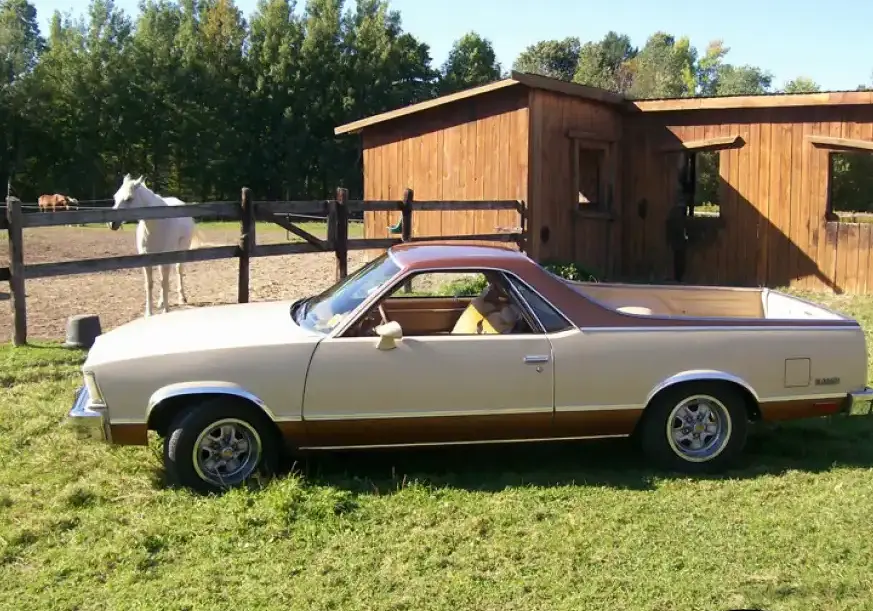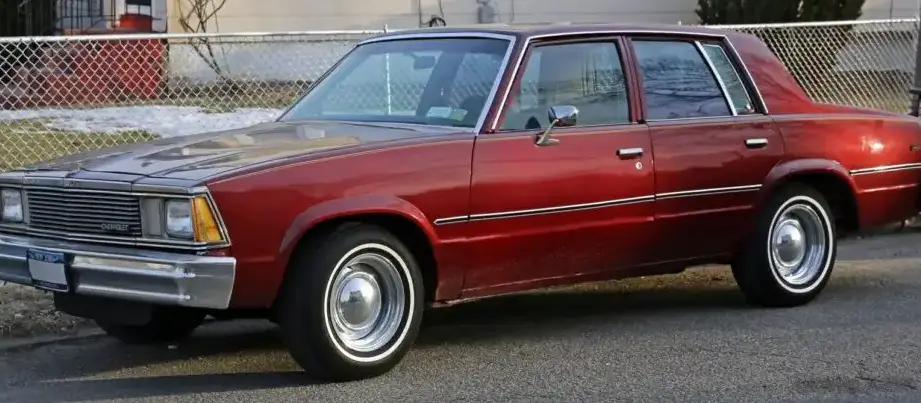
The Chevrolet Malibu IV Sedan, produced for the 1978 and 1979 model years, represented a significant downsizing for Chevrolet’s mid-size offering. Following the trend of the late 1970s towards more fuel-efficient vehicles, the Malibu IV moved to a smaller platform, a departure from the larger, more traditionally American-sized Malibus of previous years. The 3.3 V6 (94 hp) variant, equipped with a catalytic converter (“CAT”), was positioned as a base engine option, aimed at buyers prioritizing economy and practicality over outright performance. It served as the entry point into the Malibu IV lineup, slotting below the more powerful V8 options.
Technical Specifications
| Brand | Chevrolet |
| Model | Malibu |
| Generation | Malibu IV Sedan |
| Type (Engine) | 3.3 V6 (94 Hp) CAT |
| Start of production | 1978 |
| End of production | 1979 |
| Powertrain Architecture | Internal Combustion engine |
| Body type | Sedan |
| Seats | 6 |
| Doors | 4 |
| Fuel Type | Petrol (Gasoline) |
| Weight-to-power ratio | 14.9 kg/Hp, 67.1 Hp/tonne |
| Weight-to-torque ratio | 6.7 kg/Nm, 149.3 Nm/tonne |
| Power | 94 Hp @ 4000 rpm |
| Power per litre | 28.6 Hp/l |
| Torque | 209 Nm @ 2000 rpm (154.15 lb.-ft. @ 2000 rpm) |
| Engine layout | Front, Longitudinal |
| Engine displacement | 3292 cm3 (200.89 cu. in.) |
| Number of cylinders | 6 |
| Engine configuration | V-engine |
| Cylinder Bore | 88.9 mm (3.5 in.) |
| Piston Stroke | 88.4 mm (3.48 in.) |
| Compression ratio | 8.2:1 |
| Number of valves per cylinder | 2 |
| Fuel injection system | Carburettor |
| Engine aspiration | Naturally aspirated engine |
| Valvetrain | OHV |
| Engine oil capacity | 4 l (4.23 US qt | 3.52 UK qt) |
| Kerb Weight | 1400 kg (3086.47 lbs.) |
| Trunk (boot) space – maximum | 470 l (16.6 cu. ft.) |
| Fuel tank capacity | 68 l (17.96 US gal | 14.96 UK gal) |
| Length | 4895 mm (192.72 in.) |
| Width | 1816 mm (71.5 in.) |
| Height | 1376 mm (54.17 in.) |
| Wheelbase | 2745 mm (108.07 in.) |
| Front track | 1486 mm (58.5 in.) |
| Rear (Back) track | 1467 mm (57.76 in.) |
| Front overhang | 915 mm (36.02 in.) |
| Rear overhang | 1235 mm (48.62 in.) |
| Ride height (ground clearance) | 137 mm (5.39 in.) |
| Drag coefficient (Cd) | 0.45 |
| Minimum turning circle (turning diameter) | 12.2 m (40.03 ft.) |
| Approach angle | 20° |
| Departure angle | 15° |
| Ramp-over (brakeover) angle | 14° |
| Drivetrain Architecture | The Internal combustion engine (ICE) drives the rear wheels of the vehicle. |
| Drive wheel | Rear wheel drive |
| Number of gears and type of gearbox | 3 gears, manual transmission |
| Front suspension | Independent, type McPherson with coil spring and anti-roll bar |
| Rear suspension | dependent spring suspension, Transverse stabilizer, Trailing arm |
| Front brakes | Ventilated discs |
| Rear brakes | Drum |
| Steering type | Steering rack and pinion |
| Tires size | 185/75 R14 |
| Wheel rims size | 6.0J x 14 |
Powertrain & Engine Architecture
The 3.3-liter V6 engine, designated with various codes depending on specific calibration and emissions equipment, was a relatively simple design. It utilized a traditional overhead valve (OHV) valvetrain and a two-barrel carburetor for fuel delivery. The catalytic converter, mandated by increasingly stringent emissions regulations, was a key feature of this engine variant. The engine’s 8.2:1 compression ratio was a compromise between performance and fuel economy, and the relatively low horsepower output reflected the focus on efficiency. The engine was mounted longitudinally in the engine bay, driving the rear wheels through a three-speed manual transmission in this specific configuration. While automatic transmissions were available on other Malibu IV trims, the 3.3L engine was primarily paired with the manual gearbox for the base model.
Driving Characteristics
The 3.3L V6 with the three-speed manual transmission offered modest performance. Acceleration was adequate for everyday driving, but it wasn’t a particularly quick car. The 94 horsepower and 154 lb-ft of torque meant that passing maneuvers required planning, and steep hills could necessitate downshifting. The three-speed manual transmission had relatively wide gear ratios, prioritizing fuel economy over spirited driving. Compared to the V8-powered Malibus, the 3.3L felt significantly less powerful. However, it offered a more engaging driving experience than the automatic transmission options, providing the driver with more control over the engine’s power band. The rear-wheel-drive layout provided a balanced feel, though the suspension wasn’t tuned for aggressive cornering.
Equipment & Trim Levels
The 3.3L Malibu IV was typically the base trim level, meaning it came with a relatively sparse list of standard features. Interior upholstery was typically cloth, and the dashboard featured a simple, functional design. Standard equipment included basic instrumentation, a heater and defroster, and a basic AM radio. Optional extras included air conditioning, power steering, and upgraded audio systems. The focus was on providing a practical and affordable family sedan, rather than luxury or advanced features. The interior trim was generally durable but lacked the refinement of higher-end models.
Chassis & Braking
The Malibu IV utilized a body-on-frame construction, which was common for American cars of the era. The front suspension was independent, employing a McPherson strut design with coil springs and an anti-roll bar. The rear suspension was a more traditional dependent spring setup with trailing arms and a transverse stabilizer. Braking was accomplished via ventilated discs at the front and drum brakes at the rear. The braking system was adequate for normal driving conditions, but it lacked the stopping power of more modern systems. The relatively simple suspension setup prioritized ride comfort over handling precision.
Market Reception & Comparison
The 3.3L Malibu IV received mixed reviews. Critics generally praised its fuel economy and affordability, but criticized its lack of power and refinement. Compared to the V8-powered Malibus, the 3.3L was seen as a compromise, offering lower performance but better gas mileage. Against competitors like the Ford Fairmont and the Dodge Aries, the Malibu IV offered a similar level of practicality and affordability. However, some reviewers found the interior to be somewhat bland and the ride quality to be less refined than some of its rivals. The 3.3L engine was considered reliable, but the carburetor required periodic maintenance.
Legacy
The 3.3L V6-powered Malibu IV is now a relatively uncommon sight on the road. While not particularly collectible, well-maintained examples are appreciated by enthusiasts of classic American cars. The engine itself is generally considered reliable, though parts availability can be a challenge. The carburetor requires regular tuning and maintenance to ensure optimal performance. The Malibu IV represents a transitional period in automotive history, as manufacturers began to respond to the oil crises of the 1970s by downsizing their vehicles and focusing on fuel efficiency. The 3.3L variant, while not a performance leader, played a role in making the Malibu more accessible to a wider range of buyers.