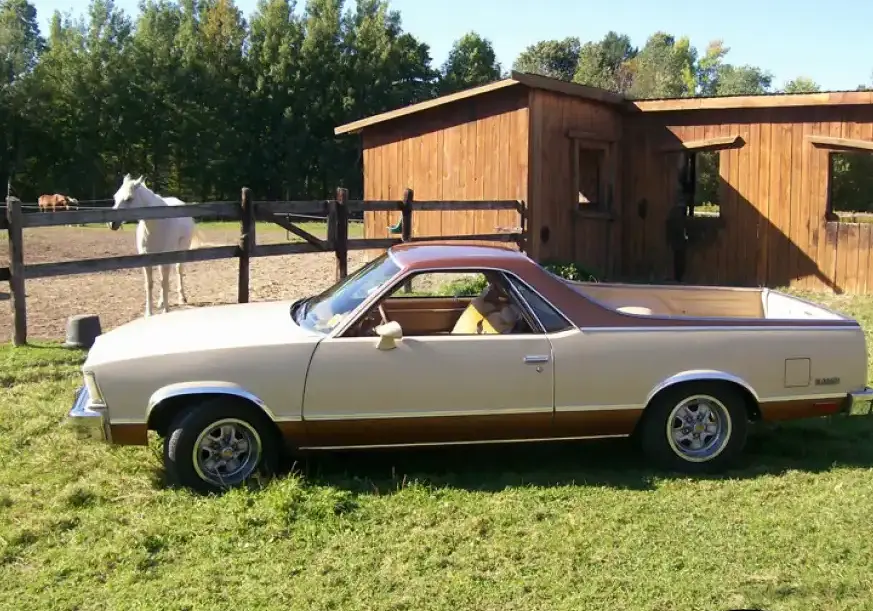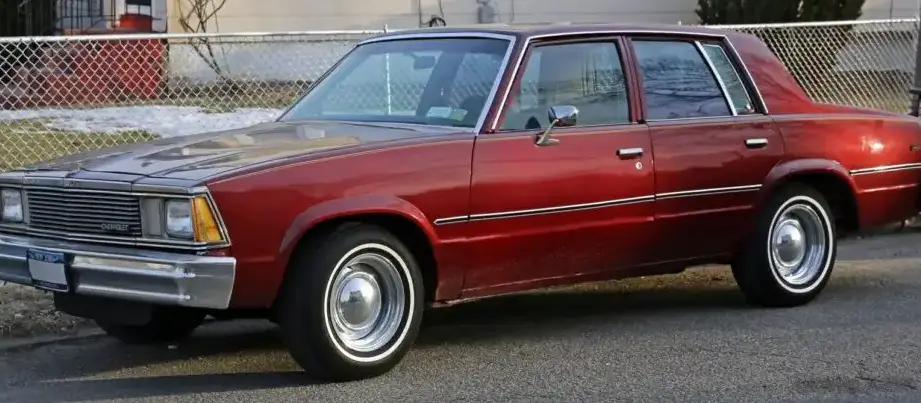
The Chevrolet Malibu IV Sedan, produced for the 1977 and 1978 model years, represented a significant downsizing effort for Chevrolet in response to the growing popularity of more fuel-efficient, import vehicles. This generation of the Malibu, built on the A-body platform, aimed to offer a comfortable and spacious family sedan with a focus on practicality. The 3.8 V6 (105 hp) with a catalytic converter and automatic transmission variant occupied a middle ground in the Malibu lineup, offering a balance between performance and economy. It was positioned above the base inline-six models but below the more powerful V8 options.
Technical Specifications
| Brand | Chevrolet |
| Model | Malibu |
| Generation | Malibu IV Sedan |
| Type (Engine) | 3.8 V6 (105 Hp) CAT Automatic |
| Start of production | 1977 year |
| End of production | 1978 year |
| Powertrain Architecture | Internal Combustion engine |
| Body type | Sedan |
| Seats | 6 |
| Doors | 4 |
| Fuel Type | Petrol (Gasoline) |
| Weight-to-power ratio | 13.5 kg/Hp, 73.8 Hp/tonne |
| Weight-to-torque ratio | 5.7 kg/Nm, 176.5 Nm/tonne |
| Power | 105 Hp @ 3800 rpm |
| Power per litre | 27.7 Hp/l |
| Torque | 251 Nm @ 2000 rpm, 185.13 lb.-ft. @ 2000 rpm |
| Engine layout | Front, Longitudinal |
| Engine displacement | 3791 cm3, 231.34 cu. in. |
| Number of cylinders | 6 |
| Engine configuration | V-engine |
| Cylinder Bore | 96.5 mm, 3.8 in. |
| Piston Stroke | 86.4 mm, 3.4 in. |
| Compression ratio | 8.2:1 |
| Number of valves per cylinder | 2 |
| Fuel injection system | Carburettor |
| Engine aspiration | Naturally aspirated engine |
| Valvetrain | OHV |
| Engine oil capacity | 4 l, 4.23 US qt | 3.52 UK qt |
| Kerb Weight | 1422 kg, 3134.97 lbs |
| Trunk (boot) space – maximum | 470 l, 16.6 cu. ft |
| Fuel tank capacity | 68 l, 17.96 US gal | 14.96 UK gal |
| Length | 4895 mm, 192.72 in |
| Width | 1816 mm, 71.5 in |
| Height | 1376 mm, 54.17 in |
| Wheelbase | 2745 mm, 108.07 in |
| Front track | 1486 mm, 58.5 in |
| Rear (Back) track | 1467 mm, 57.76 in |
| Front overhang | 915 mm, 36.02 in |
| Rear overhang | 1235 mm, 48.62 in |
| Ride height (ground clearance) | 137 mm, 5.39 in |
| Drag coefficient (Cd) | 0.45 |
| Minimum turning circle (turning diameter) | 12.2 m, 40.03 ft |
| Approach angle | 20° |
| Departure angle | 15° |
| Ramp-over (brakeover) angle | 14° |
| Drivetrain Architecture | The Internal combustion engine (ICE) drives the rear wheels of the vehicle. |
| Drive wheel | Rear wheel drive |
| Number of gears and type of gearbox | 3 gears, automatic transmission |
| Front suspension | Independent, type McPherson with coil spring and anti-roll bar |
| Rear suspension | dependent spring suspension, Transverse stabilizer, Trailing arm |
| Front brakes | Ventilated discs |
| Rear brakes | Drum |
| Steering type | Steering rack and pinion |
| Tires size | 195/75 R14; 205/75 R14 |
| Wheel rims size | 6.0J x 14 |
INTRODUCTION
The 1977-1978 Chevrolet Malibu IV Sedan with the 3.8L V6 and automatic transmission was a key offering in Chevrolet’s mid-size lineup. Following the oil crises of the 1970s, Chevrolet responded to consumer demand for smaller, more fuel-efficient vehicles by downsizing its popular models. The Malibu, along with the Chevelle and Monte Carlo, moved to a new, lighter A-body platform. This particular configuration, pairing the 3.8L V6 with a three-speed automatic, aimed to provide a comfortable and relatively economical driving experience for families and commuters. The catalytic converter was a new addition for these years, reflecting increasing environmental regulations.
Powertrain & Engine Architecture
The heart of this Malibu variant was the 3.8-liter (231 cubic inch) V6 engine. This engine, internally designated as the 3800, was a descendant of Chevrolet’s long-running small-block V6 family. It featured a 90-degree V-angle and an overhead valve (OHV) valvetrain with two valves per cylinder. Fuel delivery was handled by a two-barrel carburetor, a common setup for the era. The engine produced 105 horsepower at 3800 rpm and 251 Nm (185 lb-ft) of torque at 2000 rpm. The 3.8L engine was mounted longitudinally in the engine bay, driving the rear wheels. The three-speed automatic transmission, a TH350, was a standard offering and provided smooth, if not particularly sporty, gear changes. The transmission’s gear ratios were optimized for cruising and fuel economy rather than outright acceleration.
Driving Characteristics
The 1977-1978 Malibu 3.8L automatic offered a comfortable, but not particularly exhilarating, driving experience. The 105 horsepower engine provided adequate power for everyday driving, but acceleration was modest. The automatic transmission contributed to a relaxed driving style, with smooth shifts and a focus on fuel efficiency. Compared to the available V8 engines, the 3.8L V6 was noticeably slower, especially in highway passing situations. However, it offered a significant improvement in fuel economy. The automatic transmission’s gear ratios were relatively tall, prioritizing fuel economy over quick acceleration. The rear-wheel-drive layout provided a balanced feel, but the suspension was tuned for comfort rather than sporty handling.
Equipment & Trim Levels
The Malibu IV Sedan with the 3.8L V6 automatic typically came standard with features like cloth upholstery, a basic AM radio, and full wheel covers. Power steering and power brakes were often included. Optional extras included air conditioning, a stereo upgrade, cruise control, and upgraded interior trim. The Malibu’s interior was designed for practicality and comfort, with a spacious cabin and comfortable seating for up to six passengers. The dashboard layout was straightforward and functional, with easy-to-read gauges. Trim levels varied, but the 3.8L automatic generally represented a mid-range offering, positioned above the base models with the inline-six engine.
Chassis & Braking
The Malibu IV Sedan utilized a body-on-frame construction, a common practice for American cars of the era. The front suspension was an independent McPherson strut design with coil springs and an anti-roll bar, providing a comfortable ride. The rear suspension was a traditional leaf spring setup with a transverse stabilizer, offering a more robust but less sophisticated ride. Braking duties were handled by ventilated discs at the front and drum brakes at the rear. The braking system was adequate for normal driving conditions, but lacked the stopping power of more modern systems. Steering was accomplished via a steering rack and pinion system, providing reasonably precise control.
Market Reception & Comparison
The 1977-1978 Chevrolet Malibu IV Sedan with the 3.8L V6 automatic received mixed reviews. Critics praised its comfortable ride and spacious interior, but noted its modest performance. Compared to the V8-powered Malibus, the 3.8L V6 offered significantly lower fuel consumption, making it a popular choice for buyers concerned about gas prices. However, it lacked the power and responsiveness of the V8 models. The 3.8L automatic was often compared to similar offerings from Ford and Chrysler, with the Malibu generally considered to be competitive in terms of price, features, and fuel economy. Reliability was generally good, although carburetor issues could occasionally arise.
Legacy
The 1977-1978 Chevrolet Malibu IV Sedan, particularly the 3.8L V6 automatic variant, represents a transitional period in American automotive history. It reflects the industry’s response to changing consumer preferences and stricter fuel economy standards. While not a performance icon, this Malibu offered a practical and comfortable transportation solution for families. Today, these cars are relatively affordable and can be found in varying conditions. The 3.8L V6 engine is known for its durability, and well-maintained examples can still provide reliable service. However, age-related issues such as rust and carburetor problems are common. The Malibu IV Sedan remains a popular choice for classic car enthusiasts and collectors seeking a representative example of 1970s American automotive design.