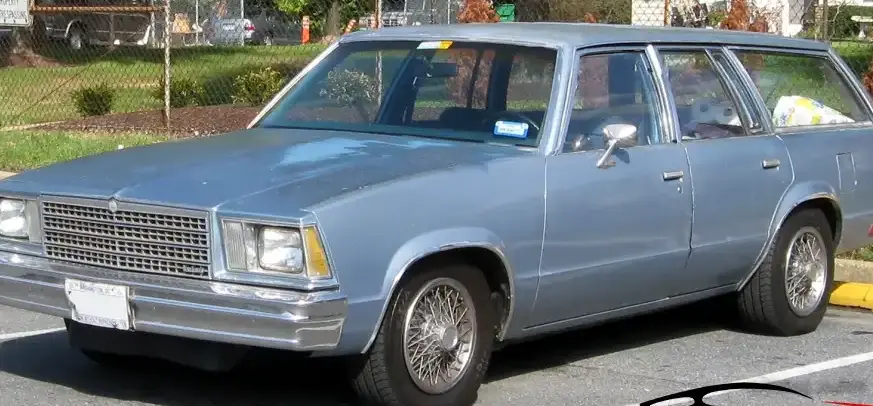
The Chevrolet Malibu IV Station Wagon, produced for a limited run between 1980 and 1981, represented a somewhat unusual offering from Chevrolet during a period increasingly focused on smaller, more fuel-efficient vehicles. This generation Malibu, while sharing a platform with other GM “A-body” cars, distinguished itself with a spacious station wagon body style and, in this particular variant, a relatively large 4.4-liter V8 engine paired with a three-speed automatic transmission. The 4.4L V8 (120 hp) CAT Automatic trim occupied a middle ground in the Malibu IV Station Wagon lineup, offering a balance between practicality and a degree of performance not typically associated with family wagons of the era. It was positioned above the smaller six-cylinder options but below any potential higher-performance variants that were never fully realized.
Technical Specifications
| Brand | Chevrolet |
| Model | Malibu |
| Generation | Malibu IV Station Wagon |
| Type (Engine) | 4.4 V8 (120 Hp) CAT Automatic |
| Start of production | 1980 |
| End of production | 1981 |
| Powertrain Architecture | Internal Combustion engine |
| Body type | Station wagon (estate) |
| Seats | 6 |
| Doors | 5 |
| Fuel Type | Petrol (Gasoline) |
| Weight-to-power ratio | 12.7 kg/Hp, 78.7 Hp/tonne |
| Weight-to-torque ratio | 5.2 kg/Nm, 190.9 Nm/tonne |
| Power | 120 Hp @ 3600 rpm |
| Power per litre | 27.3 Hp/l |
| Torque | 291 Nm @ 2000 rpm, 214.63 lb.-ft. @ 2000 rpm |
| Engine layout | Front, Longitudinal |
| Engine displacement | 4389 cm3, 267.83 cu. in. |
| Number of cylinders | 8 |
| Engine configuration | V-engine |
| Cylinder Bore | 88.9 mm, 3.5 in. |
| Piston Stroke | 88.4 mm, 3.48 in. |
| Compression ratio | 8.3:1 |
| Number of valves per cylinder | 2 |
| Fuel injection system | Carburettor |
| Engine aspiration | Naturally aspirated engine |
| Valvetrain | OHV |
| Kerb Weight | 1524 kg, 3359.84 lbs |
| Trunk (boot) space – minimum | 1133 l, 40.01 cu. ft |
| Trunk (boot) space – maximum | 2050 l, 72.4 cu. ft |
| Fuel tank capacity | 69 l, 18.23 US gal | 15.18 UK gal |
| Length | 4911 mm, 193.35 in |
| Width | 1816 mm, 71.5 in |
| Height | 1410 mm, 55.51 in |
| Wheelbase | 2745 mm, 108.07 in |
| Front track | 1486 mm, 58.5 in |
| Rear (Back) track | 1467 mm, 57.76 in |
| Front overhang | 915 mm, 36.02 in |
| Rear overhang | 1251 mm, 49.25 in |
| Ride height (ground clearance) | 145 mm, 5.71 in |
| Minimum turning circle (turning diameter) | 13.0 m, 42.65 ft |
| Approach angle | 23° |
| Departure angle | 16° |
| Ramp-over (brakeover) angle | 14° |
| Drivetrain Architecture | The Internal combustion engine (ICE) drives the rear wheels of the vehicle. |
| Drive wheel | Rear wheel drive |
| Number of gears and type of gearbox | 3 gears, automatic transmission |
| Front suspension | Independent, type McPherson with coil spring and anti-roll bar |
| Rear suspension | dependent spring suspension, Transverse stabilizer, Trailing arm |
| Front brakes | Ventilated discs |
| Rear brakes | Drum |
| Steering type | Steering rack and pinion |
| Tires size | 195/75 R14 |
| Wheel rims size | 6.0J x 14 |
Powertrain & Engine Architecture
The heart of this Malibu variant was Chevrolet’s 4.4-liter (268 cubic inch) small-block V8 engine. This engine, designated with emissions control systems (CAT), produced 120 horsepower at 3600 rpm and 291 Nm (214.63 lb-ft) of torque at 2000 rpm. The engine utilized a conventional overhead valve (OHV) valvetrain with two valves per cylinder and a carburetor for fuel delivery. While not a high-performance engine by any means, the 4.4L V8 provided adequate power for comfortable cruising and hauling, especially considering the weight of the station wagon body style. The engine was mounted longitudinally in the front of the vehicle. The three-speed automatic transmission, a GM-built unit, was the sole transmission option for this configuration. It was designed for smooth, if not particularly quick, shifts, prioritizing comfort over outright performance. The transmission’s gear ratios were optimized for relaxed highway driving and moderate acceleration.
Driving Characteristics
The 120 hp, automatic transmission combination resulted in a driving experience geared towards comfort and practicality. Acceleration was modest, and the car wasn’t designed for spirited driving. The automatic transmission, while smooth, lacked the responsiveness of a manual gearbox. The weight of the station wagon, combined with the relatively low horsepower output, meant that passing maneuvers required careful planning. However, the engine’s torque output at lower rpm provided sufficient power for everyday driving situations. The rear-wheel-drive layout offered a balanced feel, but the suspension, while adequate, wasn’t particularly sporty. Compared to a Malibu with a smaller six-cylinder engine and manual transmission, this V8 automatic offered more relaxed cruising and easier towing capability, but at the expense of fuel economy and agility.
Equipment & Trim Levels
The 4.4L V8 Automatic Malibu IV Station Wagon typically came standard with features considered fairly basic for the time, including cloth upholstery, a standard AM/FM radio, and manual windows and locks. Power steering and power brakes were often included. Optional extras included air conditioning, a more upgraded sound system, and a roof rack. Interior trim was generally functional and durable, reflecting the car’s intended role as a family vehicle. The dashboard layout was straightforward, with clearly marked gauges and easy-to-use controls.
Chassis & Braking
The Malibu IV Station Wagon utilized a body-on-frame construction, common for American cars of that era. The front suspension was independent, employing a McPherson strut design with coil springs and an anti-roll bar. The rear suspension was a more traditional dependent spring setup with a transverse stabilizer and trailing arms. Braking duties were handled by ventilated discs at the front and drum brakes at the rear. While adequate for the car’s weight and performance, the braking system wasn’t particularly powerful by modern standards. The steering was a rack-and-pinion system, providing reasonably precise control.
Market Reception & Comparison
The 4.4L V8 Automatic Malibu IV Station Wagon received mixed reviews. Critics generally praised its spacious interior and comfortable ride, but noted its lackluster performance and relatively poor fuel economy. Compared to other station wagons of the time, such as those offered by Ford and Chrysler, the Malibu offered a competitive level of space and practicality, but lacked the refinement and fuel efficiency of some of its rivals. Within the Malibu lineup, the V8 automatic was seen as a step up from the six-cylinder models in terms of power and towing capacity, but it came at a higher price and with increased fuel consumption.
Legacy
The Chevrolet Malibu IV Station Wagon with the 4.4L V8 and automatic transmission is now a relatively rare vehicle, largely due to its limited production run and the effects of time. While not a particularly sought-after classic, it represents a unique chapter in Chevrolet’s history. The 4.4L small-block V8 is known for its durability and relative simplicity, making it a reasonably reliable engine if properly maintained. However, age and potential neglect can lead to issues with the carburetor, ignition system, and cooling system. Today, these Malibus are often found in the hands of collectors and enthusiasts who appreciate their vintage charm and classic American styling. The powertrain, while not particularly efficient by modern standards, remains a testament to the era of large-displacement V8 engines.