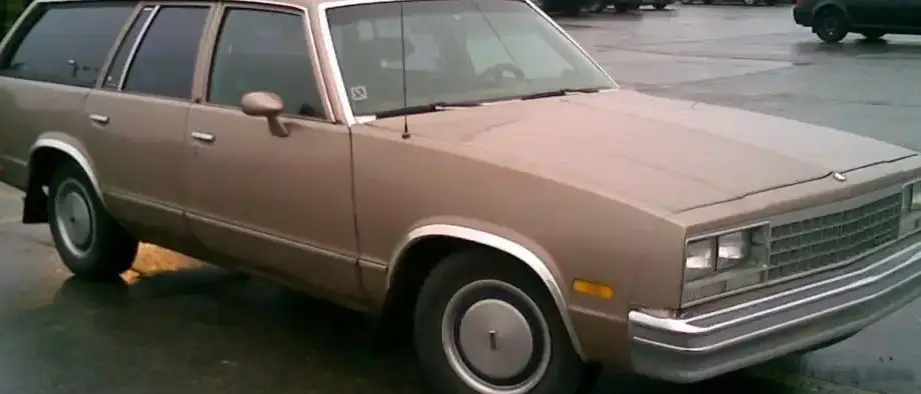
The Chevrolet Malibu IV Wagon, particularly the facelifted version introduced in 1981, represented a significant offering in the American station wagon market. Produced from 1981 through 1983, this variant featured a 4.4-liter V8 engine producing 115 horsepower, paired with a three-speed automatic transmission. This configuration positioned the Malibu Wagon as a comfortable, family-oriented vehicle, though not necessarily the performance leader within the broader Malibu lineup. It was built on the rear-wheel drive G-body platform, shared with other Chevrolet models like the Monte Carlo and El Camino, and aimed to provide a spacious and practical alternative to increasingly popular smaller, more fuel-efficient cars.
Technical Specifications
| Brand | Chevrolet |
| Model | Malibu |
| Generation | Malibu IV Wagon (facelift 1981) |
| Type (Engine) | 4.4 V8 (115 Hp) CAT Automatic |
| Start of production | 1981 |
| End of production | 1983 |
| Powertrain Architecture | Internal Combustion engine |
| Body type | Station wagon (estate) |
| Seats | 6 |
| Doors | 5 |
| Fuel Type | Petrol (Gasoline) |
| Weight-to-power ratio | 13.7 kg/Hp, 72.8 Hp/tonne |
| Weight-to-torque ratio | 5.7 kg/Nm, 175.9 Nm/tonne |
| Power | 115 Hp @ 4000 rpm |
| Power per litre | 26.3 Hp/l |
| Torque | 278 Nm @ 2400 rpm, 205.04 lb.-ft. @ 2400 rpm |
| Engine layout | Front, Longitudinal |
| Engine Model/Code | L39 |
| Engine displacement | 4376 cm3, 267.04 cu. in. |
| Number of cylinders | 8 |
| Engine configuration | V-engine |
| Cylinder Bore | 88.9 mm, 3.5 in. |
| Piston Stroke | 88.4 mm, 3.48 in. |
| Compression ratio | 8.3:1 |
| Number of valves per cylinder | 2 |
| Fuel injection system | Carburettor |
| Engine aspiration | Naturally aspirated engine |
| Valvetrain | OHV |
| Engine oil capacity | 3.8 l, 4.02 US qt | 3.34 UK qt |
| Coolant | 17.9 l, 18.91 US qt | 15.75 UK qt |
| Kerb Weight | 1580 kg, 3483.3 lbs |
| Trunk (boot) space – minimum | 1131 l, 39.94 cu. ft |
| Trunk (boot) space – maximum | 2050 l, 72.4 cu. ft |
| Fuel tank capacity | 69 l, 18.23 US gal | 15.18 UK gal |
| Length | 4911 mm, 193.35 in |
| Width | 1826 mm, 71.89 in |
| Height | 1418 mm, 55.83 in |
| Wheelbase | 2745 mm, 108.07 in |
| Front track | 1486 mm, 58.5 in |
| Rear (Back) track | 1467 mm, 57.76 in |
| Front overhang | 915 mm, 36.02 in |
| Rear overhang | 1251 mm, 49.25 in |
| Ride height (ground clearance) | 158 mm, 6.22 in |
| Minimum turning circle (turning diameter) | 13.0 m, 42.65 ft |
| Drive wheel | Rear wheel drive |
| Number of gears and type of gearbox | 3 gears, automatic transmission |
| Front suspension | Independent, type McPherson with coil spring and anti-roll bar |
| Rear suspension | dependent spring suspension, Transverse stabilizer, Trailing arm |
| Front brakes | Ventilated discs |
| Rear brakes | Drum |
| Steering type | Steering rack and pinion |
| Tires size | 195/75 R14 |
| Wheel rims size | 6.0J x 14 |
Powertrain & Engine Architecture
The heart of this Malibu Wagon was the Chevrolet 305 cubic inch (4.4-liter) small-block V8, designated the L39 engine code. This engine was a staple of Chevrolet’s lineup for many years, known for its durability and relatively simple design. The L39 featured a cast iron block and cylinder heads, with a two-barrel carburetor managing fuel delivery. The overhead valve (OHV) valvetrain, while traditional, was reliable and easy to maintain. The 8.3:1 compression ratio was a compromise between performance and emissions requirements of the era. The three-speed automatic transmission, a TH350, was a common and robust unit, providing smooth, if not particularly sporty, shifts. It was geared for comfortable cruising and maximizing fuel economy, which was a growing concern for consumers in the early 1980s.
Driving Characteristics
The 115 horsepower and 205 lb-ft of torque delivered by the L39 engine provided adequate, but not exhilarating, performance. Acceleration was leisurely, and passing maneuvers required planning. The automatic transmission’s gear ratios were optimized for fuel efficiency and smooth operation, rather than aggressive acceleration. Compared to the available V6 engines or even the higher-output V8 options in other Malibu models, this configuration prioritized comfort and practicality over outright speed. The rear-wheel drive layout offered a balanced feel, but the relatively soft suspension tuning emphasized ride comfort over sharp handling. It was a car designed for long highway trips and everyday family duties.
Equipment & Trim Levels
The 1981-1983 Malibu Wagon with the 4.4L V8 and automatic transmission typically came with a fairly standard level of equipment. This included cloth upholstery, a basic AM radio, and manual windows and locks. Air conditioning was a popular option, as was power steering. Higher trim levels, such as the Malibu Classic, offered upgrades like upgraded interior materials, additional chrome trim, and more advanced audio systems. The wagon’s interior was designed for practicality, with a spacious cabin and a large cargo area. The rear seats could be folded down to create even more storage space.
Chassis & Braking
The Malibu Wagon’s chassis featured an independent front suspension with McPherson struts and a coil spring, providing a comfortable ride. The rear suspension utilized a traditional leaf spring setup with a transverse stabilizer bar, which helped to reduce body roll. Front brakes were ventilated discs, offering adequate stopping power, while the rear brakes were drums. The steering was a rack-and-pinion system, providing reasonably precise control. The 195/75 R14 tires were chosen for a balance of ride comfort and durability.
Market Reception & Comparison
The Malibu Wagon, in general, was well-received as a practical and spacious family vehicle. However, the 4.4L V8/automatic combination wasn’t the most popular choice. Critics often pointed to its relatively low horsepower and lackluster acceleration compared to other engines available in the Malibu lineup. The V6 offered better fuel economy, while the larger V8s provided more performance. The automatic transmission, while smooth, was seen as detracting from the driving experience compared to the available manual transmission. Fuel economy was typical for a full-size American wagon of the era, but it was becoming increasingly scrutinized as fuel prices rose.
Legacy
The Chevrolet Malibu IV Wagon with the 4.4L V8 and automatic transmission, while not a standout performer, remains a relatively reliable and affordable classic car today. The L39 engine is known for its durability, and parts are readily available. These wagons are often sought after by enthusiasts looking for a comfortable and spacious cruiser. While not a collector’s item in the same vein as some muscle cars, they represent a significant piece of American automotive history and offer a nostalgic driving experience. The simplicity of the powertrain makes it relatively easy to maintain and repair, appealing to those who enjoy working on their own vehicles. The large cargo capacity continues to make it a practical choice for those needing a versatile vehicle.