
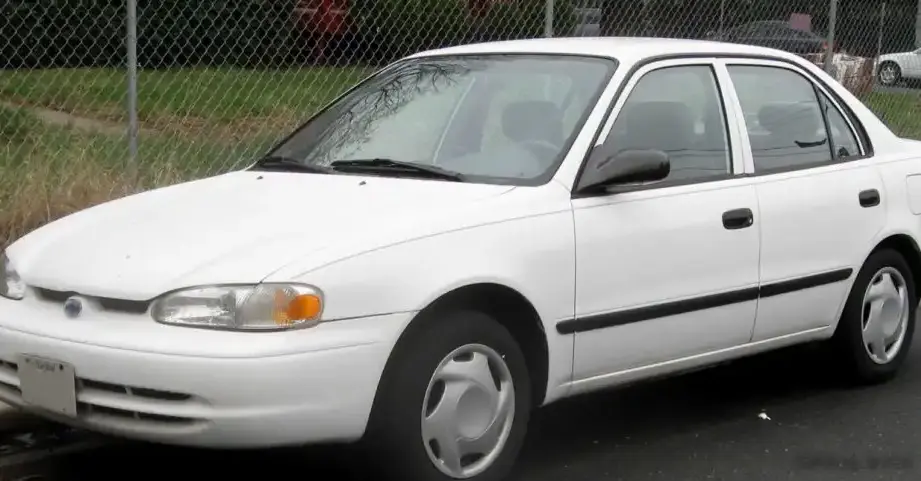
The Chevrolet Prizm 1.8 i 16V, produced between 1998 and 2001, represented a significant offering in the compact sedan segment for the American market. Essentially a rebadged Toyota Corolla, the Prizm was Chevrolet’s attempt to provide a reliable and affordable vehicle, leveraging Toyota’s manufacturing expertise. This particular 1.8-liter, 122 horsepower variant occupied a middle ground within the Prizm lineup, offering a balance between performance and economy. It was positioned above the base 1.6-liter engine and below any potential higher-performance trims, aiming for buyers seeking a practical and reasonably equipped daily driver. The Prizm, built under a joint venture with Toyota (NUMMI – New United Motor Manufacturing, Inc.), was a key part of GM’s strategy to compete with Japanese imports on their own terms.
Technical Specifications
| Brand | Chevrolet |
| Model | Prizm |
| Generation | Prizm |
| Type (Engine) | 1.8 i 16V (122 Hp) |
| Start of production | 1998 |
| End of production | 2001 |
| Powertrain Architecture | Internal Combustion engine |
| Body type | Sedan |
| Seats | 5 |
| Doors | 4 |
| Fuel consumption (urban) | 7.6 l/100 km (30.9 US mpg) |
| Fuel consumption (extra urban) | 6.4 l/100 km (36.8 US mpg) |
| Fuel Type | Petrol (Gasoline) |
| Maximum speed | 190 km/h (118.06 mph) |
| Weight-to-power ratio | 8.9 kg/Hp |
| Weight-to-torque ratio | 6.6 kg/Nm |
| Power | 122 Hp @ 5600 rpm |
| Power per litre | 68 Hp/l |
| Torque | 165 Nm @ 4400 rpm (121.7 lb.-ft. @ 4400 rpm) |
| Engine layout | Front, Longitudinal |
| Engine Model/Code | LV6 |
| Engine displacement | 1794 cm3 (109.48 cu. in.) |
| Number of cylinders | 4 |
| Engine configuration | Inline |
| Cylinder Bore | 79 mm (3.11 in.) |
| Piston Stroke | 91.5 mm (3.6 in.) |
| Compression ratio | 10.1:1 |
| Number of valves per cylinder | 4 |
| Fuel injection system | Multi-port manifold injection |
| Engine aspiration | Naturally aspirated engine |
| Valvetrain | DOHC |
| Engine oil capacity | 3.7 l (3.91 US qt | 3.26 UK qt) |
| Coolant | 6.2 l (6.55 US qt | 5.46 UK qt) |
| Kerb Weight | 1090 kg (2403.04 lbs.) |
| Trunk (boot) space – minimum | 340 l (12.01 cu. ft.) |
| Fuel tank capacity | 50 l (13.21 US gal | 11 UK gal) |
| Length | 4430 mm (174.41 in.) |
| Width | 1690 mm (66.54 in.) |
| Height | 1360 mm (53.54 in.) |
| Wheelbase | 2465 mm (97.05 in.) |
| Front track | 1460 mm (57.48 in.) |
| Rear (Back) track | 1450 mm (57.09 in.) |
| Drivetrain Architecture | Front wheel drive |
| Number of gears and type of gearbox | 5 gears, manual transmission |
| Front suspension | Spring Strut |
| Rear suspension | Coil spring |
| Front brakes | Ventilated discs |
| Rear brakes | Drum |
| Assisting systems | ABS (Anti-lock braking system) |
| Steering type | Steering rack and pinion |
| Power steering | Hydraulic Steering |
| Tires size | 185/65 R14 |
Powertrain & Engine Architecture
The heart of the Prizm 1.8 i 16V was the 1.8-liter (1794 cc) inline-four cylinder engine, designated as the LV6. This engine, derived from Toyota’s 7A-FE series, featured a double overhead camshaft (DOHC) valvetrain with four valves per cylinder, contributing to its relatively high output for its displacement. The engine utilized a multi-port fuel injection system, providing precise fuel delivery for improved efficiency and performance. The 10.1:1 compression ratio was a standard figure for engines of this era, balancing power and fuel economy. The engine was mounted longitudinally in the front of the vehicle, driving the front wheels. The five-speed manual transmission was the standard offering, providing drivers with full control over the engine’s power band. The transmission’s gear ratios were tuned for a balance of acceleration and highway cruising, though it wasn’t particularly sporty.
Driving Characteristics
The 122 horsepower and 121.7 lb.-ft. of torque produced by the 1.8-liter engine provided adequate, though not exhilarating, performance. Acceleration from 0 to 60 mph was estimated to be around 9-10 seconds. The five-speed manual transmission allowed drivers to keep the engine in its optimal power range, but the engine lacked the low-end grunt of larger displacement engines. Compared to the base 1.6-liter Prizm, the 1.8-liter offered noticeably improved acceleration and highway passing power. However, it didn’t match the responsiveness of higher-performance compacts available at the time. The steering was light and precise, making the Prizm easy to maneuver in city traffic. The suspension provided a comfortable ride, but it wasn’t particularly sporty, leaning towards a softer setup for everyday driving.
Equipment & Trim Levels
The Prizm 1.8 i 16V typically came standard with features such as air conditioning, power steering, a basic audio system, and cloth upholstery. Power windows and door locks were often included, but could vary depending on specific packages. Optional extras included an upgraded audio system, alloy wheels, and a sunroof. The interior was functional and straightforward, prioritizing practicality over luxury. The dashboard layout was simple and easy to use, with clearly labeled controls. The seats provided adequate support for long drives, but lacked the bolstering found in more performance-oriented vehicles.
Chassis & Braking
The Prizm utilized a front-wheel-drive layout with a MacPherson strut front suspension and a coil spring rear suspension. This setup provided a comfortable ride and predictable handling. The front brakes were ventilated discs, offering good stopping power, while the rear brakes were drums, a cost-saving measure common in this class of vehicle. Anti-lock braking system (ABS) was standard, enhancing safety by preventing wheel lockup during hard braking. The chassis was relatively lightweight, contributing to the Prizm’s fuel efficiency and nimble handling.
Market Reception & Comparison
The Chevrolet Prizm 1.8 i 16V was generally well-received by critics as a reliable and affordable compact sedan. It was praised for its fuel efficiency, comfortable ride, and Toyota-derived reliability. However, it was often criticized for its somewhat bland styling and lack of sporty driving dynamics. Compared to other compacts of the time, such as the Honda Civic and Toyota Corolla (its direct sibling), the Prizm offered a competitive value proposition, often at a lower price point. Fuel economy was comparable to other 1.8-liter engines in the segment, averaging around 31 mpg city and 37 mpg highway. Reliability was a strong point, with few reported issues with the engine or transmission.
Legacy
The Chevrolet Prizm, and specifically the 1.8 i 16V variant, has developed a reputation as a dependable and economical used car. The Toyota-engineered powertrain is known for its longevity, and many examples are still on the road today with relatively high mileage. Maintenance costs are generally low, thanks to the readily available parts and simple mechanical design. While not a particularly exciting vehicle, the Prizm 1.8 i 16V remains a practical and affordable option for buyers seeking a reliable and fuel-efficient compact sedan. Its enduring reputation for reliability ensures its continued presence in the used car market for years to come.
