
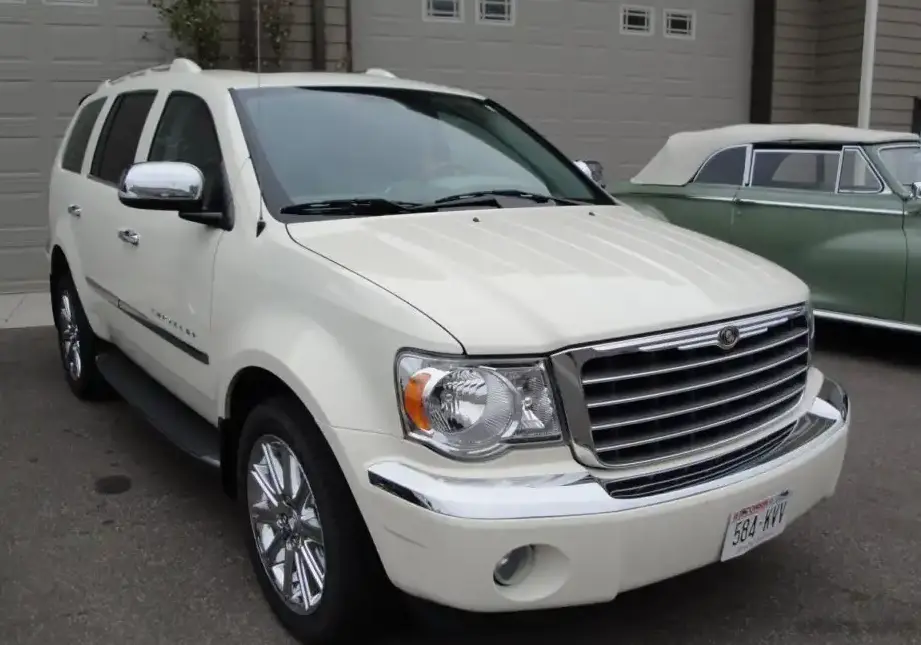
The Chrysler Aspen, produced for a brief period between 2006 and 2008, was a full-size SUV intended to fill a gap in Chrysler’s lineup above the Durango. Utilizing the same platform as the Dodge Durango, the Aspen aimed for a more premium experience, offering a more refined interior and a focus on comfort. The 4.7i V8 16V (235 Hp) 4WD Automatic variant represented a mid-range offering within the Aspen lineup, positioned between the base model and the more powerful 5.7L Hemi V8 option. It was designed to appeal to buyers needing substantial towing capacity and all-weather capability, but who didn’t necessarily require the highest levels of performance.
Technical Specifications
| Brand | Chrysler |
| Model | Aspen |
| Generation | Aspen |
| Type (Engine) | 4.7 i V8 16V (235 Hp) 4WD Automatic |
| Start of production | September, 2006 |
| End of production | 2008 |
| Powertrain Architecture | Internal Combustion engine |
| Body type | SUV |
| Seats | 8 |
| Doors | 5 |
| Fuel consumption (urban) | 16.8 l/100 km (14 US mpg, 16.8 UK mpg, 6 km/l) |
| Fuel consumption (extra urban) | 13.1 l/100 km (18 US mpg, 21.6 UK mpg, 7.6 km/l) |
| Fuel consumption (combined) | 15.7 l/100 km (15 US mpg, 18 UK mpg, 6.4 km/l) |
| Fuel Type | Petrol (Gasoline) |
| Maximum speed | 180 km/h (111.85 mph) |
| Weight-to-power ratio | 9.7 kg/Hp, 103.2 Hp/tonne |
| Weight-to-torque ratio | 5.8 kg/Nm, 172.6 Nm/tonne |
| Power | 235 Hp @ 4600 rpm |
| Power per litre | 50 Hp/l |
| Torque | 393 Nm @ 3600 rpm (289.86 lb.-ft. @ 3600 rpm) |
| Maximum engine speed | 6000 rpm |
| Engine layout | Front, Longitudinal |
| Engine Model/Code | EVA |
| Engine displacement | 4701 cm3 (286.87 cu. in.) |
| Number of cylinders | 8 |
| Engine configuration | V-engine |
| Cylinder Bore | 93 mm (3.66 in.) |
| Piston Stroke | 86.5 mm (3.41 in.) |
| Compression ratio | 9:1 |
| Number of valves per cylinder | 2 |
| Fuel injection system | Multi-port manifold injection |
| Engine aspiration | Naturally aspirated engine |
| Valvetrain | SOHC |
| Engine oil capacity | 5.7 l (6.02 US qt | 5.02 UK qt) |
| Coolant | 13.5 l (14.27 US qt | 11.88 UK qt) |
| Kerb Weight | 2277 kg (5019.93 lbs.) |
| Max. weight | 3039 kg (6699.85 lbs.) |
| Max load | 762 kg (1679.92 lbs.) |
| Trunk (boot) space – minimum | 538 l (19 cu. ft.) |
| Trunk (boot) space – maximum | 2900 l (102.41 cu. ft.) |
| Fuel tank capacity | 102 l (26.95 US gal | 22.44 UK gal) |
| Permitted trailer load with brakes (12%) | 2654 kg (5851.07 lbs.) |
| Length | 5101 mm (200.83 in.) |
| Width | 1930 mm (75.98 in.) |
| Height | 1887 mm (74.29 in.) |
| Wheelbase | 3027 mm (119.17 in.) |
| Front track | 1637 mm (64.45 in.) |
| Rear (Back) track | 1636 mm (64.41 in.) |
| Ride height (ground clearance) | 254 mm (10 in.) |
| Drag coefficient (Cd) | 0.391 |
| Minimum turning circle (turning diameter) | 12.2 m (40.03 ft.) |
| Drivetrain Architecture | The Internal combustion engine (ICE) drives the rear wheels permanently, and the front wheels are driven through an electrically or mechanically operated clutch if necessary. |
| Drive wheel | All wheel drive (4×4) |
| Number of gears and type of gearbox | 5 gears, automatic transmission |
| Front suspension | Independent torsion bar, double wishbone |
| Rear suspension | Coil spring, Elastic beam |
| Front brakes | Ventilated discs, 336×28 mm |
| Rear brakes | Disc, 352×22 mm |
| Assisting systems | ABS (Anti-lock braking system) |
| Steering type | Steering rack and pinion |
| Tires size | 245/70 R17; 265/60 R18 |
| Wheel rims size | 7.5J x 17; 8J x 18 |
Powertrain & Engine Architecture
The heart of this Aspen variant is the 4.7-liter V8 engine, internally designated as the EVA engine code. This engine is a member of Chrysler’s third-generation small-block V8 family. It features a cast iron block with aluminum cylinder heads, and a single overhead camshaft (SOHC) design operating two valves per cylinder. Fuel delivery is managed by a multi-port fuel injection system, providing adequate, though not cutting-edge, fuel atomization. The 4.7L V8 produces 235 horsepower at 4,600 rpm and 290 lb-ft of torque at 3,600 rpm. This power is then routed through a five-speed automatic transmission, a common choice for full-size SUVs prioritizing ease of use over outright performance. The transmission was tuned for smooth shifts and adequate acceleration, but wasn’t known for particularly quick response times.
Driving Characteristics
The 4.7L V8 and five-speed automatic combination in the Aspen delivered a comfortable, if not exhilarating, driving experience. Acceleration was adequate for merging onto highways and passing slower traffic, but it lacked the punch of the optional 5.7L Hemi. The automatic transmission’s gear ratios were optimized for cruising, resulting in relatively low engine speeds at highway speeds. However, this also meant that the engine could feel strained when climbing hills or towing heavy loads. Compared to manual transmission versions of the Durango (which shared the same engine), the Aspen 4.7 automatic felt noticeably less responsive. The all-wheel-drive system provided enhanced traction in inclement weather, making it a capable vehicle for year-round use.
Equipment & Trim Levels
The 4.7L Aspen typically came standard with features like tri-zone automatic climate control, a premium audio system, power-adjustable front seats, and leather upholstery. Safety features included ABS brakes, stability control, and multiple airbags. Optional extras included a rear-seat entertainment system, a navigation system, and upgraded wheels. The interior trim was generally well-appointed, aiming for a more luxurious feel than the Dodge Durango. However, the Aspen’s interior materials weren’t quite on par with more upscale competitors like the Cadillac Escalade or Lincoln Navigator.
Chassis & Braking
The Aspen’s chassis featured an independent torsion bar suspension in the front and a coil-spring elastic beam suspension in the rear. This setup provided a reasonably comfortable ride, but didn’t offer the same level of handling precision as more sophisticated suspension designs. The braking system consisted of ventilated discs up front and solid discs in the rear. ABS was standard, providing enhanced braking control in emergency situations. The Aspen’s relatively heavy weight (over 5,000 lbs) meant that braking distances were longer than those of lighter vehicles.
Market Reception & Comparison
The Chrysler Aspen received mixed reviews from automotive critics. While praised for its spacious interior and comfortable ride, it was often criticized for its unremarkable performance and relatively poor fuel economy (15 mpg combined). Compared to the Durango, the Aspen offered a more refined interior and a slightly more upscale image, but at a higher price point. The 5.7L Hemi V8 version of the Aspen was generally considered a better value for buyers prioritizing performance. Fuel economy was a significant drawback, especially compared to newer crossover SUVs that were gaining popularity at the time.
Legacy
The Chrysler Aspen was discontinued after only two model years due to slow sales. The 4.7L V8 engine, while generally reliable, is known to be susceptible to issues with the exhaust manifold bolts breaking, and oil leaks developing over time. The five-speed automatic transmission is also relatively durable, but can require servicing as it ages. Today, the Aspen 4.7L 4WD is a relatively affordable used SUV, but potential buyers should be aware of the potential maintenance issues associated with the engine and transmission. It remains a capable tow vehicle and a practical choice for families needing a large, eight-passenger SUV, but its fuel economy and overall refinement are dated by modern standards.
