
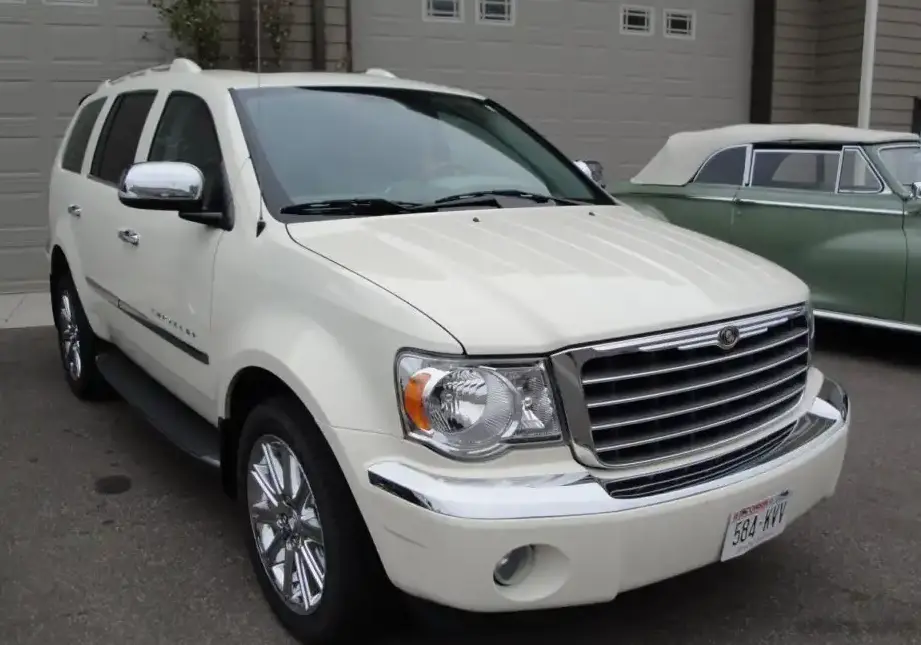
The Chrysler Aspen 5.7i V8 16V Hybrid 4WD EVT was a full-size SUV produced by Chrysler for the 2008 and 2009 model years. Positioned as a premium offering within the Chrysler lineup, the Aspen was based on the same platform as the Dodge Durango, but distinguished itself through more luxurious appointments and, in this specific configuration, a sophisticated full hybrid powertrain. This variant, combining a 5.7-liter HEMI V8 engine with an electric motor and a unique EVT (Electro-Variable Transmission), aimed to deliver both substantial power and improved fuel efficiency for a vehicle of its size. The Aspen was Chrysler’s attempt to compete directly with hybrid SUVs from General Motors and Toyota in the burgeoning hybrid market of the late 2000s.
Technical Specifications
| Brand | Chrysler |
| Model | Aspen |
| Generation | Aspen |
| Type (Engine) | 5.7 i V8 16V (385 Hp) Hybrid 4WD EVT |
| Start of production | 2008 |
| End of production | 2009 |
| Powertrain Architecture | FHEV (Full Hybrid Electric Vehicle) |
| Body type | SUV |
| Seats | 8 |
| Doors | 5 |
| Fuel consumption (urban) | 12.4 l/100 km (19 US mpg) |
| Fuel consumption (extra urban) | 11.8 l/100 km (19.9 US mpg) |
| Fuel Type | Petrol / electricity |
| Weight-to-power ratio | 6.6 kg/Hp |
| Weight-to-torque ratio | 5 kg/Nm |
| Electric motor power | 87 Hp |
| Electric motor Torque | 319 Nm (235.28 lb.-ft.) |
| Electric motor location | Integrated into the transmission |
| System power | 385 Hp |
| System torque | 515 Nm (379.84 lb.-ft.) |
| Power | 345 Hp @ 5300 rpm |
| Torque | 515 Nm @ 4200 rpm (379.84 lb.-ft. @ 4200 rpm) |
| Maximum engine speed | 5800 rpm |
| Engine layout | Front, Longitudinal |
| Engine Model/Code | EZH |
| Engine displacement | 5654 cm3 (345.03 cu. in.) |
| Number of cylinders | 8 |
| Engine configuration | V-engine |
| Cylinder Bore | 99.5 mm (3.92 in.) |
| Piston Stroke | 90.9 mm (3.58 in.) |
| Compression ratio | 10.5:1 |
| Number of valves per cylinder | 2 |
| Fuel injection system | Multi-port manifold injection |
| Valvetrain | OHV |
| Engine oil capacity | 6.6 l (6.97 US qt | 5.81 UK qt) |
| Coolant | 15.8 l (16.7 US qt | 13.9 UK qt) |
| Kerb Weight | 2557 kg (5637.22 lbs.) |
| Max. weight | 3198 kg (7050.38 lbs.) |
| Max load | 641 kg (1413.16 lbs.) |
| Trunk (boot) space – minimum | 569 l (20.09 cu. ft.) |
| Trunk (boot) space – maximum | 2900 l (102.41 cu. ft.) |
| Fuel tank capacity | 102 l (26.95 US gal | 22.44 UK gal) |
| Permitted trailer load with brakes (12%) | 2722 kg (6000.98 lbs.) |
| Length | 5132 mm (202.05 in.) |
| Width | 1929 mm (75.94 in.) |
| Height | 1869 mm (73.58 in.) |
| Wheelbase | 3027 mm (119.17 in.) |
| Front track | 1637 mm (64.45 in.) |
| Rear (Back) track | 1637 mm (64.45 in.) |
| Ride height (ground clearance) | 198 mm (7.8 in.) |
| Minimum turning circle (turning diameter) | 12.2 m (40.03 ft.) |
| Drivetrain Architecture | ICE and electric motor drive rear wheels, front wheels engaged via clutch |
| Drive wheel | All wheel drive (4×4) |
| Number of gears and type of gearbox | 4 gears, automatic transmission EVT |
| Front suspension | Independent torsion bar, double wishbone |
| Rear suspension | Coil spring, Elastic beam |
| Front brakes | Ventilated discs, 336×28 mm |
| Rear brakes | Disc, 352×22 mm |
| Assisting systems | ABS (Anti-lock braking system) |
| Steering type | Steering rack and pinion |
| Power steering | Electric Steering |
| Tires size | 265/60 R18 |
| Wheel rims size | 8J x 18 |
Powertrain & Engine Architecture
At the heart of the Aspen 5.7i Hybrid was the 5.7-liter HEMI V8 engine, designated the EZH code. This engine featured Chrysler’s Multi-Displacement System (MDS), which allowed it to deactivate four cylinders under light load conditions to improve fuel economy. The engine utilized a multi-port fuel injection system and an overhead valve (OHV) valvetrain. The hybrid system incorporated a 300-volt nickel-metal hydride battery pack and an 87-horsepower electric motor integrated into the EVT transmission. The EVT, developed by GM, wasn’t a traditional automatic transmission with fixed gears. Instead, it used a continuously variable ratio to optimize engine efficiency and provide smooth acceleration. The system allowed for electric-only operation at low speeds and assisted the V8 during acceleration, resulting in a combined system output of 385 horsepower and 515 lb-ft of torque.
Driving Characteristics
The 5.7i Hybrid Aspen offered a unique driving experience for a full-size SUV. The electric motor provided instant torque, enhancing low-speed responsiveness. While not as overtly sporty as some of its competitors, the Aspen delivered ample power for merging onto highways and towing. The EVT transmission, while smooth, could sometimes feel less engaging than a conventional automatic. The hybrid system did contribute to improved fuel economy compared to the non-hybrid Aspen, but the substantial weight of the vehicle still limited overall efficiency. The 4WD system provided confident traction in various weather conditions. The gear ratios were tuned for a balance between acceleration and fuel efficiency, prioritizing usability over outright performance.
Equipment & Trim Levels
The Aspen 5.7i Hybrid was typically well-equipped, reflecting its positioning as a premium model. Standard features included leather upholstery, heated front seats, a premium sound system, rear parking sensors, and automatic climate control. Optional extras included a navigation system, a rear-seat entertainment system, and power-adjustable pedals. The interior design was generally upscale, with woodgrain trim and a comfortable layout. The Aspen offered seating for up to eight passengers, with a spacious cabin and ample cargo space, especially with the rear seats folded down.
Chassis & Braking
The Aspen’s chassis featured an independent torsion bar suspension in the front and a coil spring elastic beam suspension in the rear. This setup provided a comfortable ride, although it wasn’t particularly sporty. The braking system consisted of ventilated discs in the front and solid discs in the rear. Anti-lock brakes (ABS) were standard. The steering was power-assisted, providing a light and easy feel. The Aspen’s substantial weight necessitated a robust braking system to ensure adequate stopping power.
Market Reception & Comparison
The Chrysler Aspen 5.7i Hybrid received mixed reviews from automotive critics. While praised for its spacious interior and comfortable ride, it was often criticized for its relatively low fuel economy compared to other hybrid SUVs, and the EVT transmission wasn’t universally liked. Compared to the standard Aspen models, the hybrid variant offered a slight improvement in fuel efficiency but came at a higher price. The Aspen competed with hybrid SUVs from General Motors (Chevrolet Tahoe Hybrid and GMC Yukon Hybrid) and Toyota (Highlander Hybrid), but it struggled to gain significant market share.
Legacy
The Chrysler Aspen was discontinued after only two model years, largely due to slow sales and the overall economic downturn of 2008-2009. The hybrid powertrain, while innovative for its time, proved to be complex and relatively expensive to maintain. Today, the Aspen 5.7i Hybrid is a relatively rare vehicle on the used car market. While the hybrid system can be prone to issues, the HEMI V8 engine is generally considered reliable. The Aspen represents a brief but interesting chapter in Chrysler’s history, showcasing the company’s attempt to embrace hybrid technology in the full-size SUV segment.
