
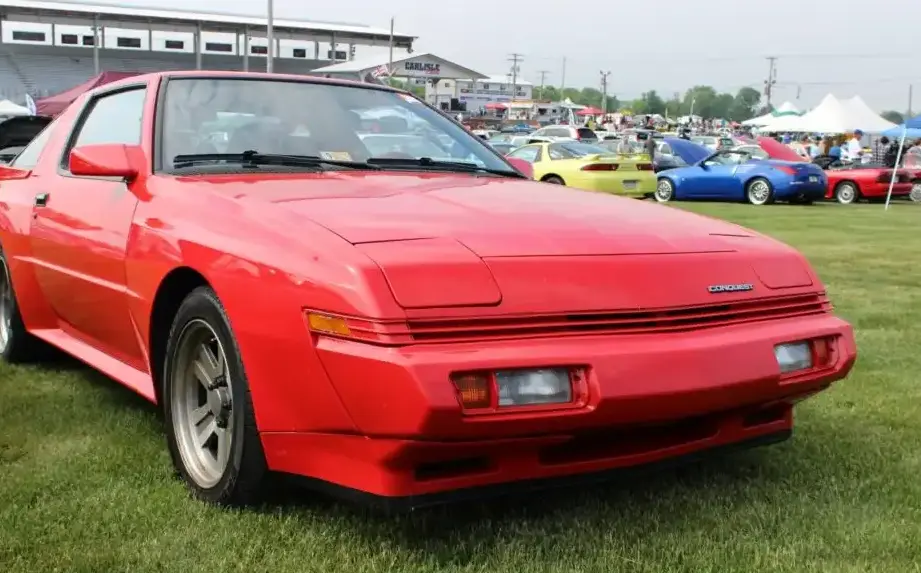
The Chrysler Conquest 2.6, produced between 1986 and 1989, marked Chrysler’s entry into the rear-wheel-drive sports coupe segment, primarily targeting North American enthusiasts. This model was essentially a rebadged version of the Mitsubishi Starion, a vehicle already recognized for its turbocharged engine and handling prowess. The Conquest 2.6, generating 176 horsepower, occupied a middle ground within the Conquest lineup, balancing affordability with performance. It sat above the base models and below the more potent versions that followed. The Conquest was exclusively sold in the North American market, providing an alternative to both domestic and Japanese sports coupes.
Technical Specifications
| Brand | Chrysler |
| Model | Conquest |
| Generation | Conquest |
| Type (Engine) | 2.6 (176 Hp) |
| Start of production | 1986 |
| End of production | 1989 |
| Powertrain Architecture | Internal Combustion engine |
| Body type | Coupe |
| Seats | 5 |
| Doors | 3 |
| Fuel Type | Petrol (Gasoline) |
| Power | 176 Hp @ 5000 rpm |
| Power per litre | 68.9 Hp/l |
| Torque | 302 Nm @ 2500 rpm |
| Torque (lb-ft) | 222.74 lb.-ft. @ 2500 rpm |
| Engine layout | Front, Longitudinal |
| Engine Model/Code | 4G54 |
| Engine displacement | 2555 cm3 |
| Engine displacement (cu. in.) | 155.92 cu. in. |
| Number of cylinders | 4 |
| Engine configuration | Inline |
| Cylinder Bore | 91.1 mm |
| Cylinder Bore (in.) | 3.59 in. |
| Piston Stroke | 98 mm |
| Piston Stroke (in.) | 3.86 in. |
| Compression ratio | 9.2:1 |
| Number of valves per cylinder | 2 |
| Fuel injection system | Dual-point throttle body fuel injection |
| Engine aspiration | Turbocharger, Intercooler |
| Valvetrain | SOHC |
| Engine oil capacity | 4.7 l |
| Engine oil capacity (US qt) | 4.97 US qt |
| Engine oil capacity (UK qt) | 4.14 UK qt |
| Coolant capacity | 9.1 l |
| Coolant capacity (US qt) | 9.62 US qt |
| Coolant capacity (UK qt) | 8.01 UK qt |
| Trunk (boot) space – minimum | 292 l |
| Trunk (boot) space – minimum (cu. ft.) | 10.31 cu. ft. |
| Trunk (boot) space – maximum | 510 l |
| Trunk (boot) space – maximum (cu. ft.) | 18.01 cu. ft. |
| Fuel tank capacity | 75 l |
| Fuel tank capacity (US gal) | 19.81 US gal |
| Fuel tank capacity (UK gal) | 16.5 UK gal |
| Length | 4399 mm |
| Length (in.) | 173.19 in. |
| Width | 1735 mm |
| Width (in.) | 68.31 in. |
| Height | 1275 mm |
| Height (in.) | 50.2 in. |
| Wheelbase | 2436 mm |
| Wheelbase (in.) | 95.91 in. |
| Front track | 1466 mm |
| Front track (in.) | 57.72 in. |
| Rear (Back) track | 1455 mm |
| Rear (Back) track (in.) | 57.28 in. |
| Ride height (ground clearance) | 114 mm |
| Ride height (ground clearance) (in.) | 4.49 in. |
| Drivetrain Architecture | Rear wheel drive |
| Drive wheel | Rear wheel drive |
| Number of gears | 5 |
| Gearbox type | Manual transmission |
| Front suspension | Independent, type McPherson with coil spring and anti-roll bar |
| Rear suspension | McPherson, Transverse stabilizer |
| Front brakes | Ventilated discs |
| Rear brakes | Ventilated discs |
| Assisting systems | ABS (Anti-lock braking system) |
| Steering type | Cone worm with recirculation balls |
| Power steering | Hydraulic Steering |
| Front tire size | 205/55 R16 |
| Rear tire size | 255/50 R16 |
| Front wheel rim size | 7J x 16 |
| Rear wheel rim size | 8J x 16 |
Powertrain & Engine Architecture
The Chrysler Conquest 2.6 was powered by the Mitsubishi 4G54 2.6-liter inline-four cylinder engine. This engine featured a cast iron block and an aluminum cylinder head, utilizing a single overhead camshaft (SOHC) valvetrain. A Garrett turbocharger, coupled with an intercooler, was central to its performance, significantly increasing power output. Fuel delivery was handled by a dual-point throttle body fuel injection system, a relatively straightforward system for the mid-1980s, but effective in providing sufficient fuel. The 4G54 engine had a compression ratio of 9.2:1. The engine was mounted longitudinally in the front of the vehicle, sending power to the rear wheels. A five-speed manual transmission was the sole transmission option for this variant, giving drivers complete control over the engine’s powerband.
Driving Characteristics
The Conquest 2.6 delivered a distinctly sporty driving experience. The turbocharged engine provided a noticeable power surge, especially in the mid-range, making it enjoyable for both city driving and highway cruising. While not as exceptionally fast as some competitors, the 176 horsepower and 222 lb-ft of torque offered ample acceleration. The rear-wheel-drive configuration contributed to a balanced feel, though the car could exhibit oversteer when pushed to its limits. The five-speed manual transmission allowed for precise gear selection, and the gear ratios were well-matched to the engine’s power delivery. Compared to the later, more powerful Conquest models, the 2.6 offered a more manageable and accessible driving experience, making it a suitable choice for drivers who desired performance without feeling overwhelmed.
Equipment & Trim Levels
The Conquest 2.6 typically came with a fairly standard set of features for a sports coupe of its time. The interior featured cloth upholstery, a basic stereo system, and manual windows and locks. Air conditioning was often included, but sometimes offered as an optional extra. The dashboard layout was functional and straightforward, with clearly visible gauges. Optional extras included a sunroof, upgraded stereo systems, and alloy wheels. The trim level was generally considered a step above the base models, offering a slightly more refined interior and a few additional convenience features.
Chassis & Braking
The Conquest 2.6 employed a McPherson strut suspension system at both the front and rear, providing a good compromise between ride comfort and handling. A front anti-roll bar helped minimize body roll during cornering. The braking system consisted of ventilated discs on all four wheels, providing adequate stopping power. An Anti-lock Braking System (ABS) was included as a standard safety feature. The chassis was relatively lightweight, contributing to the car’s nimble handling characteristics. The rear suspension incorporated a transverse stabilizer to further enhance stability.
Market Reception & Comparison
The Chrysler Conquest 2.6 was generally well-received by automotive critics, who praised its performance, handling, and styling. However, some reviewers noted that the interior was somewhat basic and lacked the refinement of some competitors. Compared to the higher-output Conquest models, the 2.6 offered a more affordable entry point into the rear-wheel-drive sports coupe market. It also delivered better fuel economy than the more powerful versions. Reliability was generally good, although the turbocharged engine required regular maintenance to maintain optimal performance. When compared to other coupes in its class, such as the Toyota Celica and Mazda RX-7, the Conquest 2.6 offered a unique combination of performance and value.
Legacy
The Chrysler Conquest 2.6, while not as widely recognized as some of its rivals, remains a popular choice among enthusiasts today. The 4G54 engine, while not renowned for exceptional durability, is relatively easy to maintain and rebuild. Parts availability is generally good, thanks to the shared components with the Mitsubishi Starion. Well-maintained examples of the Conquest 2.6 are becoming increasingly collectible, and the car is frequently seen at classic car shows and events. Its rear-wheel-drive layout and turbocharged engine continue to appeal to drivers who appreciate a classic sports car experience. The Conquest 2.6 represents a unique chapter in Chrysler’s history, demonstrating the company’s willingness to embrace performance and innovation.
