
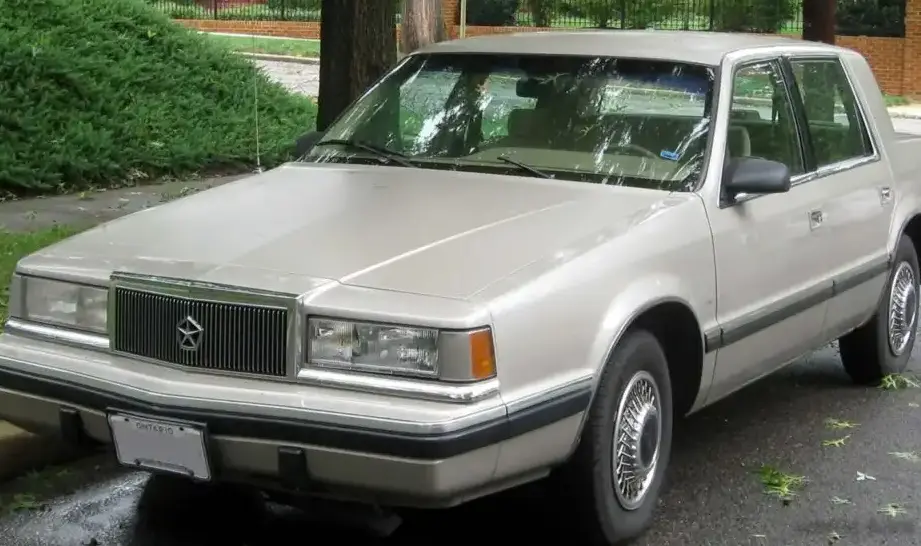
Technical Specifications
| Brand | Chrysler |
| Model | Dynasty |
| Generation | Dynasty |
| Engine Type | 3.3L V6 (163 Hp) |
| Production Years | 1988 – 1993 |
| Powertrain Architecture | Internal Combustion Engine |
| Body Type | Sedan |
| Seats | 5 |
| Doors | 4 |
| Fuel Type | Petrol (Gasoline) |
| Power | 163 Hp |
| Engine Aspiration | Naturally Aspirated |
| Length | 4877 mm (192.01 in) |
| Width | 1740 mm (68.5 in) |
| Height | 1359 mm (53.5 in) |
| Wheelbase | 2649 mm (104.29 in) |
| Drivetrain | Front Wheel Drive |
| Gearbox | 4-speed Automatic |
The Chrysler Dynasty 3.3L V6, manufactured between 1988 and 1993, marked Chrysler’s ambitious entry into the full-size sedan segment. Designed to challenge established American automakers like Ford and Chevrolet, the Dynasty aimed to provide a more comfortable and refined experience than its platform-mate, the Dodge Monaco. The 3.3L V6 engine, producing 163 horsepower, was the standard powerplant for the majority of the Dynasty’s production run, and was exclusively paired with a four-speed automatic transmission. This combination represented the core of the Dynasty lineup, offering a balance between acceptable performance and reasonable fuel efficiency for the late 1980s and early 1990s.
Powertrain & Engine Architecture
At the heart of the Dynasty 3.3L lay Chrysler’s 3.3-liter V6 engine, internally known as the 3.3L VG. This engine featured a 60-degree V6 configuration, utilizing a durable cast iron engine block and lightweight aluminum cylinder heads. The engine employed a single overhead camshaft (SOHC) design, operating two valves per cylinder. Fuel delivery was managed by a multi-port fuel injection (MPFI) system, which contributed to a relatively smooth and efficient combustion process for the era. The engine generated 163 horsepower at approximately 5200 rpm and 195 lb-ft of torque at 3200 rpm. While sufficient for moving the Dynasty’s considerable weight, it wasn’t engineered for particularly brisk acceleration. The recommended engine oil specification was 10W-30, meeting Chrysler’s MS-6395 standards.
The 3.3L V6 was exclusively mated to the Chrysler A727 four-speed automatic transmission. This transmission, a torque-converter automatic, was renowned for its robustness and smooth shifting characteristics. Although not technologically advanced by contemporary standards, the A727 proved to be a dependable unit that complemented the V6’s power delivery effectively. The transmission’s gear ratios were calibrated for comfortable cruising and adequate acceleration, prioritizing drivability over outright performance. The transmission’s shift points were designed to keep the engine within its optimal torque band for everyday driving conditions.
Driving Characteristics
The Dynasty 3.3L delivered a comfortable and isolated driving experience. The V6 engine provided enough power for typical daily driving, including highway merging and passing, but it lacked the strong acceleration offered by the larger V8 engines found in competing models. Acceleration from a standstill to 60 mph typically took around 9-10 seconds. The automatic transmission shifted smoothly, although it could exhibit some hesitation during quick downshifts. The front-wheel-drive layout contributed to predictable handling, but the Dynasty’s substantial weight (approximately 3,600 lbs) and soft suspension setup meant it wasn’t a particularly sporty vehicle. Steering was light and responsive, making it well-suited for navigating city streets.
Compared to the later 3.5-liter V6 option available on some Dynasty models, the 3.3L felt noticeably less responsive. The 3.5L engine provided a significant increase in both horsepower and torque, resulting in quicker acceleration and improved passing power. However, the 3.3L offered a slight advantage in fuel economy, achieving an EPA-estimated 18 mpg in city driving and 25 mpg on the highway. The 4-speed automatic transmission, while reliable, didn’t offer the responsiveness of more modern transmissions with additional gears.
Equipment & Trim Levels
The Dynasty 3.3L came standard with a respectable level of features for its price point. Standard equipment typically included air conditioning, power windows and door locks, a tilt steering wheel, and a basic AM/FM stereo system. Upholstery was generally cloth, although leather upholstery was offered as an optional upgrade. Higher trim levels, such as the LE, added features like upgraded sound systems, power-adjustable seats, and a sunroof. The dashboard layout was relatively straightforward, featuring clearly marked controls and a comprehensive instrument cluster. Optional extras included cruise control, a rear window defroster, and alloy wheels. The interior was designed with comfort and spaciousness in mind, reflecting the Dynasty’s positioning as a family sedan.
Chassis & Braking
The Dynasty utilized a traditional body-on-frame chassis construction, providing a comfortable ride but also contributing to its considerable weight. The front suspension consisted of independent upper and lower control arms, coil springs, and a stabilizer bar. The rear suspension employed a solid axle with leaf springs. Braking was provided by power-assisted disc brakes at the front and drum brakes at the rear. The braking system was adequate for normal driving conditions, but it lacked the stopping power of more advanced braking systems. The stabilizer bar thickness was moderate, contributing to the Dynasty’s comfortable but somewhat soft handling characteristics. The suspension was tuned for ride comfort rather than sporty handling.
Market Reception & Comparison
The Chrysler Dynasty 3.3L received mixed reviews from automotive journalists. While praised for its spacious interior, comfortable ride, and relatively affordable price, it was often criticized for its lack of performance and somewhat uninspired styling. Compared to the Dodge Monaco, the Dynasty was generally considered to be more refined and luxurious, but it also carried a slightly higher price tag. When compared to competitors like the Ford Crown Victoria and Chevrolet Caprice, the Dynasty offered a more modern design and a smoother ride, but it lacked the V8 engine options that many buyers in that segment desired. Fuel economy was considered competitive for a full-size sedan of its time. The Dynasty aimed to appeal to buyers seeking a comfortable and reliable family sedan, but it struggled to gain significant market share against more established competitors.
Legacy
The Chrysler Dynasty, and specifically the 3.3L V6/automatic combination, has become a relatively affordable and reliable classic car in the used car market. The 3.3L V6 engine is known for its durability, and with proper maintenance, it can provide many years of dependable service. While not a performance-oriented vehicle, the Dynasty remains a comfortable and spacious cruiser, appealing to enthusiasts seeking a classic American sedan. Parts availability is generally good, although some trim-specific components may be challenging to locate. The Dynasty represents a transitional period in Chrysler’s history, bridging the gap between traditional body-on-frame construction and more modern unibody designs. It remains a testament to Chrysler’s attempt to compete in the full-size sedan market with a focus on comfort and refinement.
