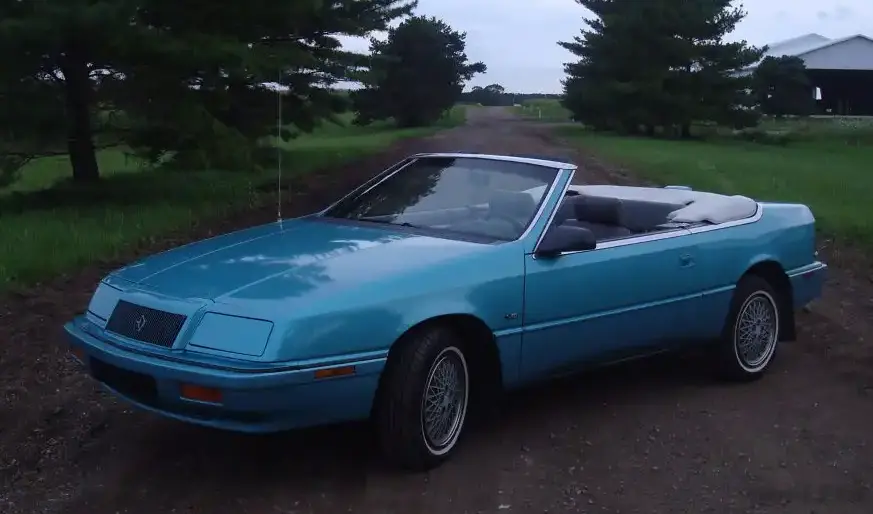
The Chrysler LeBaron 2.5i Turbo, produced between 1989 and 1994, represented a performance-oriented variant within the second generation of the LeBaron (1987-1995). Positioned as a step up from the naturally aspirated 2.5-liter engine, the turbocharger significantly boosted power output, appealing to drivers seeking a more engaging driving experience. This model year fell within the broader Chrysler J-body platform, shared with the Dodge Spirit and Plymouth Acclaim, but the LeBaron aimed for a slightly more upscale and sporty image. The 2.5i Turbo was offered primarily as a coupe and sedan, offering a blend of comfort and performance that was relatively uncommon in the American market at the time.
Technical Specifications
| Brand | Chrysler |
| Model | Le Baron |
| Generation | Le Baron |
| Type (Engine) | 2.5 i Turbo (152 Hp) |
| Start of production | 1989 year |
| End of production | 1994 year |
| Powertrain Architecture | Internal Combustion engine |
| Body type | Sedan |
| Seats | 5 |
| Doors | 4 |
| Fuel consumption (economy) – urban | 13.9 l/100 km (16.9 US mpg, 20.3 UK mpg, 7.2 km/l) |
| Fuel consumption (economy) – extra urban | 6.8 l/100 km (34.6 US mpg, 41.5 UK mpg, 14.7 km/l) |
| Fuel consumption (economy) – combined | 9 l/100 km (26.1 US mpg, 31.4 UK mpg, 11.1 km/l) |
| Fuel Type | Petrol (Gasoline) |
| Acceleration 0 – 100 km/h | 8.7 sec |
| Acceleration 0 – 62 mph | 8.7 sec |
| Acceleration 0 – 60 mph | 8.3 sec |
| Maximum speed | 193 km/h (119.92 mph) |
| Weight-to-power ratio | 8.7 kg/Hp, 115.6 Hp/tonne |
| Weight-to-torque ratio | 5.4 kg/Nm, 185.6 Nm/tonne |
| Power | 152 Hp @ 4800 rpm |
| Power per litre | 60.8 Hp/l |
| Torque | 244 Nm @ 2000 rpm (179.97 lb.-ft. @ 2000 rpm) |
| Engine layout | Front, Transverse |
| Engine displacement | 2501 cm3 (152.62 cu. in.) |
| Number of cylinders | 4 |
| Engine configuration | Inline |
| Cylinder Bore | 87.5 mm (3.44 in.) |
| Piston Stroke | 104 mm (4.09 in.) |
| Compression ratio | 7.8:1 |
| Number of valves per cylinder | 2 |
| Fuel injection system | Multi-port manifold injection |
| Engine aspiration | Turbocharger |
| Valvetrain | OHC |
| Engine oil capacity | 4.4 l (4.65 US qt | 3.87 UK qt) |
| Coolant | 8.5 l (8.98 US qt | 7.48 UK qt) |
| Kerb Weight | 1315 kg (2899.08 lbs.) |
| Trunk (boot) space – minimum | 410 l (14.48 cu. ft.) |
| Fuel tank capacity | 61 l (16.11 US gal | 13.42 UK gal) |
| Length | 4640 mm (182.68 in.) |
| Width | 1730 mm (68.11 in.) |
| Height | 1365 mm (53.74 in.) |
| Wheelbase | 2630 mm (103.54 in.) |
| Front track | 1465 mm (57.68 in.) |
| Rear (Back) track | 1455 mm (57.28 in.) |
| Drivetrain Architecture | The Internal combustion engine (ICE) drives the front wheels of the vehicle. |
| Drive wheel | Front wheel drive |
| Number of gears and type of gearbox | 5 gears, manual transmission |
| Front suspension | Coil spring |
| Rear suspension | Coil spring |
| Front brakes | Ventilated discs |
| Rear brakes | Disc |
| Assisting systems | ABS (Anti-lock braking system) |
| Steering type | Steering rack and pinion |
| Power steering | Hydraulic Steering |
| Tires size | 195/70 R14 |
Powertrain & Engine Architecture
The heart of the LeBaron 2.5i Turbo was the Chrysler 2.5-liter inline-four cylinder engine, designated with engine codes such as 525. This engine featured a single overhead camshaft (OHC) design and multi-port fuel injection. The addition of a Garrett turbocharger, along with an intercooler, significantly increased the engine’s output compared to the naturally aspirated versions. The turbocharger boosted horsepower to 152 hp at 4800 rpm and torque to 244 Nm (179.97 lb-ft) at 2000 rpm. The engine utilized a relatively low 7.8:1 compression ratio, typical for turbocharged engines to prevent pre-ignition. The 5-speed manual transmission was standard, providing drivers with full control over the engine’s power. While an automatic transmission was offered, it was generally considered to detract from the sporty nature of the Turbo model.
Driving Characteristics
The 2.5i Turbo offered a noticeable performance improvement over the base LeBaron models. Acceleration to 60 mph was achieved in approximately 8.3 seconds, and the car could reach a top speed of around 119.92 mph. The turbocharger provided a distinct surge of power, particularly in the mid-range, making overtaking maneuvers easier. However, the engine did exhibit some turbo lag, a common characteristic of early turbocharger systems. The manual transmission allowed for precise gear selection, maximizing the engine’s potential. The front-wheel-drive configuration provided decent handling, although it wasn’t as balanced as a rear-wheel-drive setup. Compared to the naturally aspirated versions, the Turbo model felt significantly more responsive and engaging to drive.
Equipment & Trim Levels
The LeBaron 2.5i Turbo typically came with a more comprehensive list of standard features than the base models. These included power windows, power locks, air conditioning, and a premium sound system. Interior upholstery was often upgraded to include cloth or leather seating. Optional extras included a sunroof, upgraded stereo systems, and alloy wheels. The dashboard layout was typical of the late 1980s/early 1990s, featuring analog gauges and a relatively simple design. The Turbo model often received unique badging and exterior trim to distinguish it from other LeBaron variants.
Chassis & Braking
The LeBaron 2.5i Turbo utilized a coil spring suspension system at both the front and rear. The front suspension featured independent coil springs, while the rear suspension was a semi-independent twist beam setup. Brakes consisted of ventilated discs at the front and solid discs at the rear. An anti-lock braking system (ABS) was standard, enhancing safety and control. The steering system was a rack-and-pinion setup with hydraulic power assistance. The tires were typically 195/70 R14, providing a balance of comfort and grip.
Market Reception & Comparison
The LeBaron 2.5i Turbo was generally well-received by automotive critics, who praised its performance and value. It offered a compelling alternative to more expensive European sports sedans. However, some critics noted the turbo lag and the somewhat basic interior compared to its rivals. Compared to the naturally aspirated LeBaron models, the Turbo offered significantly more power and a more engaging driving experience, but at a higher price point. The 2.5i Turbo was also positioned below the more luxurious Chrysler Fifth Avenue in the Chrysler lineup.
Legacy
The Chrysler LeBaron 2.5i Turbo remains a popular choice among enthusiasts today. The 2.5-liter turbo engine, while not without its quirks, is known for its durability and potential for modification. Parts availability is generally good, although some specific turbocharger components can be difficult to find. The LeBaron 2.5i Turbo represents a unique chapter in Chrysler’s history, offering a blend of American comfort and European-inspired performance. Well-maintained examples are increasingly sought after by collectors and enthusiasts who appreciate its distinctive character and driving dynamics.