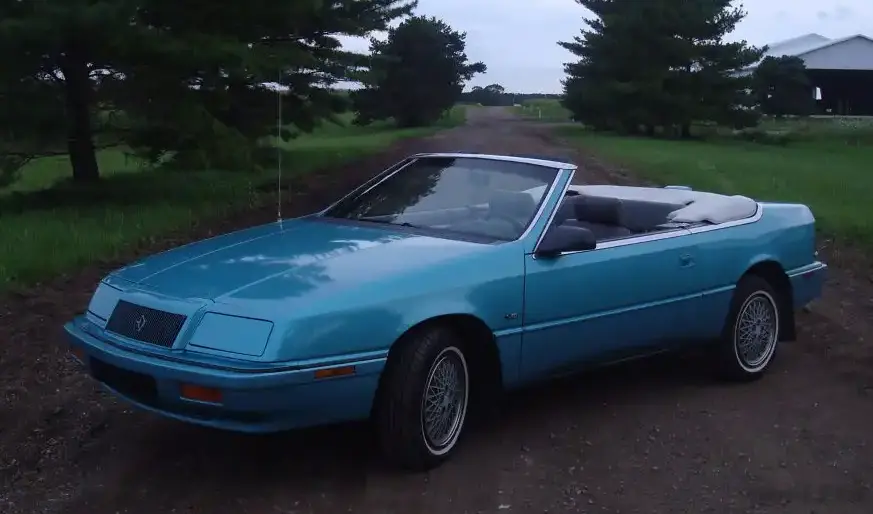
The Chrysler Le Baron 2.5i Turbo Automatic, produced between 1989 and 1994, represented a performance-oriented variant within the second generation of the Le Baron (1987-1995). Positioned as a step up from the naturally aspirated models, the 2.5i Turbo aimed to deliver a more engaging driving experience while maintaining the Le Baron’s reputation for comfortable, American-style motoring. This model year falls within the broader ‘AA’ body platform shared with the Dodge Spirit and Plymouth Acclaim, representing Chrysler’s attempt to offer a competitive mid-size sedan. The inclusion of a turbocharger and automatic transmission distinguished it from the base models and provided a unique offering in the segment.
Technical Specifications
| Brand | Chrysler |
| Model | Le Baron |
| Generation | Le Baron |
| Type (Engine) | 2.5 i Turbo (152 Hp) Automatic |
| Start of production | 1989 |
| End of production | 1994 |
| Powertrain Architecture | Internal Combustion engine |
| Body type | Sedan |
| Seats | 5 |
| Doors | 4 |
| Fuel consumption (urban) | 13.9 l/100 km (16.9 US mpg) |
| Fuel consumption (extra urban) | 6.8 l/100 km (34.6 US mpg) |
| Fuel consumption (combined) | 9 l/100 km (26.1 US mpg) |
| Fuel Type | Petrol (Gasoline) |
| Acceleration 0 – 100 km/h | 8.7 sec |
| Acceleration 0 – 62 mph | 8.7 sec |
| Acceleration 0 – 60 mph | 8.3 sec |
| Maximum speed | 193 km/h (119.92 mph) |
| Weight-to-power ratio | 8.7 kg/Hp |
| Weight-to-torque ratio | 5.4 kg/Nm |
| Power | 152 Hp @ 4800 rpm |
| Power per litre | 60.8 Hp/l |
| Torque | 244 Nm @ 2000 rpm (179.97 lb.-ft. @ 2000 rpm) |
| Engine layout | Front, Transverse |
| Engine displacement | 2501 cm3 (152.62 cu. in.) |
| Number of cylinders | 4 |
| Engine configuration | Inline |
| Cylinder Bore | 87.5 mm (3.44 in.) |
| Piston Stroke | 104 mm (4.09 in.) |
| Compression ratio | 7.8:1 |
| Number of valves per cylinder | 2 |
| Fuel injection system | Multi-port manifold injection |
| Engine aspiration | Turbocharger |
| Valvetrain | OHC |
| Engine oil capacity | 4.4 l (4.65 US qt | 3.87 UK qt) |
| Coolant | 8.5 l (8.98 US qt | 7.48 UK qt) |
| Kerb Weight | 1315 kg (2899.08 lbs.) |
| Trunk (boot) space – minimum | 410 l (14.48 cu. ft.) |
| Fuel tank capacity | 61 l (16.11 US gal | 13.42 UK gal) |
| Length | 4640 mm (182.68 in.) |
| Width | 1730 mm (68.11 in.) |
| Height | 1365 mm (53.74 in.) |
| Wheelbase | 2630 mm (103.54 in.) |
| Front track | 1465 mm (57.68 in.) |
| Rear (Back) track | 1455 mm (57.28 in.) |
| Drivetrain Architecture | The Internal combustion engine (ICE) drives the front wheels of the vehicle. |
| Drive wheel | Front wheel drive |
| Number of gears and type of gearbox | 3 gears, automatic transmission |
| Front suspension | Coil spring |
| Rear suspension | Coil spring |
| Front brakes | Ventilated discs |
| Rear brakes | Disc |
| Assisting systems | ABS (Anti-lock braking system) |
| Steering type | Steering rack and pinion |
| Power steering | Hydraulic Steering |
| Tires size | 195/70 R14 |
Powertrain & Engine Architecture
The heart of the Le Baron 2.5i Turbo was the Chrysler 2.5-liter inline-four cylinder engine, internally designated as the 525 engine family. This engine featured a single overhead camshaft (OHC) design and a turbocharger, significantly boosting its output compared to the naturally aspirated 2.5L engines available in other Le Baron trims. The turbocharger was a Garrett T25 unit, providing approximately 8-10 psi of boost. Fuel delivery was managed by a multi-port fuel injection system, contributing to improved efficiency and responsiveness. The engine’s 7.8:1 compression ratio was a compromise between performance and reliability when used with a turbocharger. The automatic transmission was a Chrysler A727 Torqueflite three-speed unit, known for its durability but relatively simple design. This transmission was a common choice for Chrysler vehicles of the era, prioritizing smooth operation over outright performance.
Driving Characteristics
The 2.5i Turbo offered a noticeable improvement in acceleration compared to the base Le Baron models. The 0-60 mph time of around 8.3 seconds was respectable for the early 1990s, and the turbocharger provided a surge of power during acceleration. However, the three-speed automatic transmission limited the engine’s potential, and the gear ratios weren’t optimized for maximizing performance. Turbo lag was present, but manageable, and the engine delivered a usable amount of torque at lower RPMs. The front-wheel-drive configuration provided adequate traction in most conditions, but could exhibit torque steer under hard acceleration. Overall, the driving experience was comfortable and refined, typical of a Chrysler sedan, but with a welcome dose of extra power.
Equipment & Trim Levels
The 2.5i Turbo typically came with a fairly comprehensive list of standard features. These included power windows, power locks, air conditioning, and an upgraded sound system. Interior upholstery was usually cloth, with options for leather available. The dashboard featured a straightforward layout with analog gauges. Optional extras included a sunroof, upgraded stereo systems, and alloy wheels. The trim level generally sat in the mid-range of the Le Baron lineup, offering a balance of features and performance without the full luxury appointments of the higher-end models.
Chassis & Braking
The Le Baron 2.5i Turbo utilized a relatively conventional chassis design. Front suspension consisted of coil springs and a stabilizer bar, while the rear suspension also employed coil springs. Brakes were ventilated discs at the front and solid discs at the rear, providing adequate stopping power for the vehicle’s weight and performance. An anti-lock braking system (ABS) was standard, enhancing safety. The steering was a rack-and-pinion system with hydraulic power assistance, offering a reasonable level of responsiveness.
Market Reception & Comparison
The Le Baron 2.5i Turbo received mixed reviews from automotive critics. While the added performance was appreciated, some reviewers found the three-speed automatic transmission to be a limiting factor. Fuel economy was also a concern, with combined figures around 26.1 US mpg. Compared to other trims, the 2.5i Turbo offered a more engaging driving experience but at the cost of slightly lower fuel efficiency. The naturally aspirated models were more affordable and fuel-efficient, while the higher-end trims offered more luxurious features. The 2.5i Turbo occupied a niche position, appealing to drivers who wanted a bit more performance without sacrificing comfort.
Legacy
The Chrysler Le Baron 2.5i Turbo Automatic, while not a groundbreaking vehicle, holds a certain appeal for enthusiasts today. The 525 engine, when properly maintained, is known for its durability. However, turbocharger failures and issues with the automatic transmission are common concerns for used examples. Parts availability can be challenging, but not insurmountable. The Le Baron 2.5i Turbo represents a unique chapter in Chrysler’s history, offering a glimpse of the company’s attempt to blend performance and practicality in a mid-size sedan. It remains a relatively affordable classic car, offering a distinctive driving experience for those willing to invest in its upkeep.