Technical Specifications
| Brand | Chrysler |
| Model | LeBaron |
| Generation | LeBaron Cabrio |
| Type (Engine) | 3.0 i V6 (143 Hp) Automatic |
| Start of production | 1990 year |
| End of production | 1996 year |
| Powertrain Architecture | Internal Combustion engine |
| Body type | Cabriolet |
| Seats | 4 |
| Doors | 2 |
| Fuel consumption (urban) | 14 l/100 km (16.8 US mpg, 20.2 UK mpg, 7.1 km/l) |
| Fuel consumption (extra urban) | 6.9 l/100 km (34.1 US mpg, 40.9 UK mpg, 14.5 km/l) |
| Fuel consumption (combined) | 8.9 l/100 km (26.4 US mpg, 31.7 UK mpg, 11.2 km/l) |
| Fuel Type | Petrol (Gasoline) |
| Acceleration 0 – 100 km/h | 11.1 sec |
| Acceleration 0 – 62 mph | 11.1 sec |
| Acceleration 0 – 60 mph | 10.5 sec |
| Maximum speed | 182 km/h (113.09 mph) |
| Weight-to-power ratio | 10.1 kg/Hp, 98.8 Hp/tonne |
| Weight-to-torque ratio | 6.2 kg/Nm, 160.3 Nm/tonne |
| Power | 143 Hp @ 5000 rpm |
| Power per litre | 48.1 Hp/l |
| Torque | 232 Nm @ 2800 rpm (171.11 lb.-ft. @ 2800 rpm) |
| Engine layout | Front, Transverse |
| Engine Model/Code | 6G72 |
| Engine displacement | 2972 cm3 (181.36 cu. in.) |
| Number of cylinders | 6 |
| Engine configuration | V-engine |
| Cylinder Bore | 91.1 mm (3.59 in.) |
| Piston Stroke | 76 mm (2.99 in.) |
| Compression ratio | 8.9:1 |
| Number of valves per cylinder | 2 |
| Fuel injection system | Multi-port manifold injection |
| Engine aspiration | Naturally aspirated engine |
| Valvetrain | OHC |
| Engine oil capacity | 4.5 l (4.76 US qt | 3.96 UK qt) |
| Coolant | 9.1 l (9.62 US qt | 8.01 UK qt) |
| Kerb Weight | 1447 kg (3190.09 lbs.) |
| Max. weight | 1840 kg (4056.51 lbs.) |
| Max load | 393 kg (866.42 lbs.) |
| Trunk (boot) space – minimum | 292 l (10.31 cu. ft.) |
| Fuel tank capacity | 53 l (14 US gal | 11.66 UK gal) |
| Length | 4694 mm (184.8 in.) |
| Width | 1757 mm (69.17 in.) |
| Height | 1331 mm (52.4 in.) |
| Wheelbase | 2554 mm (100.55 in.) |
| Front track | 1464 mm (57.64 in.) |
| Rear (Back) track | 1464 mm (57.64 in.) |
| Drivetrain Architecture | The Internal combustion engine (ICE) drives the front wheels of the vehicle. |
| Drive wheel | Front wheel drive |
| Number of gears and type of gearbox | 4 gears, automatic transmission |
| Front suspension | Double wishbone |
| Rear suspension | Coil spring |
| Front brakes | Ventilated discs |
| Rear brakes | Disc |
| Assisting systems | ABS (Anti-lock braking system) |
| Steering type | Steering rack and pinion |
| Power steering | Hydraulic Steering |
| Tires size | 205/60 R15 |
| Wheel rims size | 15 |
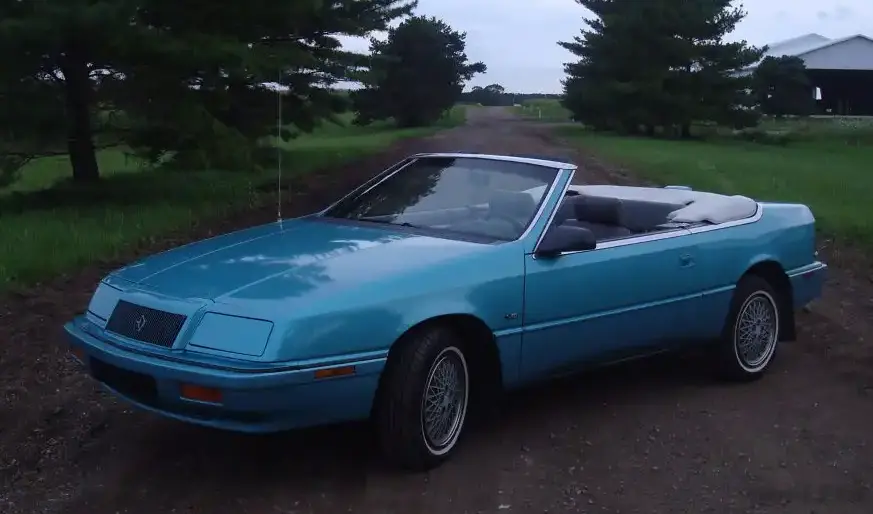
The Chrysler LeBaron Cabrio 3.0i V6, produced between 1990 and 1996, was a popular choice in the American convertible market. Positioned as a relatively affordable luxury option, it was part of the second generation (1987-1995) of the LeBaron, which saw the introduction of a dedicated convertible model. This variant, equipped with the 3.0-liter V6 engine and a four-speed automatic transmission, aimed to provide a balance of performance and convenience for buyers seeking an open-air driving experience. It occupied a mid-range position within the LeBaron Cabrio lineup, offering more power than the base four-cylinder models but falling short of the performance potential of later, turbocharged variants.
Powertrain & Engine Architecture
The heart of this LeBaron Cabrio variant is the Chrysler 6G72 3.0-liter V6 engine. This engine, a member of the Chrysler’s V6 family, featured a 60-degree V-angle and utilized a single overhead camshaft (OHC) design with two valves per cylinder. The 6G72 employed multi-port fuel injection, delivering fuel directly to each intake port for improved efficiency and responsiveness. The engine’s 8.9:1 compression ratio was a compromise between performance and the ability to run on readily available 87-octane gasoline. Paired with this engine was a four-speed automatic transmission, providing smooth shifts and ease of use, particularly appealing to the target demographic. This transmission, while reliable, wasn’t known for particularly quick shifts or sporty performance. It was a common A727-derived unit, known for its durability but not its sophistication.
Driving Characteristics
The 143 horsepower and 171 lb-ft of torque produced by the 3.0L V6 and automatic transmission combination resulted in adequate, but not exhilarating, performance. Acceleration from 0-60 mph took around 10.5 seconds, and top speed was approximately 113 mph. The automatic transmission’s gear ratios were geared towards comfortable cruising rather than aggressive acceleration. Compared to the manual transmission versions of the same engine, the automatic resulted in a noticeable decrease in responsiveness. The LeBaron Cabrio 3.0i offered a relaxed driving experience, well-suited for leisurely drives with the top down. It wasn’t a sports car, but provided sufficient power for everyday driving and highway merging. The automatic transmission, while smooth, did contribute to a slight feeling of sluggishness, especially when attempting quicker maneuvers.
Equipment & Trim Levels
The 3.0i V6 Automatic LeBaron Cabrio typically included features such as power windows, power locks, air conditioning, and a basic sound system. Upholstery was generally cloth, though leather options were available. Dashboard configuration was fairly standard for the era, with analog gauges and a simple layout. Optional extras included a premium sound system, upgraded leather upholstery, and a power-operated convertible top. The trim level often dictated the availability of these options, with higher trims offering more standard features. The “Highline” trim, for example, often included leather seating and a more comprehensive sound system as standard equipment.
Chassis & Braking
The LeBaron Cabrio utilized a front-wheel-drive layout with a double wishbone suspension in the front and a coil spring suspension in the rear. Front brakes were ventilated discs, providing adequate stopping power, while rear brakes were solid discs. Hydraulic power steering was standard, making maneuvering easy. The suspension was tuned for comfort, prioritizing a smooth ride over sharp handling. The car’s weight, around 3190 pounds, contributed to its relatively soft ride quality. Stabilizer bars were present, but relatively thin, further emphasizing the comfort-oriented suspension tuning.
Market Reception & Comparison
The LeBaron Cabrio 3.0i V6 Automatic was generally well-received as an affordable and stylish convertible. Critics praised its comfortable ride and ease of use, but noted that its performance was not particularly exciting. Compared to the four-cylinder models, the 3.0i offered a significant power upgrade, but fuel economy suffered slightly. Compared to the later turbocharged variants, the 3.0i lacked the same level of performance and responsiveness. Reliability was generally good, though the automatic transmission could occasionally require maintenance. Some reviewers also pointed out the relatively basic interior compared to more expensive European convertibles.
Legacy
The Chrysler LeBaron Cabrio 3.0i V6 Automatic remains a popular choice among classic car enthusiasts seeking an affordable and enjoyable convertible. The 6G72 engine is known for its durability, and parts availability is generally good. However, like many cars of this era, rust can be a concern, particularly in areas with harsh winters. Today, these cars are often found in good condition, offering a nostalgic driving experience and a relatively low cost of ownership. The combination of a V6 engine and automatic transmission makes it an accessible classic for those who prefer a more relaxed driving style. While not a collector’s item in the same vein as some more exotic convertibles, the LeBaron Cabrio 3.0i represents a significant piece of American automotive history, offering a taste of open-air motoring from the early 1990s.