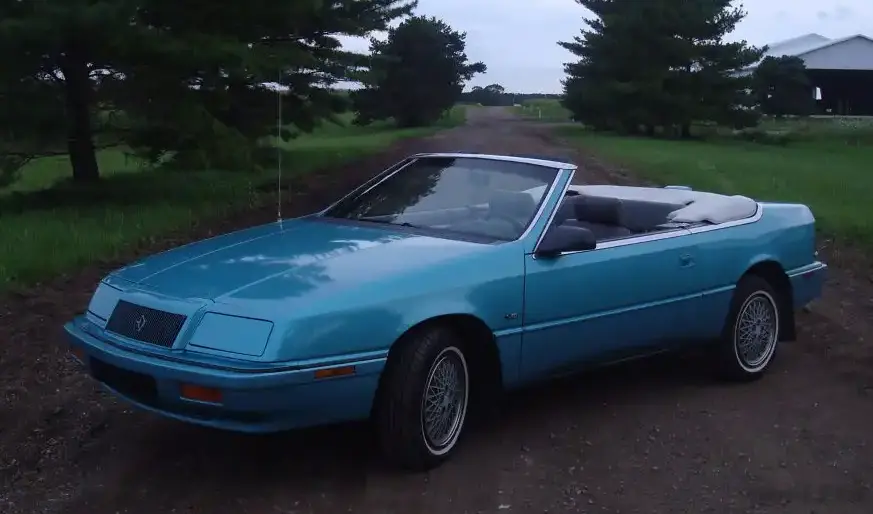
The Chrysler LeBaron Coupe 2.5i Turbo, produced between 1989 and 1994, represented a performance-oriented variant within the second generation of the LeBaron (1987-1995). Positioned as a step up from the naturally aspirated models, the 2.5i Turbo offered a significant boost in power and a more engaging driving experience. This coupe, built on the Chrysler J-body platform, aimed to attract buyers seeking a stylish and relatively affordable personal luxury car with a touch of sporting character. It was primarily marketed in North America, offering a domestic alternative to imported coupes.
Technical Specifications
| Brand | Chrysler |
| Model | LE Baron |
| Generation | LE Baron Coupe |
| Type (Engine) | 2.5 i Turbo (155 Hp) Automatic 4-speed |
| Start of production | 1989 year |
| End of production | 1994 year |
| Powertrain Architecture | Internal Combustion engine |
| Body type | Coupe |
| Seats | 5 |
| Doors | 2 |
| Fuel consumption (urban) | 13.1 l/100 km (18 US mpg, 21.6 UK mpg, 7.6 km/l) |
| Fuel consumption (extra urban) | 10.2 l/100 km (23.1 US mpg, 27.7 UK mpg, 9.8 km/l) |
| Fuel consumption (combined) | 11.8 l/100 km (19.9 US mpg, 23.9 UK mpg, 8.5 km/l) |
| Fuel Type | Petrol (Gasoline) |
| Acceleration 0 – 100 km/h | 8.5 sec |
| Acceleration 0 – 62 mph | 8.5 sec |
| Acceleration 0 – 60 mph | 8.1 sec |
| Maximum speed | 202 km/h (125.52 mph) |
| Weight-to-power ratio | 8.9 kg/Hp, 112.7 Hp/tonne |
| Weight-to-torque ratio | 4.8 kg/Nm, 206.5 Nm/tonne |
| Power | 155 Hp @ 4800 rpm |
| Power per litre | 62 Hp/l |
| Torque | 284 Nm @ 2400 rpm (209.47 lb.-ft. @ 2400 rpm) |
| Engine layout | Front, Transverse |
| Engine displacement | 2501 cm3 (152.62 cu. in.) |
| Number of cylinders | 4 |
| Engine configuration | Inline |
| Cylinder Bore | 87.5 mm (3.44 in.) |
| Piston Stroke | 104 mm (4.09 in.) |
| Compression ratio | 7.8:1 |
| Number of valves per cylinder | 2 |
| Fuel injection system | Multi-port manifold injection |
| Engine aspiration | Turbocharger |
| Valvetrain | OHC |
| Engine oil capacity | 4.4 l (4.65 US qt | 3.87 UK qt) |
| Coolant capacity | 8.5 l (8.98 US qt | 7.48 UK qt) |
| Kerb Weight | 1375 kg (3031.36 lbs.) |
| Max. weight | 1840 kg (4056.51 lbs.) |
| Max load | 465 kg (1025.15 lbs.) |
| Trunk (boot) space – minimum | 395 l (13.95 cu. ft.) |
| Fuel tank capacity | 53 l (14 US gal | 11.66 UK gal) |
| Length | 4695 mm (184.84 in.) |
| Width | 1740 mm (68.5 in.) |
| Height | 1300 mm (51.18 in.) |
| Wheelbase | 2550 mm (100.39 in.) |
| Front track | 1460 mm (57.48 in.) |
| Rear (Back) track | 1460 mm (57.48 in.) |
| Drivetrain Architecture | The Internal combustion engine (ICE) drives the front wheels of the vehicle. |
| Drive wheel | Front wheel drive |
| Number of gears and type of gearbox | 4 gears, automatic transmission |
| Front suspension | Coil spring |
| Rear suspension | Coil spring |
| Front brakes | Ventilated discs |
| Rear brakes | Disc |
| Assisting systems | ABS (Anti-lock braking system) |
| Steering type | Steering rack and pinion |
| Power steering | Hydraulic Steering |
| Tires size | 195/70 R13 |
| Wheel rims size | 13 |
Powertrain & Engine Architecture
The heart of the LeBaron Coupe 2.5i Turbo was the Chrysler 2.5-liter inline-four cylinder engine. Internally designated as the 525 engine family, this powerplant featured a cast iron block and an aluminum cylinder head. The turbocharger, a Garrett T25, significantly increased the engine’s output compared to the naturally aspirated 2.5-liter versions. Fuel delivery was handled by a multi-port fuel injection system, providing precise fuel metering for optimal performance and efficiency. The engine utilized a single overhead camshaft (OHC) design with two valves per cylinder. The automatic transmission was a Chrysler-built A727 Torqueflite three-speed automatic, known for its durability, though not its efficiency by modern standards. This transmission was chosen for its ability to handle the increased torque produced by the turbocharger.
Driving Characteristics
The 155 horsepower and 209 lb-ft of torque provided by the 2.5i Turbo engine gave the LeBaron Coupe a noticeable performance advantage over its base-model counterparts. Acceleration to 60 mph was achieved in approximately 8.1 seconds, making it a reasonably quick vehicle for its time. The automatic transmission, while reliable, did result in some power loss compared to the available five-speed manual. The gear ratios were optimized for acceleration, but the three-speed design meant that highway cruising could be somewhat noisy and less fuel-efficient. The turbocharger provided a distinct boost in power during acceleration, but turbo lag was present, requiring drivers to anticipate their throttle inputs. Handling was adequate, but the LeBaron Coupe was not designed as a sports car. The front-wheel-drive layout offered predictable handling characteristics, but understeer was common when pushed hard.
Equipment & Trim Levels
The 2.5i Turbo trim generally included features such as air conditioning, power windows and locks, a premium sound system, and upgraded interior trim. Upholstery typically consisted of cloth or vinyl, with optional leather available. The dashboard featured analog gauges, including a boost gauge to monitor turbocharger performance. Optional extras included a sunroof, cruise control, and upgraded wheels. The LeBaron Coupe offered a relatively well-equipped interior for its price point, aiming to provide a comfortable and convenient driving experience.
Chassis & Braking
The LeBaron Coupe utilized a relatively simple chassis design, featuring a MacPherson strut front suspension and a twist-beam rear suspension. The front suspension incorporated coil springs and a stabilizer bar to reduce body roll. The rear suspension also used coil springs. Braking duties were handled by ventilated discs at the front and solid discs at the rear. An anti-lock braking system (ABS) was standard, enhancing safety and control during hard braking. The suspension tuning was geared towards comfort rather than sporty handling, providing a relatively smooth ride over most road surfaces.
Market Reception & Comparison
The LeBaron Coupe 2.5i Turbo was generally well-received by automotive critics, who praised its performance and value. However, some reviewers noted the presence of turbo lag and the somewhat dated interior design. Compared to the naturally aspirated LeBaron models, the 2.5i Turbo offered a significant performance upgrade, but at a higher price. It competed with other domestic coupes, such as the Ford Thunderbird and Chevrolet Camaro, as well as imported models like the Toyota Celica. Fuel economy was average for the time, with combined fuel consumption around 19.9 US mpg. Reliability was generally good, but the turbocharger added complexity to the engine, potentially increasing maintenance costs.
Legacy
The Chrysler LeBaron Coupe 2.5i Turbo remains a relatively affordable and accessible classic car today. The 2.5-liter turbo engine, while not known for exceptional longevity, is generally reliable if properly maintained. Parts availability is decent, although some components may be difficult to find. The LeBaron Coupe 2.5i Turbo is appreciated by enthusiasts for its unique combination of style, performance, and affordability. It represents a relatively rare and interesting chapter in Chrysler’s history, offering a glimpse into the era of turbocharged, front-wheel-drive coupes.