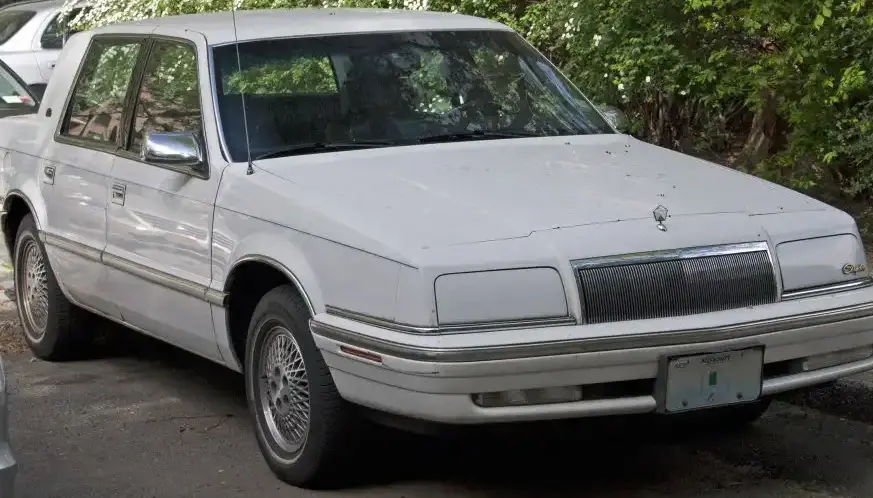
Technical Specifications
| Brand | Chrysler |
| Model | New Yorker |
| Generation | New Yorker XIII Salon |
| Type (Engine) | 3.3 V6 (150 Hp) |
| Start of production | 1988 |
| End of production | 1993 |
| Powertrain Architecture | Internal Combustion engine |
| Body type | Sedan |
| Seats | 5 |
| Doors | 4 |
| Fuel consumption (urban) | 16 l/100 km (14.7 US mpg, 17.7 UK mpg, 6.3 km/l) |
| Fuel consumption (extra urban) | 10 l/100 km (23.5 US mpg, 28.2 UK mpg, 10 km/l) |
| Fuel Type | Petrol (Gasoline) |
| Maximum speed | 190 km/h (118.06 mph) |
| Weight-to-power ratio | 10 kg/Hp, 100.3 Hp/tonne |
| Weight-to-torque ratio | 6 kg/Nm, 165.9 Nm/tonne |
| Power | 150 Hp @ 4800 rpm |
| Power per litre | 45.4 Hp/l |
| Torque | 248 Nm @ 3600 rpm (182.92 lb.-ft. @ 3600 rpm) |
| Engine layout | Front, Transverse |
| Engine displacement | 3301 cm3 (201.44 cu. in.) |
| Number of cylinders | 6 |
| Engine configuration | V-engine |
| Cylinder Bore | 93 mm (3.66 in.) |
| Piston Stroke | 81 mm (3.19 in.) |
| Compression ratio | 8.9:1 |
| Number of valves per cylinder | 2 |
| Fuel injection system | Multi-port manifold injection |
| Engine aspiration | Naturally aspirated engine |
| Valvetrain | OHC |
| Engine oil capacity | 4.3 l (4.54 US qt | 3.78 UK qt) |
| Coolant | 9 l (9.51 US qt | 7.92 UK qt) |
| Kerb Weight | 1495 kg (3295.91 lbs.) |
| Trunk (boot) space (minimum) | 465 l (16.42 cu. ft.) |
| Fuel tank capacity | 61 l (16.11 US gal | 13.42 UK gal) |
| Length | 4920 mm (193.7 in.) |
| Width | 1750 mm (68.9 in.) |
| Height | 1400 mm (55.12 in.) |
| Wheelbase | 2655 mm (104.53 in.) |
| Front track | 1465 mm (57.68 in.) |
| Rear track | 1465 mm (57.68 in.) |
| Drivetrain Architecture | The Internal combustion engine (ICE) drives the front wheels of the vehicle. |
| Drive wheel | Front wheel drive |
| Number of gears and type of gearbox | 4 gears, automatic transmission |
| Front suspension | Coil spring |
| Rear suspension | Coil spring |
| Front brakes | Ventilated discs |
| Rear brakes | Disc |
| Assisting systems | ABS (Anti-lock braking system) |
| Steering type | Steering rack and pinion |
| Power steering | Hydraulic Steering |
| Tires size | 195/75 R14 |
The Chrysler New Yorker XIII Salon, produced from 1988 to 1993, marked a departure for the New Yorker lineage. Abandoning the traditional body-on-frame construction of earlier models, the XIII Salon embraced a more contemporary, front-wheel-drive unibody platform – the Chrysler Y-body. This generation aimed to deliver the traditional American attributes of comfort and spaciousness alongside improved fuel economy and handling, broadening its appeal to a wider range of buyers. The 3.3L V6 variant, generating 150 horsepower, occupied a middle ground in the New Yorker lineup, offering a compromise between performance and affordability. It was positioned as an upgrade from the base 2.5L four-cylinder models, yet remained below the less common, more potent 3.0L V6 option.
Powertrain & Engine Architecture
The Chrysler 3.3L engine, designated EGJ internally, powered the New Yorker XIII Salon. This engine featured a 60-degree V6 configuration, utilizing a cast iron engine block and aluminum cylinder heads. A single overhead camshaft (OHC) controlled two valves per cylinder. Fuel delivery was handled by a multi-port fuel injection system, striking a balance between efficiency and performance. The 3.3L V6 was known for its relatively smooth operation and sufficient power for everyday driving needs. The engine was mated to a four-speed automatic transmission, a front-wheel-drive adaptation of the Chrysler A727. This transmission was selected for its emphasis on comfort and ease of operation, aligning with the New Yorker’s focus on a relaxed driving experience. While not prioritizing rapid acceleration, the automatic transmission offered smooth gear changes and contributed to the vehicle’s overall refinement.
Driving Characteristics
The combination of 150 horsepower and 183 lb-ft of torque from the 3.3L V6, paired with the four-speed automatic transmission, resulted in a driving experience prioritizing comfort over outright performance. Acceleration was adequate for highway merging and passing maneuvers, but lacked a sense of urgency. The automatic transmission’s gear ratios were optimized for fuel economy and smooth cruising, occasionally leading to delayed downshifts when more immediate response was desired. Compared to the base 2.5L four-cylinder engine, the V6 provided a noticeable improvement in both power and refinement. However, it didn’t quite match the more engaging driving experience offered by the optional 3.0L V6. The front-wheel-drive layout provided predictable handling characteristics, though it lacked the dynamic feel associated with rear-wheel-drive vehicles.
Equipment & Trim Levels
The New Yorker XIII Salon 3.3 V6 typically came equipped with features considered luxurious for its time. Standard amenities included air conditioning, power windows and door locks, a tilt steering wheel, and a premium audio system. Interior upholstery was generally cloth, with optional leather available. The dashboard layout was straightforward and featured easily readable gauges. Optional extras included a sunroof, upgraded sound systems, and alloy wheels. The Salon trim level represented a mid-range offering, providing a balanced combination of features and value. It sat above the base New Yorker models, which often omitted some of the convenience features found in the Salon.
Chassis & Braking
The New Yorker XIII Salon featured an independent front suspension with coil springs and a multi-link rear suspension, also utilizing coil springs. This suspension setup aimed to deliver a comfortable ride while maintaining acceptable handling. The front brakes were ventilated discs, providing strong stopping power, while the rear brakes were solid discs. An anti-lock braking system (ABS) was standard equipment, enhancing safety by preventing wheel lockup during hard braking. The steering system was a rack-and-pinion design with hydraulic power assist, offering light and effortless steering feel. The standard tire size was 195/75 R14, chosen to balance ride comfort and handling performance.
Market Reception & Comparison
Automotive critics offered mixed reviews of the New Yorker XIII Salon 3.3 V6. While the spacious interior, comfortable ride, and improved fuel efficiency compared to older New Yorker models were praised, the car was often criticized for its uninspired handling and somewhat underwhelming performance. Compared to competitors such as the Ford Taurus and Chevrolet Lumina, the New Yorker offered a more luxurious interior and a smoother ride, but lacked the same level of performance and handling agility. Fuel economy was considered average for its class, with the 3.3L V6 offering a slight advantage over the larger 3.0L engine. Reliability was generally good, although some owners reported issues with the automatic transmission over the long term.
Legacy
The Chrysler New Yorker XIII Salon 3.3 V6, while not a performance benchmark, occupies a significant place in automotive history as a transitional vehicle. It symbolized Chrysler’s shift towards more modern, fuel-efficient designs. Today, these cars are relatively affordable in the used car market, making them appealing to collectors and enthusiasts seeking a comfortable and spacious American sedan. The 3.3L V6 powertrain, while not renowned for exceptional longevity, is generally reliable with proper maintenance. Parts availability is reasonable, although certain components may become increasingly difficult to source. The New Yorker XIII Salon remains a testament to an era when American automakers sought to reconcile traditional values of comfort and space with the evolving demands of the automotive landscape.