
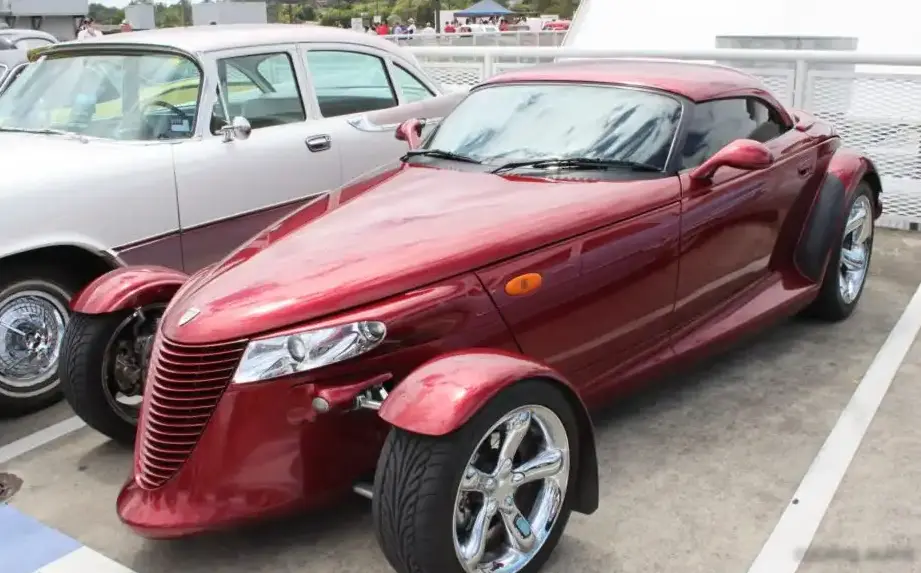
The Chrysler Prowler 3.5 i V6 24V, produced from 1997 to 2002, was a striking and unconventional American sports car. Designed to evoke the hot rods of the 1930s and 40s, the Prowler was a bold statement from Chrysler, aiming to recapture a sense of American automotive enthusiasm. It was built on a unique platform, eschewing traditional Chrysler architecture for a rear-wheel-drive layout and a visually arresting open-wheel design. The 3.5L V6 24V variant, producing 257 horsepower, represented the sole engine and transmission configuration offered throughout its production run, paired exclusively with a four-speed automatic transmission. The Prowler was positioned as a niche vehicle, appealing to enthusiasts seeking a distinctive and head-turning automobile rather than a practical daily driver.
Technical Specifications
| Brand | Chrysler |
| Model | Prowler |
| Generation | Prowler |
| Type (Engine) | 3.5 i V6 24V (257 Hp) |
| Start of production | 1997 year |
| End of production | 2002 year |
| Powertrain Architecture | Internal Combustion engine |
| Body type | Cabriolet |
| Seats | 2 |
| Doors | 2 |
| Fuel consumption (economy) – urban | 13.8 l/100 km (17 US mpg, 20.5 UK mpg, 7.2 km/l) |
| Fuel consumption (economy) – extra urban | 10.2 l/100 km (23.1 US mpg, 27.7 UK mpg, 9.8 km/l) |
| Fuel Type | Petrol (Gasoline) |
| Acceleration 0 – 100 km/h | 6.8 sec |
| Acceleration 0 – 62 mph | 6.8 sec |
| Acceleration 0 – 60 mph | 6.5 sec |
| Maximum speed | 210 km/h (130.49 mph) |
| Weight-to-power ratio | 5 kg/Hp, 199.2 Hp/tonne |
| Weight-to-torque ratio | 3.7 kg/Nm, 268.2 Nm/tonne |
| Power | 257 Hp @ 6400 rpm |
| Power per litre | 73.1 Hp/l |
| Torque | 346 Nm @ 3950 rpm (255.2 lb.-ft. @ 3950 rpm) |
| Engine layout | Front, Longitudinal |
| Engine Model/Code | EGG |
| Engine displacement | 3518 cm3 (214.68 cu. in.) |
| Number of cylinders | 6 |
| Engine configuration | V-engine |
| Cylinder Bore | 96 mm (3.78 in.) |
| Piston Stroke | 81 mm (3.19 in.) |
| Compression ratio | 9.9:1 |
| Number of valves per cylinder | 4 |
| Fuel injection system | Multi-port manifold injection |
| Engine aspiration | Naturally aspirated engine |
| Valvetrain | DOHC |
| Engine oil capacity | 4.7 l (4.97 US qt | 4.14 UK qt) |
| Kerb Weight | 1290 kg (2843.96 lbs.) |
| Trunk (boot) space – minimum | 50 l (1.77 cu. ft.) |
| Fuel tank capacity | 46 l (12.15 US gal | 10.12 UK gal) |
| Length | 4200 mm (165.35 in.) |
| Width | 1945 mm (76.57 in.) |
| Height | 1295 mm (50.98 in.) |
| Wheelbase | 2880 mm (113.39 in.) |
| Front track | 1580 mm (62.2 in.) |
| Rear (Back) track | 1615 mm (63.58 in.) |
| Drivetrain Architecture | The Internal combustion engine (ICE) drives the rear wheels of the vehicle. |
| Drive wheel | Rear wheel drive |
| Number of gears and type of gearbox | 4 gears, automatic transmission |
| Front suspension | Coil spring |
| Rear suspension | Coil spring |
| Front brakes | Ventilated discs |
| Rear brakes | Ventilated discs |
| Assisting systems | ABS (Anti-lock braking system) |
| Steering type | Steering rack and pinion |
| Power steering | Hydraulic Steering |
| Tires size | 225/45 R17; 295/40 R20 |
Powertrain & Engine Architecture
The Prowler’s engine, designated EGG, was a 3.5-liter (214.68 cubic inches) SOHC 24-valve V6. While sharing a basic architecture with other Chrysler V6 engines of the era, the Prowler’s engine was significantly modified for performance and to fit within the car’s unique chassis. It featured a cast iron block and aluminum cylinder heads, incorporating multi-port fuel injection. The engine produced 257 horsepower at 6400 rpm and 346 Nm (255.2 lb-ft) of torque at 3950 rpm. The sole transmission option was a four-speed automatic, chosen for its ease of use and suitability for the car’s intended cruising character. This automatic, while reliable, wasn’t known for particularly quick shifts and contributed to a slightly less engaging driving experience compared to a manual transmission, had one been offered.
Driving Characteristics
The Prowler, with its relatively lightweight construction (approximately 2844 lbs), offered brisk acceleration. The 0-60 mph sprint took around 6.5 seconds, and it could reach a top speed of 130 mph. However, the four-speed automatic transmission limited the engine’s potential. Gear ratios were optimized for cruising rather than outright performance, meaning the engine didn’t always feel as responsive as it could have been. Compared to a hypothetical Prowler with a manual transmission, the automatic version felt slightly more relaxed and less eager to rev. The rear-wheel-drive layout provided a balanced feel, but the relatively wide tires and firm suspension could make the ride somewhat harsh on uneven surfaces.
Equipment & Trim Levels
The Prowler was relatively sparsely equipped, focusing on the core driving experience and its distinctive styling. Standard features included leather upholstery, air conditioning, power windows and locks, and an AM/FM stereo. Options were limited but included a premium sound system, upgraded wheels, and special paint colors. Interior trim was generally straightforward, with a focus on a retro aesthetic. The dashboard featured large, easy-to-read gauges, and the overall cabin design aimed to evoke the spirit of classic hot rods. There weren’t distinct “trim levels” in the traditional sense; customization was primarily achieved through optional extras and special edition paint schemes.
Chassis & Braking
The Prowler’s chassis was a tubular steel space frame, designed for high rigidity and low weight. This construction method was unusual for a production car of its time and contributed to the Prowler’s distinctive handling characteristics. Suspension consisted of independent coil springs at all four wheels. Braking was provided by ventilated discs on all four corners, assisted by an anti-lock braking system (ABS). The rear brakes were notably smaller than the front, reflecting the car’s weight distribution. Steering was rack-and-pinion with hydraulic power assistance.
Market Reception & Comparison
The Chrysler Prowler received mixed reviews upon its release. Critics praised its striking design and engaging handling, but some found the interior cramped and the ride harsh. The automatic transmission was a common point of criticism, with many reviewers wishing for a manual option. Fuel economy was also a concern, averaging around 17 mpg in the city and 23 mpg on the highway. Compared to other sports cars of the era, such as the Mazda MX-5 Miata or the Ford Mustang, the Prowler offered a more unique and attention-grabbing experience, but at a higher price point. Its reliability was generally considered average for a Chrysler product of the late 1990s and early 2000s.
Legacy
The Chrysler Prowler, despite its relatively short production run, left a lasting impression on the automotive landscape. It represented a bold attempt by Chrysler to inject some personality and excitement into its lineup. Today, the Prowler is a sought-after collectible, particularly among enthusiasts of American hot rods and unique automobiles. The 3.5L V6 and four-speed automatic powertrain, while not known for exceptional performance or fuel efficiency, has proven to be reasonably reliable with proper maintenance. Parts availability can be a challenge, but a dedicated community of Prowler owners and enthusiasts helps to keep these cars on the road. The Prowler remains a symbol of a time when Chrysler was willing to take risks and create truly distinctive vehicles.
