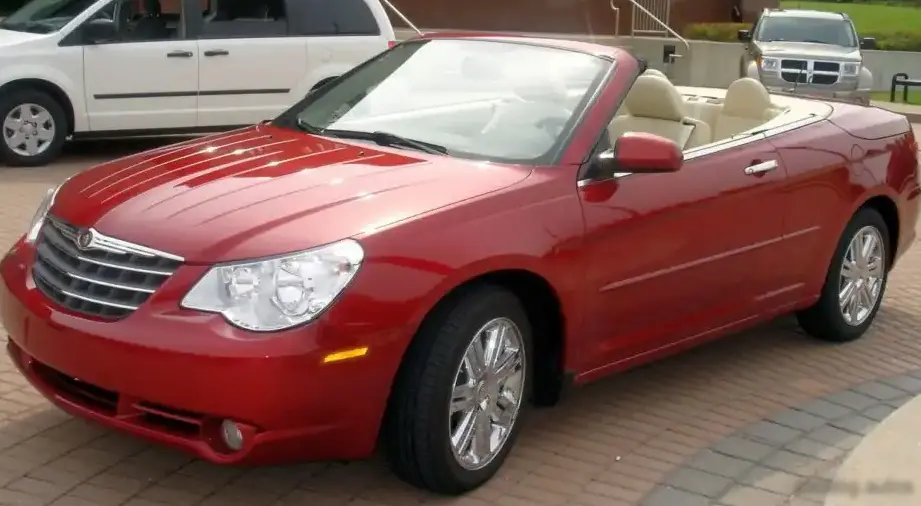
The Chrysler Sebring Convertible (JS) 2.0i, produced between 2007 and 2010, represented a mid-cycle offering within the JS generation of the Sebring convertible. Positioned as a more accessible alternative to the higher-powered variants, the 2.0i aimed to provide a balance of style, affordability, and reasonable performance in the North American convertible market. This model occupied a space between the base engine options and the more performance-oriented trims, targeting buyers who prioritized open-air enjoyment over outright speed. It was built on the Chrysler JS platform, shared with the Dodge Caliber and Jeep Compass.
Technical Specifications
| Brand | Chrysler |
| Model | Sebring |
| Generation | Sebring Convertible (JS) |
| Type (Engine) | 2.0 i (156 Hp) |
| Start of production | 2007 |
| End of production | 2010 |
| Powertrain Architecture | Internal Combustion engine |
| Body type | Cabriolet |
| Seats | 4 |
| Doors | 2 |
| Fuel Type | Petrol (Gasoline) |
| Emission standard | Euro 5 |
| Power | 156 Hp @ 6600 rpm |
| Power per litre | 78.2 Hp/l |
| Torque | 190 Nm @ 5500 rpm / 140.14 lb.-ft. @ 5500 rpm |
| Engine layout | Front, Transverse |
| Engine Model/Code | ECN |
| Engine displacement | 1996 cm3 / 121.8 cu. in. |
| Number of cylinders | 4 |
| Engine configuration | Inline |
| Cylinder Bore | 87.5 mm / 3.44 in. |
| Piston Stroke | 83 mm / 3.27 in. |
| Compression ratio | 9.8:1 |
| Number of valves per cylinder | 4 |
| Fuel injection system | Multi-port manifold injection |
| Engine aspiration | Naturally aspirated engine |
| Valvetrain | DOHC |
| Engine oil capacity | 4.3 l / 4.54 US qt | 3.78 UK qt |
| Coolant | 7.3 l / 7.71 US qt | 6.42 UK qt |
| Fuel tank capacity | 64 l / 16.91 US gal | 14.08 UK gal |
| Length | 4850 mm / 190.94 in. |
| Width | 1843 mm / 72.56 in. |
| Height | 1497 mm / 58.94 in. |
| Wheelbase | 2765 mm / 108.86 in. |
| Drivetrain Architecture | The Internal combustion engine (ICE) drives the front wheels of the vehicle. |
| Drive wheel | Front wheel drive |
| Number of gears and type of gearbox | 6 gears, manual transmission |
| Front suspension | Independent type McPherson |
| Rear suspension | Several levers and rods |
| Front brakes | Ventilated discs |
| Rear brakes | Disc |
| Assisting systems | ABS (Anti-lock braking system) |
| Steering type | Steering rack and pinion |
| Power steering | Hydraulic Steering |
Powertrain & Engine Architecture
The heart of the Sebring Convertible 2.0i was the Chrysler ECN engine, a 1.996-liter (121.8 cubic inch) inline-four cylinder powerplant. This engine utilized a multi-port fuel injection system and a double overhead camshaft (DOHC) valvetrain, contributing to its relatively efficient operation. The 9.8:1 compression ratio was a standard figure for naturally aspirated engines of the era. The ECN engine was designed for a balance of fuel economy and adequate power, rather than outright performance. It was a relatively simple design, which aided in its reliability and ease of maintenance. The engine’s transverse mounting within the front-wheel-drive configuration was typical for vehicles in this class. The ECN engine, while not a particularly advanced design, represented a cost-effective solution for providing acceptable performance in the Sebring Convertible.
Driving Characteristics
With 156 horsepower and 190 Nm (140 lb-ft) of torque, the 2.0i Sebring Convertible offered adequate, but not exhilarating, performance. Acceleration was reasonable for everyday driving, but it wasn’t designed for quick bursts of speed. The six-speed manual transmission allowed drivers to keep the engine in its optimal power band, but the car wasn’t particularly sporty. Compared to the higher-output 2.4L engine option, the 2.0i felt noticeably less powerful, especially when fully loaded with passengers. The gear ratios were tuned for fuel efficiency and comfortable cruising, rather than aggressive acceleration. The front-wheel-drive configuration provided predictable handling, but lacked the dynamic capabilities of a rear-wheel-drive setup. Steering feel was light, making it easy to maneuver in city traffic, but offering limited feedback at higher speeds. Overall, the driving experience was geared towards comfortable, relaxed cruising rather than spirited driving.
Equipment & Trim Levels
The 2.0i trim typically included standard features such as air conditioning, power windows and locks, a basic audio system, and cloth upholstery. Safety features like ABS were standard. Optional extras included a premium sound system, leather upholstery, alloy wheels, and a power-operated convertible top. The interior design was functional but not luxurious, reflecting the car’s positioning as a more affordable convertible option. The dashboard layout was straightforward, with easy-to-read gauges and controls. The standard seats provided adequate comfort for short to medium-length journeys. While not lavishly equipped, the 2.0i offered a reasonable level of convenience and comfort for its price point. The availability of optional extras allowed buyers to customize the car to their preferences.
Chassis & Braking
The Sebring Convertible utilized an independent McPherson strut suspension in the front, providing a comfortable ride quality. The rear suspension employed a multi-link setup, designed to minimize body roll and improve handling. Ventilated disc brakes were fitted to the front wheels, while solid discs were used at the rear. The hydraulic power steering provided light and easy steering input. The chassis was designed to provide a balance of rigidity and weight, crucial for a convertible. Stabilizer bars were included to reduce body roll during cornering, but the car wasn’t intended to be a performance machine. The braking system was adequate for everyday driving, but lacked the stopping power of more performance-oriented vehicles. The suspension tuning prioritized ride comfort over sharp handling.
Market Reception & Comparison
The Chrysler Sebring Convertible 2.0i was generally viewed as a reasonably priced and stylish convertible option. Critics noted its comfortable ride and adequate performance, but also pointed out its lack of refinement compared to some of its European competitors. Fuel economy was considered average for its class. Compared to the 2.4L Sebring Convertible, the 2.0i offered a lower price point but sacrificed some performance. The 2.0i appealed to buyers who prioritized affordability and open-air enjoyment over sporty handling and rapid acceleration. Reliability reports were mixed, with some owners experiencing issues with the engine and electrical systems. The 2.0i often found itself competing with other affordable convertibles like the Mazda MX-5 Miata, which offered a more engaging driving experience, but less interior space.
Legacy
The Sebring Convertible 2.0i, while not a standout performer, remains a relatively affordable entry point into the world of convertible ownership. The ECN engine, while not known for exceptional longevity, is generally reliable if properly maintained. Parts availability is reasonable, although some components may be becoming increasingly difficult to find. In the used car market, these models are often sought after by buyers looking for a stylish and affordable convertible for weekend cruising. The 2.0i represents a practical and accessible option within the Sebring Convertible lineup, offering a balance of features and affordability that appealed to a broad range of buyers. Today, it represents a budget-friendly option for those seeking the experience of open-top motoring, though potential buyers should be aware of the potential for age-related maintenance issues.