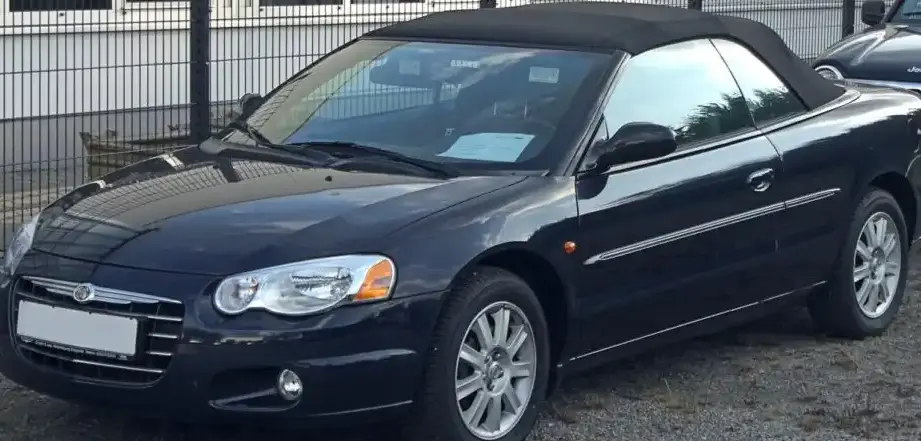
The Chrysler Sebring Sedan (JR) 2.4i 16V Automatic, produced from 2001 to 2006, represented a key offering in Chrysler’s mid-size sedan lineup. Positioned as a comfortable and relatively affordable option, this variant utilized a 2.4-liter inline-four engine paired with a four-speed automatic transmission. It was part of the JR generation Sebring, which aimed to modernize the model and appeal to a broader customer base. The JR Sebring competed directly with vehicles like the Honda Accord, Toyota Camry, and Ford Fusion in the North American market.
Technical Specifications
| Brand | Chrysler |
| Model | Sebring |
| Generation | Sebring Sedan (JR) |
| Type (Engine) | 2.4 i 16V (150 Hp) Automatic |
| Start of production | 2001 |
| End of production | 2006 |
| Powertrain Architecture | Internal Combustion engine |
| Body type | Sedan |
| Seats | 5 |
| Doors | 4 |
| Fuel consumption (urban) | 10.7 l/100 km (22 US mpg) |
| Fuel consumption (extra urban) | 7.8 l/100 km (30.2 US mpg) |
| Fuel Type | Petrol (Gasoline) |
| Acceleration 0 – 100 km/h | 11 sec |
| Acceleration 0 – 62 mph | 11 sec |
| Acceleration 0 – 60 mph | 10.5 sec |
| Maximum speed | 180 km/h (111.85 mph) |
| Weight-to-power ratio | 9.6 kg/Hp |
| Weight-to-torque ratio | 6.6 kg/Nm |
| Power | 150 Hp @ 5500 rpm |
| Torque | 218 Nm @ 4200 rpm (160.79 lb.-ft. @ 4200 rpm) |
| Engine layout | Front, Transverse |
| Engine displacement | 2429 cm3 (148.23 cu. in.) |
| Number of cylinders | 4 |
| Engine configuration | Inline |
| Cylinder Bore | 87.5 mm (3.44 in.) |
| Piston Stroke | 101 mm (3.98 in.) |
| Compression ratio | 9.4:1 |
| Number of valves per cylinder | 4 |
| Fuel injection system | Multi-port manifold injection |
| Engine aspiration | Naturally aspirated |
| Engine oil capacity | 4.7 l (4.97 US qt | 4.14 UK qt) |
| Coolant capacity | 7.5 l (7.93 US qt | 6.6 UK qt) |
| Kerb Weight | 1439 kg (3172.45 lbs.) |
| Max. weight | 1990 kg (4387.2 lbs.) |
| Max load | 551 kg (1214.75 lbs.) |
| Trunk (boot) space – minimum | 453 l (16 cu. ft.) |
| Fuel tank capacity | 61 l (16.11 US gal | 13.42 UK gal) |
| Permitted trailer load with brakes (12%) | 454 kg (1000.9 lbs.) |
| Length | 4843 mm (190.67 in.) |
| Width | 1793 mm (70.59 in.) |
| Height | 1394 mm (54.88 in.) |
| Wheelbase | 2743 mm (107.99 in.) |
| Front track | 1529 mm (60.2 in.) |
| Rear track | 1529 mm (60.2 in.) |
| Drag coefficient (Cd) | 0.325 |
| Minimum turning circle | 11.22 m (36.81 ft.) |
| Drivetrain Architecture | Front wheel drive |
| Number of gears | 4 |
| Gearbox type | Automatic transmission |
| Front suspension | Spring Strut |
| Rear suspension | Coil spring |
| Front brakes | Ventilated discs, 282×23 mm |
| Rear brakes | Disc, 270×9 mm |
| Assisting systems | ABS (Anti-lock braking system) |
| Steering type | Steering rack and pinion |
| Tires size | 205/60 R16 |
| Wheel rims size | 6.5J x 16 |
Powertrain & Engine Architecture
The heart of the 2.4i Sebring was the Chrysler’s 2.4-liter inline-four engine, internally designated as the EDZ. This engine featured a cast iron block with an aluminum cylinder head, employing dual overhead camshafts (DOHC) and four valves per cylinder. The multi-port fuel injection system delivered fuel directly into the intake ports, optimizing combustion. The engine produced 150 horsepower at 5500 rpm and 160.79 lb-ft of torque at 4200 rpm. Paired with this engine was a four-speed automatic transmission, a common choice for drivers prioritizing ease of use over outright performance. This transmission was designed for smooth shifts and adequate acceleration, but lacked the responsiveness of a manual gearbox or more modern automatic transmissions with additional gears.
Driving Characteristics
The 2.4L automatic Sebring offered a comfortable, if not particularly sporty, driving experience. Acceleration from 0-60 mph took around 10.5 seconds, making it adequate for everyday driving but not exceptionally quick. The four-speed automatic transmission, while smooth, had relatively wide gear ratios. This meant that the engine often felt strained during quick acceleration, and downshifts weren’t always as prompt as desired. Compared to the optional 2.7L V6 engine, the 2.4L offered significantly less power and acceleration. However, it provided better fuel economy and a more relaxed driving experience. The suspension was tuned for comfort, absorbing bumps and road imperfections reasonably well, but it didn’t offer the sharp handling found in some of its competitors.
Equipment & Trim Levels
The 2.4i Automatic Sebring typically came standard with features like air conditioning, power windows and locks, an AM/FM stereo, and cloth upholstery. Higher trim levels, such as the Limited, added features like alloy wheels, a power driver’s seat, upgraded audio systems, and optional leather upholstery. Available options included a sunroof, cruise control, and a premium sound system. The interior design was generally functional and straightforward, prioritizing usability over luxury. The dashboard layout was clean and easy to navigate, with clearly labeled controls.
Chassis & Braking
The Sebring JR utilized a front-wheel-drive layout with an independent front suspension featuring MacPherson struts and a multi-link rear suspension. The braking system consisted of ventilated disc brakes on the front wheels and solid disc brakes on the rear. Anti-lock Braking System (ABS) was standard, enhancing safety and control during emergency braking situations. The suspension was tuned for a comfortable ride, with stabilizer bars helping to reduce body roll during cornering. The 205/60R16 tires provided adequate grip for most driving conditions.
Market Reception & Comparison
The 2.4i Automatic Sebring was generally well-received as a practical and affordable mid-size sedan. Critics praised its comfortable ride and spacious interior, but noted its lack of sporty handling and relatively modest acceleration. Compared to the V6-powered Sebring, the 2.4L offered better fuel economy – around 22 mpg city and 30 mpg highway – but significantly less performance. The 2.4L version was often seen as a good choice for drivers who prioritized fuel efficiency and comfort over outright speed. Reliability was generally considered average for the era, with some reports of minor issues with the automatic transmission and fuel injection system.
Legacy
The Chrysler Sebring Sedan (JR) 2.4i Automatic, while not a standout performer, remains a relatively common sight on used car lots today. The 2.4L engine and four-speed automatic transmission are generally considered reliable, although regular maintenance is crucial to prevent issues. Parts availability is good, and repair costs are typically reasonable. The JR Sebring represents a transitional period for Chrysler, as the company sought to modernize its lineup and compete more effectively in the mid-size sedan segment. While it may not be a collector’s item, it remains a practical and affordable option for those seeking a comfortable and reliable used car.