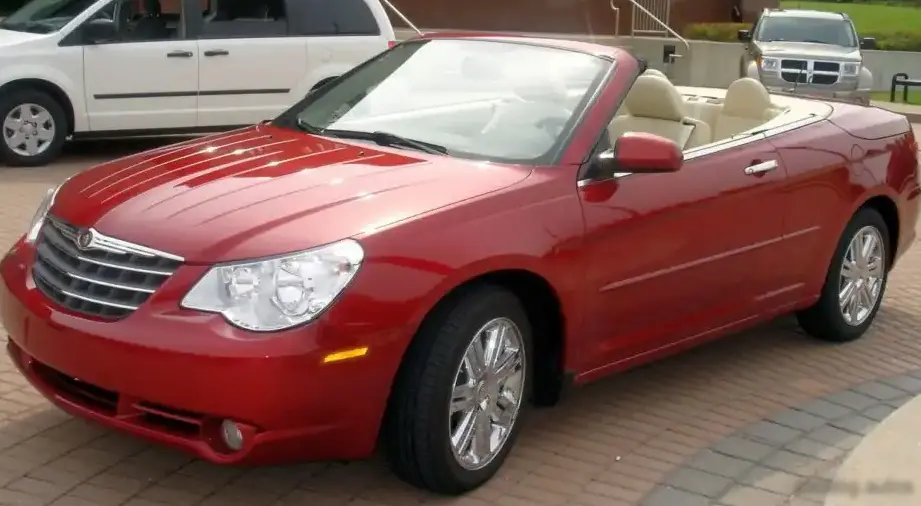
The Chrysler Sebring Sedan (JS) 2.0i 16V, produced from 2006 to 2010, represented a mid-range offering within the JS generation of the Sebring. Positioned between the base 2.4L engine and the more powerful 2.7L V6, the 2.0i 16V aimed to provide a balance of fuel efficiency and acceptable performance for the average commuter. This variant was primarily marketed in Europe and other international markets where smaller displacement engines were favored, and it played a role in Chrysler’s attempt to broaden the Sebring’s appeal beyond the North American market. The JS Sebring, as a whole, was Chrysler’s entry into the mid-size sedan segment, competing with established rivals like the Toyota Camry, Honda Accord, and Ford Fusion.
Technical Specifications
| Brand | Chrysler |
| Model | Sebring |
| Generation | Sebring Sedan (JS) |
| Type (Engine) | 2.0i 16V (156 Hp) |
| Start of production | 2006 |
| End of production | 2010 |
| Powertrain Architecture | Internal Combustion engine |
| Body type | Sedan |
| Seats | 5 |
| Doors | 4 |
| Fuel consumption (urban) | 10.7 l/100 km (22 US mpg, 26.4 UK mpg, 9.3 km/l) |
| Fuel consumption (extra urban) | 6.1 l/100 km (38.6 US mpg, 46.3 UK mpg, 16.4 km/l) |
| Fuel consumption (combined) | 7.8 l/100 km (30.2 US mpg, 36.2 UK mpg, 12.8 km/l) |
| CO2 emissions | 146 g/km |
| Fuel Type | Petrol (Gasoline) |
| Emission standard | Euro 5 |
| Power | 156 Hp @ 6600 rpm |
| Power per litre | 78.2 Hp/l |
| Torque | 190 Nm @ 5500 rpm (140.14 lb.-ft. @ 5500 rpm) |
| Engine layout | Front, Transverse |
| Engine Model/Code | ECN |
| Engine displacement | 1996 cm3 (121.8 cu. in.) |
| Number of cylinders | 4 |
| Engine configuration | Inline |
| Cylinder Bore | 87.5 mm (3.44 in.) |
| Piston Stroke | 83 mm (3.27 in.) |
| Compression ratio | 9.8:1 |
| Number of valves per cylinder | 4 |
| Fuel injection system | Multi-port manifold injection |
| Engine aspiration | Naturally aspirated engine |
| Valvetrain | DOHC |
| Engine oil capacity | 4.3 l (4.54 US qt, 3.78 UK qt) |
| Coolant | 7.8 l (8.24 US qt, 6.86 UK qt) |
| Trunk (boot) space (minimum) | 441 l (15.57 cu. ft.) |
| Fuel tank capacity | 64 l (16.91 US gal, 14.08 UK gal) |
| Length | 4850 mm (190.94 in.) |
| Width | 1843 mm (72.56 in.) |
| Height | 1497 mm (58.94 in.) |
| Wheelbase | 2767 mm (108.94 in.) |
| Front track | 1570 mm (61.81 in.) |
| Rear track | 1570 mm (61.81 in.) |
| Drivetrain Architecture | Front wheel drive |
| Number of gears and type of gearbox | 6 gears, manual transmission |
| Front suspension | Independent type McPherson |
| Rear suspension | Several levers and rods |
| Front brakes | Ventilated discs |
| Rear brakes | Disc |
| Assisting systems | ABS (Anti-lock braking system) |
| Steering type | Steering rack and pinion |
| Power steering | Hydraulic Steering |
Powertrain & Engine Architecture
The heart of the Sebring 2.0i 16V is the ECN engine, a 1.996-liter inline-four cylinder gasoline engine. This engine utilizes a multi-port fuel injection system, delivering fuel directly into the intake ports just before the intake valves. The engine features a double overhead camshaft (DOHC) valvetrain, operating four valves per cylinder, which contributes to improved breathing and higher-RPM performance. The 9.8:1 compression ratio is a compromise between efficiency and power output. The 2.0L engine was not a particularly advanced design, relying on proven technology to deliver reliable performance. The six-speed manual transmission was the standard offering for this variant, providing drivers with a degree of control over the engine’s power delivery. While an automatic transmission was available in some markets, it wasn’t as commonly paired with this engine as the manual.
Driving Characteristics
The 156 horsepower and 190 Nm (140 lb-ft) of torque produced by the 2.0i 16V engine provided adequate, but not exhilarating, performance. Acceleration from 0 to 60 mph was estimated to be around 9-10 seconds. The six-speed manual transmission helped to keep the engine in its optimal power band, but the engine lacked the low-end grunt of larger displacement engines. Compared to the 2.7L V6 Sebring, the 2.0i felt noticeably slower, particularly during overtaking maneuvers. However, the 2.0i offered a more engaging driving experience due to the manual transmission and lighter weight. The gear ratios were tuned for a balance between fuel economy and responsiveness, with a relatively tall sixth gear for highway cruising.
Equipment & Trim Levels
The Sebring 2.0i 16V typically came equipped with a reasonable level of standard features. These included air conditioning, power windows and locks, a basic audio system, and standard safety equipment like ABS brakes and airbags. Interior upholstery was typically cloth, with optional leather available on higher trim levels. Depending on the market, features like alloy wheels, a sunroof, and upgraded audio systems were available as optional extras. The trim level often dictated the availability of these features, with the 2.0i generally positioned as a mid-range offering, offering more than the base model but less luxury than the V6-powered versions.
Chassis & Braking
The Sebring JS utilized an independent McPherson strut suspension in the front, providing a comfortable ride and decent handling. The rear suspension employed a multi-link setup, designed to minimize body roll and improve stability. Front brakes were ventilated discs, offering good stopping power, while rear brakes were solid discs. The steering was a hydraulic rack-and-pinion system, providing a reasonably direct feel. Stabilizer bars were fitted to both the front and rear axles to further reduce body roll during cornering. The suspension tuning was geared towards comfort rather than outright sportiness, making the Sebring a pleasant cruiser.
Market Reception & Comparison
The Chrysler Sebring 2.0i 16V received mixed reviews. Critics generally praised its fuel efficiency and comfortable ride, but found its performance to be somewhat underwhelming. Compared to the 2.7L V6, the 2.0i offered significantly better fuel economy – around 30.2 US mpg combined – but at the cost of performance. The 2.4L engine, while offering similar fuel economy, was often criticized for its lack of refinement. The 2.0i was seen as a sensible choice for buyers prioritizing fuel efficiency and affordability over outright performance. Reliability reports were average, with some owners reporting issues with the engine’s cooling system and electrical components.
Legacy
The Chrysler Sebring 2.0i 16V, while not a standout model, remains a relatively affordable and accessible option in the used car market. The ECN engine, while not known for its longevity, is generally reliable if properly maintained. Parts availability is reasonable, although some components may be becoming increasingly difficult to find. Today, these Sebrings are often sought after by budget-conscious buyers looking for a comfortable and practical sedan. The 2.0i variant represents a specific niche within the Sebring lineup, appealing to those who valued fuel economy and a manual transmission over outright power and luxury. Its legacy lies in providing a reasonably efficient and affordable transportation option during its production run.