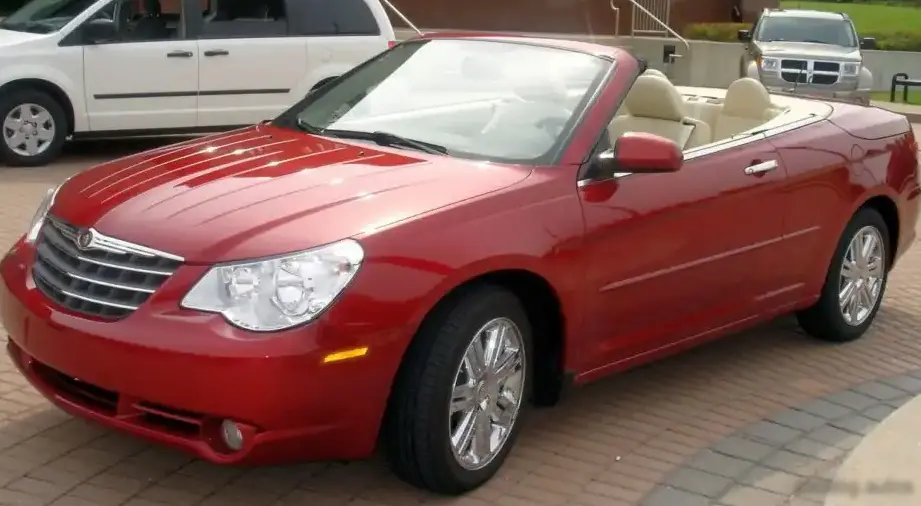
The Chrysler Sebring Sedan (JS) 2.0i 16V Automatic, produced between 2006 and 2010, represented a mid-range offering within the JS generation of the Sebring. Positioned as a more accessible alternative to the higher-powered 2.7L V6 models, the 2.0i variant aimed to balance affordability with reasonable performance and fuel economy. This model played a significant role in Chrysler’s attempt to recapture market share in the fiercely competitive mid-size sedan segment, primarily targeting buyers seeking a comfortable and practical daily driver. It was built on the Chrysler JS platform, shared with the Dodge Avenger of the same era.
Technical Specifications
| Brand | Chrysler |
| Model | Sebring |
| Generation | Sebring Sedan (JS) |
| Type (Engine) | 2.0i 16V (156 Hp) Automatic |
| Start of production | 2006 |
| End of production | 2010 |
| Powertrain Architecture | Internal Combustion engine |
| Body type | Sedan |
| Seats | 5 |
| Doors | 4 |
| Fuel Type | Petrol (Gasoline) |
| Emission standard | Euro 5 |
| Power | 156 Hp @ 6600 rpm |
| Power per litre | 78.2 Hp/l |
| Torque | 190 Nm @ 5500 rpm / 140.14 lb.-ft. @ 5500 rpm |
| Engine layout | Front, Transverse |
| Engine Model/Code | ECN |
| Engine displacement | 1996 cm3 / 121.8 cu. in. |
| Number of cylinders | 4 |
| Engine configuration | Inline |
| Cylinder Bore | 87.5 mm / 3.44 in. |
| Piston Stroke | 83 mm / 3.27 in. |
| Compression ratio | 9.8:1 |
| Number of valves per cylinder | 4 |
| Fuel injection system | Multi-port manifold injection |
| Engine aspiration | Naturally aspirated engine |
| Valvetrain | DOHC |
| Engine oil capacity | 4.3 l / 4.54 US qt | 3.78 UK qt |
| Coolant | 7.8 l / 8.24 US qt | 6.86 UK qt |
| Trunk (boot) space – minimum | 441 l / 15.57 cu. ft. |
| Fuel tank capacity | 64 l / 16.91 US gal | 14.08 UK gal |
| Length | 4850 mm / 190.94 in. |
| Width | 1843 mm / 72.56 in. |
| Height | 1497 mm / 58.94 in. |
| Wheelbase | 2767 mm / 108.94 in. |
| Front track | 1570 mm / 61.81 in. |
| Rear (Back) track | 1570 mm / 61.81 in. |
| Drivetrain Architecture | The Internal combustion engine (ICE) drives the front wheels of the vehicle. |
| Drive wheel | Front wheel drive |
| Number of gears and type of gearbox | 4 gears, automatic transmission |
| Front suspension | Independent type McPherson |
| Rear suspension | Several levers and rods |
| Front brakes | Ventilated discs |
| Rear brakes | Disc |
| Assisting systems | ABS (Anti-lock braking system) |
| Steering type | Steering rack and pinion |
| Power steering | Hydraulic Steering |
Powertrain & Engine Architecture
The heart of the Sebring 2.0i Automatic is the Chrysler ECN engine, a 1.996-liter (121.8 cubic inch) inline-four cylinder powerplant. This engine utilizes a double overhead camshaft (DOHC) valvetrain with four valves per cylinder, contributing to its relatively high output for its displacement. Fuel delivery is managed by a multi-port fuel injection system, providing precise fuel metering for optimal combustion. The engine’s 9.8:1 compression ratio strikes a balance between performance and fuel efficiency. The engine was designed to meet Euro 5 emission standards, incorporating technologies to reduce harmful pollutants. The four-speed automatic transmission, while not the most modern unit by contemporary standards, was chosen for its smoothness and ease of use, catering to the target demographic of comfort-oriented buyers.
Driving Characteristics
The 156 horsepower and 190 Nm (140 lb-ft) of torque produced by the 2.0i engine provided adequate, though not exhilarating, performance. Acceleration from 0 to 60 mph was typically in the 9-10 second range. The four-speed automatic transmission, while smooth, lacked the responsiveness of a manual gearbox or a more modern automatic with additional gears. Gear ratios were tuned for comfortable cruising rather than aggressive acceleration. Compared to the 2.7L V6 Sebring, the 2.0i offered noticeably less power, but also better fuel economy. The 2.0i felt more nimble in city driving due to its lighter weight, while the V6 provided more confident passing power on the highway.
Equipment & Trim Levels
The 2.0i Automatic trim typically included standard features such as air conditioning, power windows and locks, a basic audio system with CD player, and cloth upholstery. Higher trim levels, such as the Limited, added features like alloy wheels, upgraded audio systems, leather upholstery, and a sunroof. Optional extras included a navigation system, premium sound system, and remote keyless entry. The interior design was generally functional and comfortable, though materials were often of lower quality compared to some competitors.
Chassis & Braking
The Sebring 2.0i utilized an independent McPherson strut front suspension and a multi-link rear suspension, providing a reasonably comfortable ride. Front brakes were ventilated discs, while rear brakes were solid discs. Anti-lock Braking System (ABS) was standard. Steering was rack-and-pinion with hydraulic power assist. The suspension was tuned for comfort, prioritizing ride quality over sporty handling. Stabilizer bars were present at both the front and rear to reduce body roll during cornering, though the car was not particularly engaging to drive on winding roads.
Market Reception & Comparison
The Chrysler Sebring 2.0i Automatic received mixed reviews from automotive critics. While praised for its comfortable ride and reasonable fuel economy (estimated at around 24 mpg combined), it was often criticized for its lackluster performance and somewhat dated interior. Compared to competitors like the Honda Accord, Toyota Camry, and Ford Fusion, the Sebring 2.0i often fell short in terms of refinement and driving dynamics. However, its lower price point made it an attractive option for budget-conscious buyers. Reliability was generally average, with some reports of issues with the automatic transmission and electrical components.
Legacy
The Chrysler Sebring 2.0i Automatic, while not a standout performer, remains a relatively affordable and practical used car option. The ECN engine, while not known for exceptional longevity, is generally reliable if properly maintained. Common maintenance items include regular oil changes, timing belt replacement (if applicable), and inspection of the cooling system. The four-speed automatic transmission, while dated, is generally durable. Today, these vehicles can be found at very low prices, making them an attractive option for those seeking basic transportation. However, potential buyers should be aware of the car’s age and potential for needing repairs.