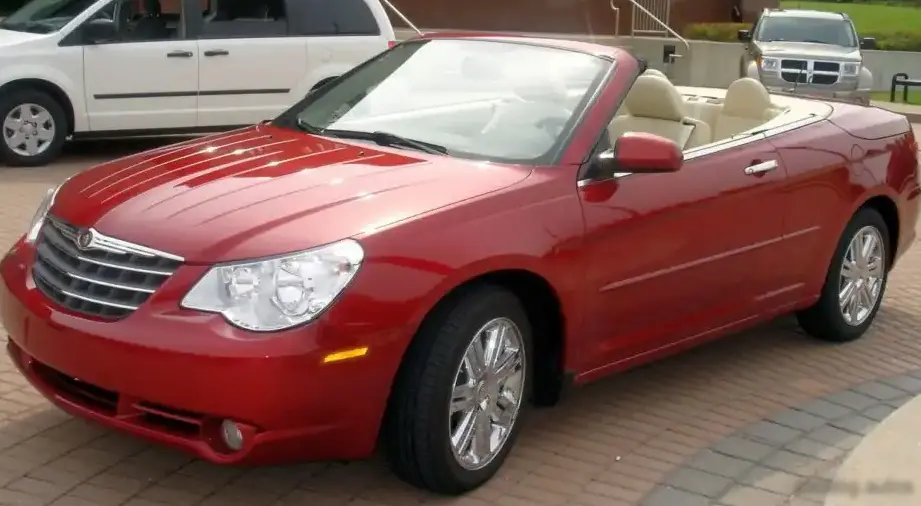
The Chrysler Sebring Sedan (JS) 2.2 CRD, produced between 2006 and 2010, represented a foray into diesel power for the North American market Sebring lineup. Positioned as a fuel-efficient alternative to the gasoline-powered models, the 2.2 CRD offered a blend of practicality and economy, though it remained a relatively niche offering in a segment dominated by petrol engines. This variant was part of the JS generation Sebring, which aimed to modernize the model with a more contemporary design and improved features, competing with mid-size sedans like the Honda Accord and Toyota Camry.
Technical Specifications
| Brand | Chrysler |
| Model | Sebring |
| Generation | Sebring Sedan (JS) |
| Type (Engine) | 2.2 CRD (150 Hp) |
| Start of production | 2006 |
| End of production | 2010 |
| Powertrain Architecture | Internal Combustion engine |
| Body type | Sedan |
| Seats | 5 |
| Doors | 4 |
| Fuel consumption (urban) | 8.2 l/100 km (28.7 US mpg) |
| Fuel consumption (extra urban) | 5.1 l/100 km (46.1 US mpg) |
| Fuel consumption (combined) | 6.2 l/100 km (37.9 US mpg) |
| CO2 emissions | 170 g/km |
| Fuel Type | Diesel |
| Emission standard | Euro 5 |
| Power | 150 Hp @ 4000 rpm |
| Torque | 300 Nm @ 1600 rpm (221.27 lb.-ft. @ 1600 rpm) |
| Engine layout | Front, Transverse |
| Engine displacement | 2148 cm3 (131.08 cu. in.) |
| Number of cylinders | 4 |
| Engine configuration | Inline |
| Cylinder Bore | 88 mm (3.46 in.) |
| Piston Stroke | 88.3 mm (3.48 in.) |
| Compression ratio | 18:1 |
| Number of valves per cylinder | 4 |
| Fuel injection system | Diesel Commonrail |
| Engine aspiration | Turbocharger, Intercooler |
| Valvetrain | OHC |
| Engine oil capacity | 7 l (7.4 US qt | 6.16 UK qt) |
| Coolant capacity | 9 l (9.51 US qt | 7.92 UK qt) |
| Trunk (boot) space (minimum) | 441 l (15.57 cu. ft.) |
| Fuel tank capacity | 64 l (16.91 US gal | 14.08 UK gal) |
| Length | 4850 mm (190.94 in.) |
| Width | 1843 mm (72.56 in.) |
| Height | 1497 mm (58.94 in.) |
| Wheelbase | 2767 mm (108.94 in.) |
| Front track | 1570 mm (61.81 in.) |
| Rear track | 1570 mm (61.81 in.) |
| Drivetrain | Front wheel drive |
| Number of gears and type of gearbox | 6 gears, manual transmission |
| Front suspension | Independent type McPherson |
| Rear suspension | Several levers and rods |
| Front brakes | Ventilated discs |
| Rear brakes | Disc |
| Assisting systems | ABS (Anti-lock braking system) |
| Steering type | Steering rack and pinion |
| Power steering | Hydraulic Steering |
Powertrain & Engine Architecture
The heart of the Sebring 2.2 CRD is the Volkswagen-sourced 2.0-liter inline-four cylinder diesel engine, designated as the VW/Audi EA188 series. While marketed as a 2.2-liter, the actual displacement is 2148 cc. This engine utilizes a common rail direct injection system, delivering fuel at extremely high pressures for optimized combustion. A turbocharger with an intercooler is employed to boost power output and improve torque across a wider RPM range. The engine features an overhead camshaft (OHC) valvetrain with four valves per cylinder, contributing to its efficiency and responsiveness. The 2.2 CRD meets Euro 5 emission standards, incorporating a diesel particulate filter (DPF) to reduce harmful emissions. The engine is transversely mounted in the front of the vehicle, driving the front wheels. The six-speed manual transmission was the only transmission option available with this engine.
Driving Characteristics
The 150 horsepower and 300 Nm (221 lb-ft) of torque provided by the 2.2 CRD engine offered a noticeable improvement in fuel economy compared to the gasoline-powered Sebring models. However, performance was modest. Acceleration was adequate for everyday driving, but it lacked the punch of the larger gasoline engines. The six-speed manual transmission helped to keep the engine in its optimal power band, but the overall driving experience was geared towards efficiency rather than spirited performance. The gear ratios were tuned for maximizing fuel economy, resulting in a slightly less engaging driving experience compared to more performance-oriented trims. Compared to a hypothetical V6 Sebring, the 2.2 CRD prioritized fuel efficiency and lower running costs over outright speed.
Equipment & Trim Levels
The 2.2 CRD trim level typically included standard features such as air conditioning, power windows and locks, a basic audio system, and cloth upholstery. Safety features included ABS brakes and front airbags. Optional extras included alloy wheels, a sunroof, upgraded audio systems, and leather upholstery. The 2.2 CRD was generally positioned as a mid-range offering, bridging the gap between the base gasoline models and the more luxurious trims. It aimed to appeal to buyers who prioritized fuel economy and practicality without sacrificing essential comfort features.
Chassis & Braking
The Sebring 2.2 CRD utilized an independent McPherson strut suspension in the front and a multi-link suspension in the rear. This setup provided a reasonable balance between ride comfort and handling. The front brakes were ventilated discs, while the rear brakes were solid discs. The hydraulic power steering offered a light and responsive feel. The suspension was tuned to prioritize comfort over sporty handling, reflecting the car’s overall focus on practicality and fuel efficiency. Stabilizer bars were included to reduce body roll during cornering.
Market Reception & Comparison
The Chrysler Sebring 2.2 CRD received mixed reviews. Critics praised its fuel economy and relatively refined diesel engine, but some found the performance to be underwhelming. The diesel engine was seen as a positive addition to the Sebring lineup, offering a viable alternative to gasoline power. However, the limited availability of diesel fuel in some areas of the United States and the higher initial cost of diesel engines hindered its widespread adoption. Compared to the gasoline-powered Sebring models, the 2.2 CRD offered significantly better fuel economy but slightly less performance. The 2.2 CRD was generally considered to be a more practical and economical choice for drivers who prioritized fuel efficiency over outright speed.
Legacy
The Chrysler Sebring 2.2 CRD, while not a sales success, represented an attempt by Chrysler to offer a more fuel-efficient option in the mid-size sedan segment. The VW-sourced diesel engine proved to be relatively reliable, although the diesel particulate filter (DPF) required periodic maintenance. Today, the Sebring 2.2 CRD can be found in the used car market at relatively affordable prices. Its fuel economy and practicality continue to appeal to budget-conscious buyers. However, potential buyers should be aware of the potential maintenance costs associated with the DPF and other diesel-specific components. The Sebring 2.2 CRD remains a somewhat uncommon sight on the road, a testament to its niche appeal in the North American market.