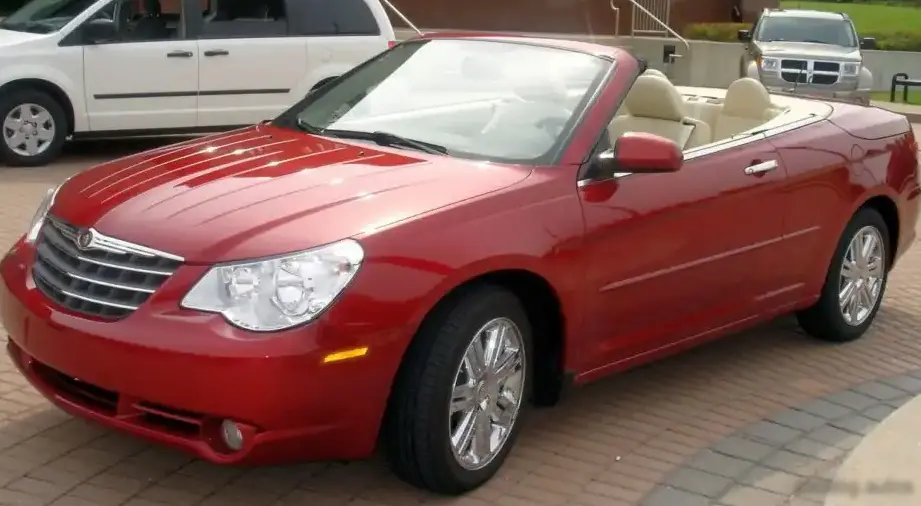
The Chrysler Sebring Sedan (JS) 2.4i 16V Automatic, produced between 2006 and 2010, represented a mid-cycle offering within the JS generation of the Sebring. Positioned as a mainstream, family-oriented sedan, it aimed to provide a balance of comfort, features, and affordability. This variant utilized a 2.4-liter inline-four engine paired with a four-speed automatic transmission, making it a popular choice for buyers prioritizing ease of driving over outright performance. The JS Sebring was Chrysler’s attempt to regain market share in the mid-size sedan segment, competing with established rivals like the Honda Accord, Toyota Camry, and Ford Fusion.
Technical Specifications
| Brand | Chrysler |
| Model | Sebring |
| Generation | Sebring Sedan (JS) |
| Type (Engine) | 2.4i 16V (172 Hp) Automatic |
| Start of production | 2006 |
| End of production | 2010 |
| Powertrain Architecture | Internal Combustion engine |
| Body type | Sedan |
| Seats | 5 |
| Doors | 4 |
| Fuel consumption (urban) | 9.8 l/100 km (24 US mpg) |
| Fuel consumption (extra urban) | 7.4 l/100 km (31.8 US mpg) |
| Fuel Type | Petrol (Gasoline) |
| Acceleration 0 – 100 km/h | 11 sec |
| Acceleration 0 – 62 mph | 11 sec |
| Acceleration 0 – 60 mph | 10.5 sec |
| Maximum speed | 200 km/h (124.27 mph) |
| Emission standard | Euro 5 |
| Weight-to-power ratio | 9.1 kg/Hp |
| Weight-to-torque ratio | 7 kg/Nm |
| Power | 172 Hp @ 5200 rpm |
| Torque | 222 Nm @ 4000 rpm (163.74 lb.-ft. @ 4000 rpm) |
| Engine layout | Front, Transverse |
| Engine Model/Code | EDG |
| Engine displacement | 2429 cm3 (148.23 cu. in.) |
| Number of cylinders | 4 |
| Engine configuration | Inline |
| Cylinder Bore | 87.5 mm (3.44 in.) |
| Piston Stroke | 101 mm (3.98 in.) |
| Compression ratio | 9.4:1 |
| Number of valves per cylinder | 4 |
| Fuel injection system | Multi-port manifold injection |
| Engine aspiration | Naturally aspirated engine |
| Valvetrain | DOHC |
| Engine oil capacity | 4.26 l (4.5 US qt | 3.75 UK qt) |
| Coolant capacity | 7.3 l (7.71 US qt | 6.42 UK qt) |
| Kerb Weight | 1560 kg (3439.21 lbs.) |
| Max. weight | 2040 kg (4497.43 lbs.) |
| Max load | 480 kg (1058.22 lbs.) |
| Trunk (boot) space – minimum | 441 l (15.57 cu. ft.) |
| Fuel tank capacity | 64 l (16.91 US gal | 14.08 UK gal) |
| Length | 4850 mm (190.94 in.) |
| Width | 1843 mm (72.56 in.) |
| Height | 1497 mm (58.94 in.) |
| Wheelbase | 2767 mm (108.94 in.) |
| Front track | 1570 mm (61.81 in.) |
| Rear track | 1570 mm (61.81 in.) |
| Drivetrain Architecture | Front wheel drive |
| Number of gears | 4 |
| Gearbox type | Automatic transmission |
| Front suspension | Independent type McPherson |
| Rear suspension | Several levers and rods |
| Front brakes | Ventilated discs |
| Rear brakes | Disc |
| Assisting systems | ABS (Anti-lock braking system) |
| Steering type | Steering rack and pinion |
| Power steering | Hydraulic Steering |
| Tires size | 215/55 R18 |
| Wheel rims size | 7.0J x 18 |
Powertrain & Engine Architecture
The heart of the Sebring 2.4i was the Chrysler EDG engine, a 2.4-liter inline-four cylinder powerplant. This engine featured a dual overhead camshaft (DOHC) valvetrain with four valves per cylinder, contributing to its relatively efficient breathing. The EDG engine utilized a multi-point fuel injection system, delivering fuel directly into the intake ports. The 172 horsepower output at 5200 rpm and 222 Nm (163.74 lb-ft) of torque at 4000 rpm were respectable for its class, but not class-leading. Paired with this engine was a four-speed automatic transmission. While adequate for everyday driving, this transmission was beginning to feel dated compared to the five and six-speed automatics appearing in competitor vehicles. The four-speed unit prioritized smooth shifts over aggressive performance, and its gear ratios were tuned for fuel economy rather than rapid acceleration.
Driving Characteristics
The Sebring 2.4i Automatic offered a comfortable, if unremarkable, driving experience. Acceleration from 0-60 mph took around 10.5 seconds, making it suitable for commuting and highway cruising but not particularly sporty. The automatic transmission contributed to a smooth and predictable power delivery, but it lacked the responsiveness of a manual transmission or a more modern automatic. The gear ratios were spaced to prioritize fuel efficiency, meaning the engine often felt strained during quick overtaking maneuvers. Compared to the more powerful 2.7L V6 Sebring, the 2.4L felt noticeably slower, but it offered better fuel economy. The handling was generally competent, but the suspension was tuned for comfort, resulting in some body roll during cornering.
Equipment & Trim Levels
The 2.4i Automatic trim typically included standard features such as air conditioning, power windows and locks, a CD player with an auxiliary input, and keyless entry. Higher trim levels, such as the Limited, added features like leather upholstery, a sunroof, upgraded audio systems, and alloy wheels. Optional extras included a navigation system, heated seats, and a premium sound system. Interior materials were generally of average quality for the segment, with a focus on durability rather than luxury. The dashboard layout was functional but somewhat dated, even for its time.
Chassis & Braking
The Sebring 2.4i utilized an independent McPherson strut suspension in the front and a multi-link suspension in the rear. This setup provided a reasonably comfortable ride, absorbing bumps and imperfections in the road surface effectively. The braking system consisted of ventilated discs in the front and solid discs in the rear. Anti-lock brakes (ABS) were standard, enhancing safety and control during emergency braking situations. The Sebring’s curb weight of approximately 1560 kg (3439.21 lbs) contributed to its somewhat sluggish handling characteristics. Stabilizer bars were included both front and rear, helping to reduce body roll, but they were not particularly thick, reflecting the car’s comfort-oriented tuning.
Market Reception & Comparison
The Chrysler Sebring 2.4i Automatic received mixed reviews from automotive critics. While praised for its comfortable ride and spacious interior, it was often criticized for its uninspired styling, dated interior, and lackluster performance. Fuel economy was considered average for the segment, and reliability ratings were below those of key competitors like the Honda Accord and Toyota Camry. Compared to the V6-powered Sebring, the 2.4L offered significantly better fuel economy but lacked the V6’s punch. The four-speed automatic transmission was also a point of criticism, as it felt outdated compared to the more advanced transmissions offered by rivals.
Legacy
The Chrysler Sebring 2.4i Automatic, while not a standout performer, remains a relatively affordable and accessible option in the used car market. The EDG engine is generally considered reliable, although regular maintenance is crucial to prevent issues. The four-speed automatic transmission, while not the most sophisticated, has proven to be reasonably durable. Common issues reported by owners include problems with the electrical system and the air conditioning compressor. Today, these Sebrings are often sought after as budget-friendly transportation for commuters or students, offering a decent level of comfort and practicality for the price. However, prospective buyers should be aware of the car’s age and potential maintenance needs.