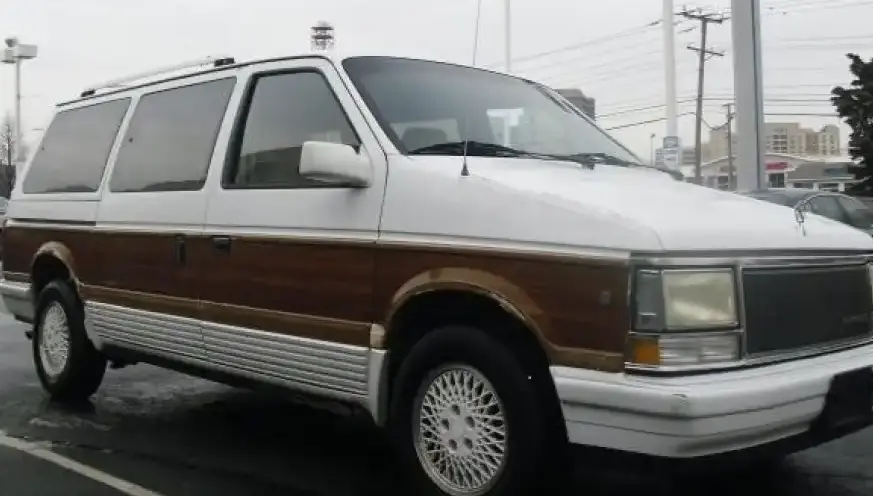
The Chrysler Town & Country I, specifically the 3.0 V6 variant with an automatic transmission, represented Chrysler’s initial foray into the modern minivan segment. Produced solely for the 1990 model year, this iteration of the Town & Country was a significant departure from the van-based models of the past, adopting a more car-like unibody construction. It shared its platform with the Dodge Caravan and Plymouth Voyager, forming the first generation of Chrysler’s highly successful minivan lineup. This particular 3.0L configuration occupied a mid-range position within the lineup, offering a balance between affordability and performance compared to the base 2.5L engine and the more powerful 3.3L V6 options.
Technical Specifications
| Brand | Chrysler |
| Model | Town & Country |
| Generation | Town & Country I |
| Type (Engine) | 3.0 V6 (144 Hp) Automatic |
| Start of production | 1990 |
| End of production | 1990 |
| Powertrain Architecture | Internal Combustion engine |
| Body type | Minivan |
| Seats | 7 |
| Doors | 4 |
| Fuel Type | Petrol (Gasoline) |
| Weight-to-power ratio | 11.8 kg/Hp, 84.7 Hp/tonne |
| Weight-to-torque ratio | 7.3 kg/Nm, 137.6 Nm/tonne |
| Power | 144 Hp @ 5000 rpm |
| Power per litre | 48.5 Hp/l |
| Torque | 234 Nm @ 2800 rpm (172.59 lb.-ft. @ 2800 rpm) |
| Engine layout | Front, Transverse |
| Engine displacement | 2972 cm3 (181.36 cu. in.) |
| Number of cylinders | 6 |
| Engine configuration | V-engine |
| Cylinder Bore | 91.1 mm (3.59 in.) |
| Piston Stroke | 76 mm (2.99 in.) |
| Compression ratio | 8.9:1 |
| Number of valves per cylinder | 2 |
| Fuel injection system | Multi-port manifold injection |
| Engine aspiration | Naturally aspirated engine |
| Valvetrain | SOHC |
| Engine oil capacity | 4.3 l (4.54 US qt | 3.78 UK qt) |
| Kerb Weight | 1700 kg (3747.86 lbs.) |
| Trunk (boot) space – minimum | 850 l (30.02 cu. ft.) |
| Fuel tank capacity | 76 l (20.08 US gal | 16.72 UK gal) |
| Length | 4862 mm (191.42 in.) |
| Width | 1829 mm (72.01 in.) |
| Height | 1646 mm (64.8 in.) |
| Wheelbase | 3025 mm (119.09 in.) |
| Front track | 1521 mm (59.88 in.) |
| Rear (Back) track | 1577 mm (62.09 in.) |
| Drag coefficient (Cd) | 0.4 |
| Minimum turning circle (turning diameter) | 13.1 m (42.98 ft.) |
| Drivetrain Architecture | The Internal combustion engine (ICE) drives the front wheels of the vehicle. |
| Drive wheel | Front wheel drive |
| Number of gears and type of gearbox | 4 gears, automatic transmission |
| Front brakes | Ventilated discs |
| Rear brakes | Drum |
| Assisting systems | ABS (Anti-lock braking system) |
| Steering type | Steering rack and pinion |
| Power steering | Hydraulic Steering |
| Tires size | 205/70 R14 |
| Wheel rims size | 14 |
Powertrain & Engine Architecture
The heart of the Town & Country I 3.0 was the 3.0-liter V6 engine, internally designated as the 3.0L. This engine was a 60-degree V6, featuring a single overhead camshaft (SOHC) design operating two valves per cylinder. The engine utilized a multi-port fuel injection system, delivering fuel directly to each intake port for improved efficiency and responsiveness. The 3.0L produced 144 horsepower at 5000 rpm and 173 lb-ft of torque at 2800 rpm. This power was routed through a four-speed automatic transmission, a common choice for family-oriented vehicles of the era. The transmission was designed for smooth shifts and ease of use, prioritizing comfort over outright performance.
Driving Characteristics
The 3.0L automatic Town & Country offered adequate, though not exhilarating, performance. Acceleration was sufficient for everyday driving and highway merging, but it wasn’t particularly quick. The automatic transmission, while smooth, did contribute to a slight loss of power compared to the available five-speed manual transmission. The gear ratios were tuned for fuel economy and drivability, rather than aggressive acceleration. Compared to the 2.5L base engine, the 3.0L provided a noticeable improvement in power, making it a more suitable choice for families frequently carrying passengers or cargo. However, the 3.3L V6 offered significantly more power and a more responsive driving experience, albeit at a higher price point.
Equipment & Trim Levels
The 1990 Town & Country I 3.0 Automatic came reasonably well-equipped for its time. Standard features typically included air conditioning, a stereo system, cloth upholstery, and power steering. The interior was designed with practicality in mind, offering comfortable seating for seven passengers. Optional extras included features like upgraded sound systems, power windows and locks, and a rear window wiper. The trim level generally featured a more upscale interior compared to the base Caravan and Voyager models, with slightly nicer fabrics and additional convenience features.
Chassis & Braking
The Town & Country I utilized a front-wheel-drive layout with an independent front suspension and a solid rear axle. The front suspension featured MacPherson struts, while the rear employed a twist-beam setup. Braking duties were handled by ventilated discs at the front and drum brakes at the rear. Anti-lock braking system (ABS) was available as an option, enhancing safety by preventing wheel lockup during hard braking. The suspension was tuned for a comfortable ride, prioritizing passenger comfort over sporty handling. The steering was rack-and-pinion, providing reasonably precise steering feel.
Market Reception & Comparison
The 1990 Chrysler Town & Country I was generally well-received by critics and consumers. It was praised for its spacious interior, comfortable ride, and car-like handling compared to older vans. The 3.0L engine was considered a good compromise between power and fuel economy. However, some reviewers noted that the automatic transmission could feel sluggish at times. Compared to the 2.5L engine, the 3.0L offered a significant performance boost, making it a more popular choice for buyers who needed to carry heavier loads or drive in hilly terrain. Fuel economy was respectable for a minivan of its size, averaging around 18 mpg city and 25 mpg highway.
Legacy
The Chrysler Town & Country I, particularly the 3.0L V6 automatic variant, laid the foundation for Chrysler’s dominance in the minivan market. While the 1990 model was a one-year-only design, it established the key features and characteristics that would define the Town & Country for decades to come. The 3.0L engine proved to be relatively reliable, although regular maintenance was crucial to prevent issues such as oil leaks and timing belt failures. Today, these vans are relatively rare and sought after by collectors and enthusiasts. The 3.0L engine, while not a powerhouse, remains a serviceable and relatively easy-to-maintain powertrain, making these early Town & Country models a viable option for those seeking a classic American minivan.