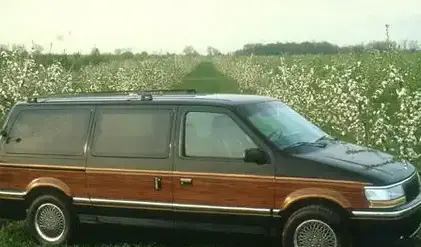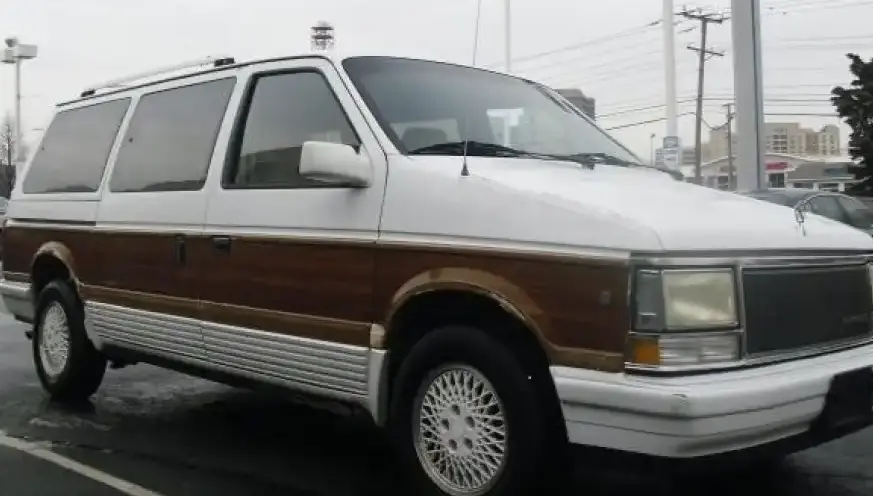
The Chrysler Town & Country I, specifically the 3.3 V6 variant with an automatic transmission, represents the initial foray of Chrysler into the modern minivan segment. Produced solely for the 1990 model year, this vehicle was a pivotal offering for families seeking a spacious and versatile vehicle. It was built on the Chrysler NS platform, sharing its underpinnings with the Dodge Caravan and Plymouth Voyager. This first generation Town & Country aimed to blend comfort, practicality, and a degree of upscale styling, positioning itself as a slightly more premium option within Chrysler’s minivan lineup. The 3.3L V6 automatic configuration was a mainstay of the range, offering a balance between affordability and acceptable performance for the target demographic.
Technical Specifications
| Brand | Chrysler |
| Model | Town & Country |
| Generation | Town & Country I |
| Type (Engine) | 3.3 V6 (152 Hp) Automatic |
| Start of production | 1990 |
| End of production | 1990 |
| Powertrain Architecture | Internal Combustion engine |
| Body type | Minivan |
| Seats | 7 |
| Doors | 4 |
| Fuel consumption (urban) | 13.1 l/100 km (18 US mpg, 21.6 UK mpg, 7.6 km/l) |
| Fuel consumption (extra urban) | 9.8 l/100 km (24 US mpg, 28.8 UK mpg, 10.2 km/l) |
| Fuel consumption (combined) | 11.8 l/100 km (19.9 US mpg, 23.9 UK mpg, 8.5 km/l) |
| Fuel Type | Petrol (Gasoline) |
| Weight-to-power ratio | 11.4 kg/Hp, 87.8 Hp/tonne |
| Weight-to-torque ratio | 6.9 kg/Nm, 145 Nm/tonne |
| Power | 152 Hp @ 4800 rpm |
| Power per litre | 46 Hp/l |
| Torque | 251 Nm @ 3600 rpm (185.13 lb.-ft. @ 3600 rpm) |
| Engine layout | Front, Transverse |
| Engine Model/Code | EGA |
| Engine displacement | 3301 cm3 (201.44 cu. in.) |
| Number of cylinders | 6 |
| Engine configuration | V-engine |
| Cylinder Bore | 93 mm (3.66 in.) |
| Piston Stroke | 81 mm (3.19 in.) |
| Compression ratio | 8.9:1 |
| Number of valves per cylinder | 2 |
| Fuel injection system | Multi-port manifold injection |
| Engine aspiration | Naturally aspirated engine |
| Engine oil capacity | 4.4 l (4.65 US qt | 3.87 UK qt) |
| Coolant | 9.6 l (10.14 US qt | 8.45 UK qt) |
| Kerb Weight | 1731 kg (3816.2 lbs.) |
| Trunk (boot) space – minimum | 850 l (30.02 cu. ft.) |
| Fuel tank capacity | 76 l (20.08 US gal | 16.72 UK gal) |
| Length | 4862 mm (191.42 in.) |
| Width | 1829 mm (72.01 in.) |
| Height | 1646 mm (64.8 in.) |
| Wheelbase | 3025 mm (119.09 in.) |
| Front track | 1521 mm (59.88 in.) |
| Rear (Back) track | 1577 mm (62.09 in.) |
| Drag coefficient (Cd) | 0.4 |
| Minimum turning circle (turning diameter) | 13.1 m (42.98 ft.) |
| Drivetrain Architecture | The Internal combustion engine (ICE) drives the front wheels of the vehicle. |
| Drive wheel | Front wheel drive |
| Number of gears and type of gearbox | 4 gears, automatic transmission |
| Front brakes | Ventilated discs |
| Rear brakes | Drum |
| Assisting systems | ABS (Anti-lock braking system) |
| Steering type | Steering rack and pinion |
| Power steering | Hydraulic Steering |
| Tires size | 205/70 R14 |
| Wheel rims size | 14 |
Introduction
The 1990 Chrysler Town & Country I, powered by the 3.3-liter V6 engine and paired with a four-speed automatic transmission, was a significant vehicle for Chrysler. It marked the company’s serious entry into the burgeoning minivan market, a segment largely defined by the Dodge Caravan and Plymouth Voyager. The Town & Country aimed for a slightly more upscale position, offering features and trim levels not typically found on its sister vehicles. This particular configuration – the 3.3L V6 automatic – was positioned as the mainstream offering, balancing affordability with acceptable performance for the average family. It was designed to appeal to buyers who needed space and practicality but didn’t necessarily require the higher performance of potential future, more powerful engine options.
Powertrain & Engine Architecture
The heart of the Town & Country I 3.3 was the Chrysler EGA engine, a 3.3-liter (201.44 cubic inches) V6. This engine utilized a 60-degree V-angle and featured a cast iron block with aluminum cylinder heads. It employed multi-port fuel injection, a relatively modern technology for the time, which helped improve fuel efficiency and throttle response compared to carbureted engines. The engine produced 152 horsepower at 4800 rpm and 251 Nm (185.13 lb-ft) of torque at 3600 rpm. The four-speed automatic transmission, a Chrysler-built Torqueflite A727 variant, was chosen for its reliability and smooth operation. While not the most technologically advanced transmission, it was well-suited to the engine’s power characteristics and the intended use of the vehicle. The transmission’s gear ratios were optimized for everyday driving, prioritizing fuel economy and comfortable cruising over outright acceleration.
Driving Characteristics
The 1990 Town & Country I 3.3L automatic offered a comfortable, if not particularly exhilarating, driving experience. Acceleration was adequate for merging onto highways and passing slower traffic, but it wasn’t a particularly quick vehicle. The automatic transmission contributed to a smooth and predictable power delivery, making it easy to drive in urban environments. Compared to the available manual transmission (though less common), the automatic sacrificed some responsiveness but gained significantly in convenience. The 3.3L V6, while sufficient, felt strained when fully loaded with passengers and cargo. The gear ratios of the A727 transmission were geared towards economy, meaning the engine often operated at higher RPMs during acceleration, contributing to a noticeable engine note. It wasn’t designed for sporty driving, but rather for providing a relaxed and practical transportation solution.
Equipment & Trim Levels
The Town & Country I 3.3 automatic came standard with a reasonable level of equipment for the time. This included features like air conditioning, power steering, a basic AM/FM radio, and cloth upholstery. The interior was designed with family use in mind, featuring durable materials and a relatively spacious layout. Optional extras included upgraded sound systems, power windows and locks, and a rear window wiper. The Town & Country trim generally featured slightly nicer interior appointments than the base Caravan or Voyager models, with upgraded seat fabrics and trim pieces. The exterior typically included body-colored trim and alloy wheels, further differentiating it from its more utilitarian siblings.
Chassis & Braking
The Town & Country I utilized a front-wheel-drive layout with an independent front suspension and a solid rear axle. The front suspension featured MacPherson struts, while the rear employed leaf springs. The braking system consisted of ventilated discs on the front wheels and drum brakes on the rear. Anti-lock brakes (ABS) were available as an option, providing improved stopping power and control in slippery conditions. The suspension was tuned for comfort, prioritizing a smooth ride over sporty handling. Stabilizer bars were included to reduce body roll during cornering, but the overall handling characteristics were typical of a large, family-oriented minivan.
Market Reception & Comparison
The 1990 Chrysler Town & Country I was generally well-received by critics and consumers. It was praised for its spacious interior, comfortable ride, and practical features. However, some reviewers noted that the 3.3L V6 engine could feel underpowered when the vehicle was fully loaded. Compared to the Dodge Caravan and Plymouth Voyager, the Town & Country offered a slightly more refined experience and a more upscale image. Fuel economy was average for the segment, with combined fuel consumption around 19.9 US mpg. Reliability was generally good, although some owners reported minor issues with the automatic transmission and electrical components.
Legacy
The 1990 Chrysler Town & Country I 3.3L automatic laid the foundation for Chrysler’s continued success in the minivan market. While the first generation was relatively short-lived, it established the Town & Country as a desirable and well-regarded vehicle. The 3.3L V6 and A727 automatic transmission proved to be reasonably durable powertrains, and many examples are still on the road today. In the used car market, these vehicles are often sought after by collectors and enthusiasts looking for a classic American minivan. The combination of practicality, comfort, and affordability made the Town & Country I a popular choice for families, and its legacy continues to influence the design and features of modern minivans.