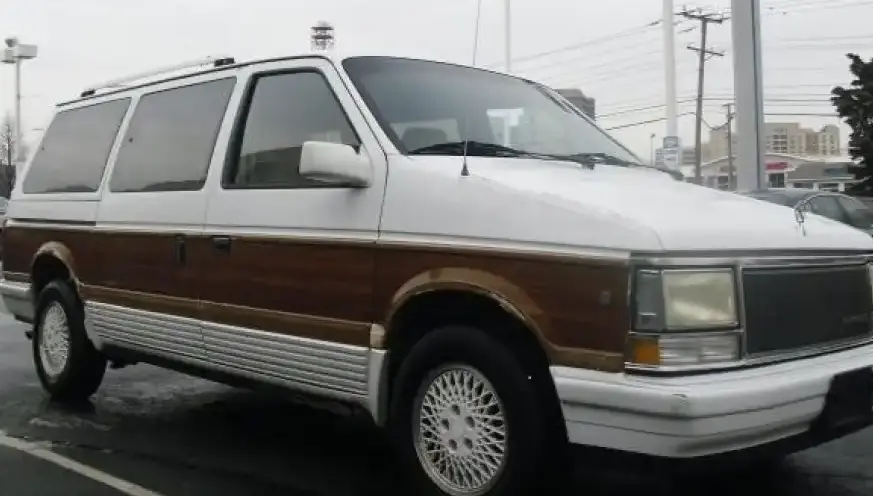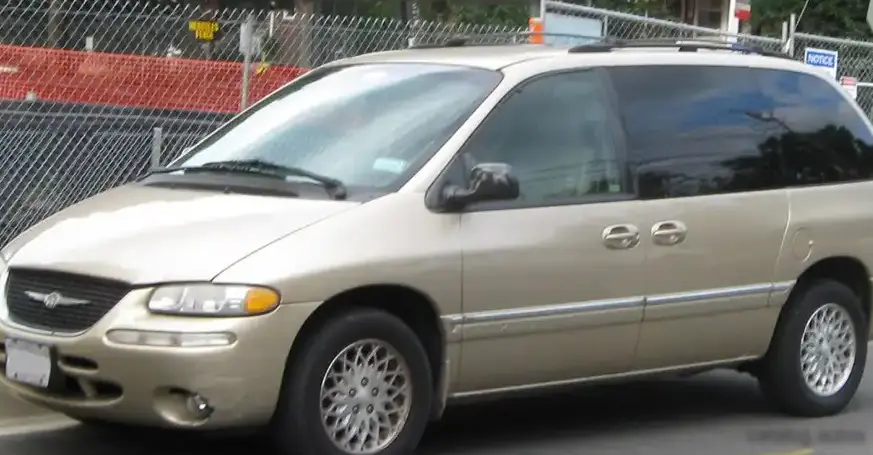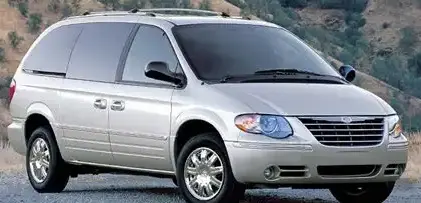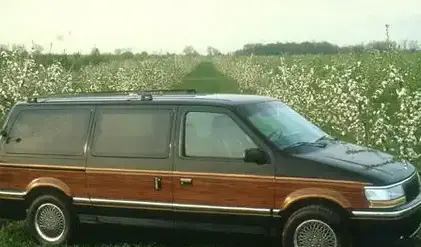
The Chrysler Town & Country II, specifically the 3.3 V6 variant with all-wheel drive and an automatic transmission, was produced between 1991 and 1995. This iteration represented a significant update to the original Town & Country, offering a more modern design and improved features. Positioned as a mid-range offering within the Town & Country II lineup, it aimed to provide a balance between affordability and capability, appealing to families needing space and all-weather traction. It was built on the Chrysler AS platform, shared with the Dodge Caravan and Plymouth Voyager.
Technical Specifications
| Brand | Chrysler |
| Model | Town & Country |
| Generation | Town & Country II |
| Type (Engine) | 3.3 V6 (152 Hp) AWD Automatic |
| Start of production | 1991 |
| End of production | 1995 |
| Powertrain Architecture | Internal Combustion engine |
| Body type | Minivan |
| Seats | 7 |
| Doors | 5 |
| Fuel consumption (urban) | 15.7 l/100 km (15 US mpg, 18 UK mpg, 6.4 km/l) |
| Fuel consumption (extra urban) | 11.8 l/100 km (19.9 US mpg, 23.9 UK mpg, 8.5 km/l) |
| Fuel consumption (combined) | 13.8 l/100 km (17 US mpg, 20.5 UK mpg, 7.2 km/l) |
| Fuel Type | Petrol (Gasoline) |
| Weight-to-power ratio | 12.5 kg/Hp, 79.8 Hp/tonne |
| Weight-to-torque ratio | 7.6 kg/Nm, 131.8 Nm/tonne |
| Power | 152 Hp @ 4800 rpm |
| Power per litre | 46 Hp/l |
| Torque | 251 Nm @ 3600 rpm (185.13 lb.-ft. @ 3600 rpm) |
| Engine layout | Front, Transverse |
| Engine Model/Code | EGA |
| Engine displacement | 3301 cm3 (201.44 cu. in.) |
| Number of cylinders | 6 |
| Engine configuration | V-engine |
| Cylinder Bore | 93 mm (3.66 in.) |
| Piston Stroke | 81 mm (3.19 in.) |
| Compression ratio | 8.9:1 |
| Number of valves per cylinder | 2 |
| Fuel injection system | Multi-port manifold injection |
| Engine aspiration | Naturally aspirated engine |
| Engine oil capacity | 4.4 l (4.65 US qt | 3.87 UK qt) |
| Coolant | 9.6 l (10.14 US qt | 8.45 UK qt) |
| Kerb Weight | 1905 kg (4199.81 lbs.) |
| Fuel tank capacity | 76 l (20.08 US gal | 16.72 UK gal) |
| Length | 4897 mm (192.8 in.) |
| Width | 1829 mm (72.01 in.) |
| Height | 1674 mm (65.91 in.) |
| Wheelbase | 3030 mm (119.29 in.) |
| Front track | 1521 mm (59.88 in.) |
| Rear track | 1577 mm (62.09 in.) |
| Drag coefficient (Cd) | 0.39 |
| Minimum turning circle | 13.1 m (42.98 ft.) |
| Drive wheel | All wheel drive (4×4) |
| Number of gears | 4 |
| Gearbox type | Automatic transmission |
| Front suspension | Wishbone |
| Rear suspension | Rigid axle suspension |
| Front brakes | Ventilated discs |
| Rear brakes | Drum |
| Assisting systems | ABS (Anti-lock braking system) |
| Steering type | Steering rack and pinion |
| Power steering | Hydraulic Steering |
| Tires size | 205/70 R15 |
| Wheel rims size | 15 |
Powertrain & Engine Architecture
The heart of this Town & Country II variant is the 3.3-liter EGA V6 engine. This engine, a member of Chrysler’s LA engine family, is a 60-degree V-engine featuring a cast iron block and aluminum cylinder heads. It utilizes a multi-port fuel injection system, delivering fuel directly to each intake port for improved efficiency and power delivery. The engine produces 152 horsepower at 4800 rpm and 251 Nm (185 lb-ft) of torque at 3600 rpm. The 8.9:1 compression ratio was a compromise between performance and the fuel quality available at the time. The engine is paired with a four-speed automatic transmission, a Torqueflite A727 variant, known for its durability. This transmission was a staple in Chrysler vehicles for many years and provided smooth, if not particularly sporty, shifts.
Driving Characteristics
The 3.3L V6 and automatic transmission combination in the Town & Country II delivered adequate, but not exhilarating, performance. Acceleration was sufficient for everyday driving and highway merging, but the vehicle’s weight (approximately 4200 lbs) meant it wasn’t particularly quick. The automatic transmission’s gear ratios were optimized for fuel economy and smooth cruising rather than aggressive acceleration. Compared to the available 3.8L V6 option, the 3.3L felt noticeably less powerful, especially when fully loaded with passengers and cargo. However, the all-wheel-drive system provided enhanced traction in inclement weather, a significant advantage over front-wheel-drive competitors. The steering was light and easy, making it maneuverable in urban environments, but lacked the precision found in more performance-oriented vehicles.
Equipment & Trim Levels
The 3.3L AWD automatic Town & Country II typically came standard with features like air conditioning, power windows and locks, an AM/FM stereo, and cloth upholstery. Higher trim levels offered upgrades such as leather seating, a premium sound system, and alloy wheels. Optional extras included a rear entertainment system, power sliding doors, and a sunroof. The interior design was functional and family-focused, with ample storage compartments and comfortable seating for seven passengers. The dashboard layout was straightforward and easy to use, with clearly labeled controls.
Chassis & Braking
The Town & Country II utilized a body-on-frame construction, providing a robust and durable platform. The front suspension featured an independent wishbone design, while the rear suspension employed a solid axle with leaf springs. This setup prioritized ride comfort over handling precision. The braking system consisted of ventilated discs on the front wheels and drum brakes on the rear. Anti-lock brakes (ABS) were standard, enhancing safety by preventing wheel lockup during hard braking. The all-wheel-drive system employed a viscous coupling to distribute torque between the front and rear axles, providing automatic engagement when slippage was detected.
Market Reception & Comparison
The 3.3L AWD Town & Country II received mixed reviews. Critics praised its spacious interior, comfortable ride, and all-weather capability. However, the engine’s performance was often criticized as being underwhelming, particularly when compared to the more powerful 3.8L V6 option. Fuel economy was also a concern, averaging around 17 mpg in combined driving. Compared to competitors like the Ford Windstar and Chevrolet Venture, the Town & Country II offered a more rugged and durable construction, but lacked the refinement and fuel efficiency of some of its rivals. The AWD system was a key differentiator, appealing to buyers in regions with harsh winters or challenging road conditions.
Legacy
The 3.3L V6 engine, while not known for its blistering performance, proved to be relatively reliable. The Torqueflite A727 automatic transmission is also renowned for its durability. Today, these vehicles are relatively affordable on the used car market, but finding well-maintained examples can be challenging. Common issues include corrosion, particularly in areas exposed to road salt, and wear and tear on suspension components. The all-wheel-drive system remains a desirable feature, and these vans are often sought after by those needing a capable and spacious vehicle for family transportation or light-duty work. While not a collector’s item, the 3.3L AWD Town & Country II represents a practical and durable minivan from a bygone era.