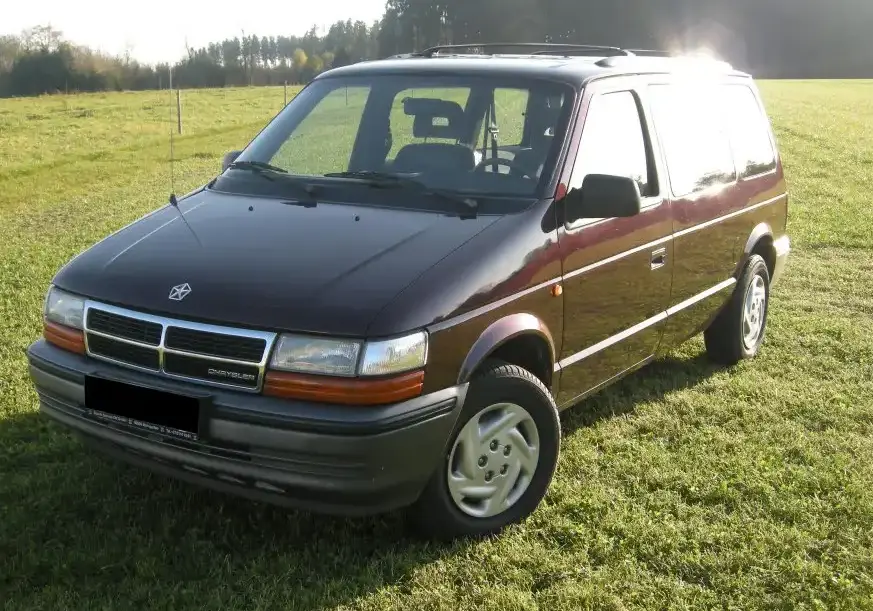
The Chrysler Voyager I 2.5i (98 hp) was a foundational model in the North American minivan market, produced from 1988 to 1990. It represented the first generation of the Voyager, a vehicle jointly developed with Renault and sold under various names globally (including Dodge Caravan and Plymouth Voyager). This particular variant, equipped with the 2.5-liter inline-four engine and a five-speed manual transmission, served as the entry-level offering for buyers seeking affordable and spacious family transportation. It was a key player in establishing the minivan as a dominant force in the American automotive landscape, challenging traditional station wagons and large sedans.
Technical Specifications
| Brand | Chrysler |
| Model | Voyager |
| Generation | Voyager I |
| Type (Engine) | 2.5 i (98 Hp) |
| Start of production | 1988 |
| End of production | 1990 |
| Powertrain Architecture | Internal Combustion engine |
| Body type | Minivan |
| Seats | 7 |
| Doors | 3 |
| Fuel consumption (combined) | 9.4 l/100 km (25 US mpg, 30.1 UK mpg, 10.6 km/l) |
| Fuel Type | Petrol (Gasoline) |
| Acceleration 0 – 100 km/h | 15.1 sec |
| Acceleration 0 – 62 mph | 15.1 sec |
| Acceleration 0 – 60 mph | 14.3 sec |
| Maximum speed | 153 km/h (95.07 mph) |
| Weight-to-power ratio | 16.2 kg/Hp (61.8 Hp/tonne) |
| Weight-to-torque ratio | 8.7 kg/Nm (115.5 Nm/tonne) |
| Power | 98 Hp @ 4700 rpm |
| Power per litre | 39.2 Hp/l |
| Torque | 183 Nm @ 2700 rpm (134.97 lb.-ft. @ 2700 rpm) |
| Engine layout | Front, Transverse |
| Engine displacement | 2501 cm3 (152.62 cu. in.) |
| Number of cylinders | 4 |
| Engine configuration | Inline |
| Cylinder Bore | 87.5 mm (3.44 in.) |
| Piston Stroke | 104 mm (4.09 in.) |
| Compression ratio | 8.9:1 |
| Number of valves per cylinder | 2 |
| Fuel injection system | Single-point injection |
| Engine aspiration | Naturally aspirated engine |
| Valvetrain | OHC |
| Engine oil capacity | 3.8 l (4.02 US qt | 3.34 UK qt) |
| Coolant | 8.1 l (8.56 US qt | 7.13 UK qt) |
| Kerb Weight | 1585 kg (3494.33 lbs.) |
| Max. weight | 2400 kg (5291.09 lbs.) |
| Max load | 815 kg (1796.77 lbs.) |
| Trunk (boot) space – minimum | 671 l (23.7 cu. ft.) |
| Trunk (boot) space – maximum | 3250 l (114.77 cu. ft.) |
| Fuel tank capacity | 76 l (20.08 US gal | 16.72 UK gal) |
| Length | 4525 mm (178.15 in.) |
| Width | 1830 mm (72.05 in.) |
| Height | 1707 mm (67.2 in.) |
| Wheelbase | 2853 mm (112.32 in.) |
| Front track | 1522 mm (59.92 in.) |
| Rear (Back) track | 1578 mm (62.13 in.) |
| Drivetrain Architecture | The Internal combustion engine (ICE) drives the front wheels of the vehicle. |
| Drive wheel | Front wheel drive |
| Number of gears and type of gearbox | 5 gears, manual transmission |
| Front suspension | Wishbone |
| Rear suspension | Leaf spring |
| Front brakes | Ventilated discs |
| Rear brakes | Drum |
| Assisting systems | ABS (Anti-lock braking system) |
| Steering type | Steering rack and pinion |
| Power steering | Hydraulic Steering |
| Tires size | 205/70 R15 |
Powertrain & Engine Architecture
The Voyager I 2.5i utilized Chrysler’s 2.5-liter inline-four cylinder engine, internally designated as the 525 engine family. This engine featured a single overhead camshaft (OHC) design and a two-valve-per-cylinder configuration. Fuel delivery was managed by a single-point fuel injection system, a relatively simple and cost-effective technology for the time. The engine’s 8.9:1 compression ratio was a compromise between performance and the fuel quality available in the American market. The five-speed manual transmission was a standard offering, providing drivers with more control over gear selection and potentially better fuel economy compared to the optional three-speed automatic. The engine was transversely mounted, a common layout for front-wheel-drive vehicles, maximizing interior space.
Driving Characteristics
With only 98 horsepower, the 2.5-liter Voyager I was not a performance-oriented vehicle. Acceleration was leisurely, taking approximately 15 seconds to reach 60 mph. However, the engine’s 183 Nm (135 lb-ft) of torque, available at a relatively low 2700 rpm, provided adequate power for everyday driving and hauling passengers. The five-speed manual transmission allowed drivers to keep the engine in its optimal power band, improving responsiveness. Compared to the later, more powerful 3.0-liter V6 versions of the Voyager, the 2.5i prioritized fuel efficiency and affordability over outright speed. The gear ratios were tuned for economy, resulting in a comfortable but not particularly engaging driving experience.
Equipment & Trim Levels
The Voyager I 2.5i was positioned as the base model, and as such, came with a relatively modest level of standard equipment. Typically, it included features such as cloth upholstery, a basic AM/FM radio, manual windows and locks, and a rear bench seat. Air conditioning was often an optional extra. The interior was designed for practicality and durability, with hard-wearing materials and a focus on maximizing space. Optional extras could include upgraded sound systems, power windows and locks, and a more comfortable seating configuration.
Chassis & Braking
The Voyager I featured a front-wheel-drive layout with an independent wishbone suspension at the front and a leaf spring suspension at the rear. The leaf spring design was a cost-saving measure, but it provided adequate load-carrying capacity for a family vehicle. Braking duties were handled by ventilated discs at the front and drum brakes at the rear. An anti-lock braking system (ABS) was available as an option, enhancing safety. The steering was rack-and-pinion with hydraulic power assistance, providing relatively light and precise steering feel.
Market Reception & Comparison
The Chrysler Voyager I 2.5i was generally well-received by critics as an affordable and practical family vehicle. Its spacious interior, versatile seating configurations, and relatively low price point made it a popular choice among budget-conscious buyers. However, its lack of power and basic features were often noted. Compared to the V6-powered Voyager models, the 2.5i offered significantly lower performance but better fuel economy. It also represented a more affordable entry point into the minivan segment. Reliability was generally good, although the single-point fuel injection system could be prone to issues over time.
Legacy
The Chrysler Voyager I 2.5i played a significant role in popularizing the minivan in the United States. While not known for its performance, it established the Voyager nameplate as a reliable and practical choice for families. Today, these early Voyagers are relatively rare and are often sought after by collectors and enthusiasts. The 2.5-liter engine, while not particularly powerful, proved to be reasonably durable, and well-maintained examples can still be found on the road. The Voyager I 2.5i remains a testament to the ingenuity and practicality of American automotive design in the late 1980s.