Technical Specifications
| Brand | Chrysler |
| Model | Voyager |
| Generation | Voyager I |
| Type (Engine) | 3.0 V6 (141 Hp) Automatic |
| Start of production | 1988 |
| End of production | 1990 |
| Powertrain Architecture | Internal Combustion engine |
| Body type | Minivan |
| Seats | 7 |
| Doors | 3 |
| Fuel consumption (urban) | 14.2 l/100 km (16.6 US mpg) |
| Fuel consumption (extra urban) | 8 l/100 km (29.4 US mpg) |
| Fuel consumption (combined) | 10.4 l/100 km (22.6 US mpg) |
| Fuel Type | Petrol (Gasoline) |
| Acceleration 0 – 100 km/h | 12.7 sec |
| Acceleration 0 – 62 mph | 12.7 sec |
| Acceleration 0 – 60 mph | 12.1 sec |
| Maximum speed | 177 km/h (109.98 mph) |
| Weight-to-power ratio | 11.2 kg/Hp |
| Weight-to-torque ratio | 7 kg/Nm |
| Power | 141 Hp @ 5200 rpm |
| Torque | 225 Nm @ 2600 rpm (165.95 lb.-ft. @ 2600 rpm) |
| Engine layout | Front, Transverse |
| Engine displacement | 2972 cm3 (181.36 cu. in.) |
| Number of cylinders | 6 |
| Engine configuration | V-engine |
| Cylinder Bore | 91.1 mm (3.59 in.) |
| Piston Stroke | 76 mm (2.99 in.) |
| Compression ratio | 8.9:1 |
| Number of valves per cylinder | 2 |
| Fuel injection system | Multi-port manifold injection |
| Engine aspiration | Naturally aspirated engine |
| Valvetrain | OHC |
| Engine oil capacity | 3.8 l (4.02 US qt | 3.34 UK qt) |
| Coolant capacity | 9.5 l (10.04 US qt | 8.36 UK qt) |
| Kerb Weight | 1585 kg (3494.33 lbs.) |
| Max. weight | 2360 kg (5202.91 lbs.) |
| Max load | 775 kg (1708.58 lbs.) |
| Trunk (boot) space – minimum | 671 l (23.7 cu. ft.) |
| Trunk (boot) space – maximum | 3250 l (114.77 cu. ft.) |
| Fuel tank capacity | 76 l (20.08 US gal | 16.72 UK gal) |
| Length | 4525 mm (178.15 in.) |
| Width | 1830 mm (72.05 in.) |
| Height | 1707 mm (67.2 in.) |
| Wheelbase | 2853 mm (112.32 in.) |
| Front track | 1522 mm (59.92 in.) |
| Rear track | 1578 mm (62.13 in.) |
| Drivetrain Architecture | Front wheel drive |
| Number of gears | 3 |
| Gearbox type | Automatic transmission |
| Front suspension | Wishbone |
| Rear suspension | Leaf spring |
| Front brakes | Ventilated discs |
| Rear brakes | Drum |
| Assisting systems | ABS (Anti-lock braking system) |
| Steering type | Steering rack and pinion |
| Power steering | Hydraulic |
| Tires size | 195/75 R14 |
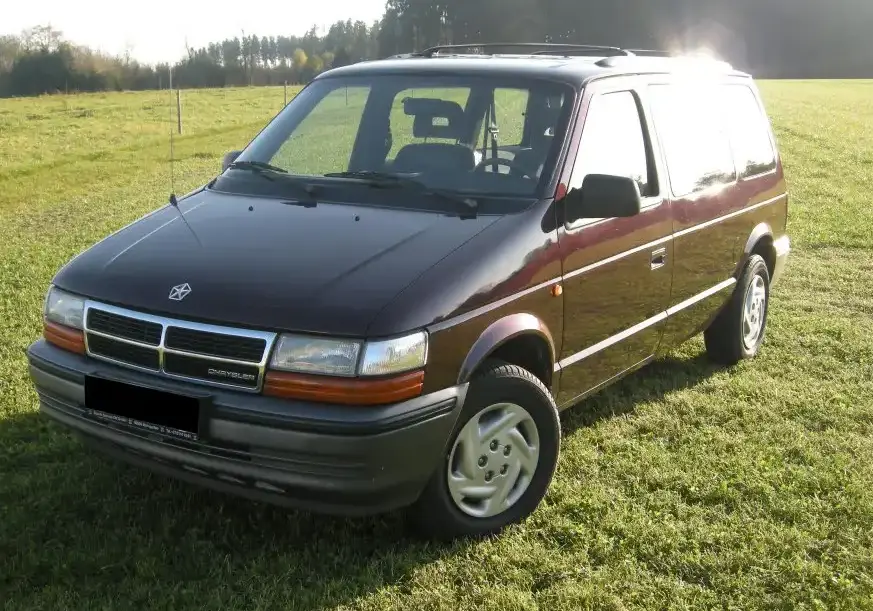
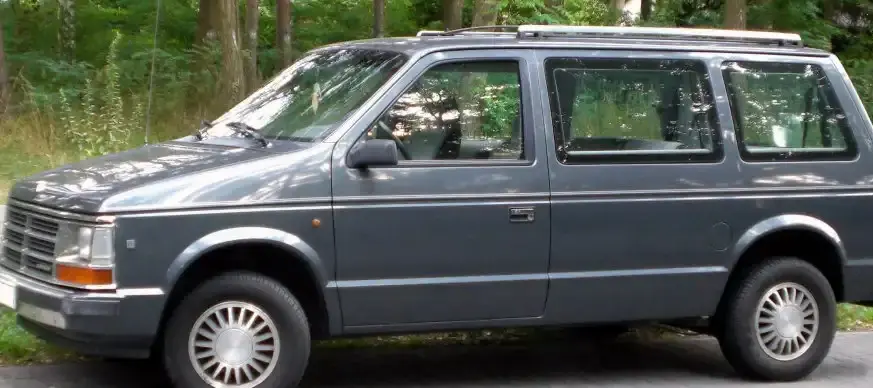
The Chrysler Voyager I 3.0 V6 Automatic, produced from 1988 to 1990, represents the entry-level offering in the first generation of Chrysler’s groundbreaking minivan. This model, built on the NS platform, was instrumental in popularizing the minivan segment in North America, providing a spacious and practical alternative to traditional station wagons and larger vans. The Voyager I, positioned as the base trim, offered a more affordable way to enter the Voyager family, appealing to families prioritizing versatility without the expense of higher-spec features. It shared many components and mechanicals with the Dodge Caravan, but was distinguished by its trim and badging.
Powertrain & Engine Architecture
The Voyager I 3.0 V6 was powered by Chrysler’s 3.0-liter V6 engine, internally known as the 3.0L. This engine belonged to the LA engine family, a robust and widely used powerplant. It featured a cast iron block and aluminum cylinder heads in a 60-degree V configuration. The engine produced 141 horsepower through the use of multi-port fuel injection and a relatively conservative 8.9:1 compression ratio. The valvetrain utilized a single overhead camshaft (OHC) design, operating two valves per cylinder. A three-speed automatic transmission was paired with the engine, offering smooth, though not particularly sporty, gear changes. This transmission was selected for its ease of operation and suitability for family use, prioritizing comfort over performance. The engine’s transverse mounting, typical of front-wheel-drive vehicles, helped maximize interior space.
Driving Characteristics
The combination of the 3.0L V6 and the three-speed automatic transmission in the Voyager I delivered adequate, but not thrilling, performance. Acceleration from 0 to 60 mph took around 12.1 seconds, making it competitive with other minivans of the era, but slower than models equipped with the optional 3.3L V6 or the Dodge Caravan’s turbocharged 2.5L engine. The automatic transmission, while smooth, lacked the responsiveness of a manual gearbox or a more modern automatic with more gears. Power delivery was relatively linear, with peak torque arriving at 2600 rpm, providing sufficient power for everyday driving and highway merging. The emphasis was clearly on practicality and fuel efficiency rather than outright speed. The automatic transmission’s gear ratios were optimized for fuel economy and smooth cruising, rather than quick acceleration.
Equipment & Trim Levels
As the base model, the Voyager I 3.0 V6 Automatic came standard with features considered essential for family transportation in the late 1980s. These included cloth upholstery, a basic AM/FM radio, manual windows and locks, and air conditioning. The interior was functional and durable, designed for ease of cleaning and long-term use. Optional extras included upgraded sound systems, power windows and locks, cruise control, and a rear window wiper. The Voyager I’s interior trim was more basic compared to the higher-spec LE and SE trims, which featured more luxurious materials and additional convenience features.
Chassis & Braking
The Voyager I utilized a front-wheel-drive layout with an independent wishbone suspension at the front and a solid leaf spring suspension at the rear. This setup provided a comfortable ride, although handling wasn’t particularly sporty. Braking was provided by ventilated discs at the front and drum brakes at the rear. Anti-lock braking system (ABS) was standard, enhancing safety. The relatively simple suspension design was chosen for its cost-effectiveness and durability, prioritizing ride comfort over dynamic handling. The leaf spring rear suspension was a common design for minivans of this era, offering a good balance of load-carrying capacity and ride quality.
Market Reception & Comparison
The Voyager I 3.0 V6 Automatic was generally well-received by automotive critics as a practical and affordable family vehicle. However, some reviewers pointed out the engine’s lack of power, especially when the vehicle was fully loaded with passengers and cargo. Compared to the higher-trim Voyager LE and SE models, the I offered less refinement and fewer features. The 3.3L V6 option provided a noticeable performance improvement, while the Dodge Caravan’s turbocharged 2.5L engine offered better fuel economy. Despite these drawbacks, the Voyager I’s affordability and spacious interior made it a popular choice for budget-conscious families.
Legacy
The Chrysler Voyager I 3.0 V6 Automatic, while not the most powerful or technologically advanced minivan of its time, played a crucial role in establishing the minivan segment. The 3.0L V6 engine, while known to exhibit some oil consumption as it aged, proved to be reasonably reliable. Today, these Voyagers are becoming increasingly rare and are sought after by collectors and enthusiasts. The combination of affordability, practicality, and a spacious interior continues to appeal to those looking for a classic American minivan. Parts availability remains generally good, making these vehicles relatively easy to maintain and restore. The Voyager I represents a significant moment in automotive history, marking the beginning of the modern minivan era.