Technical Specifications
| Brand | Chrysler |
| Model | Voyager |
| Generation | Voyager I |
| Type (Engine) | 3.0 V6 (144 Hp) Automatic |
| Start of production | 1988 |
| End of production | 1990 |
| Powertrain Architecture | Internal Combustion engine |
| Body type | Minivan |
| Seats | 7 |
| Doors | 3 |
| Fuel consumption (urban) | 14.7 l/100 km (16 US mpg, 19.2 UK mpg, 6.8 km/l) |
| Fuel consumption (extra urban) | 8 l/100 km (29.4 US mpg, 35.3 UK mpg, 12.5 km/l) |
| Fuel consumption (combined) | 10.4 l/100 km (22.6 US mpg, 27.2 UK mpg, 9.6 km/l) |
| Fuel Type | Petrol (Gasoline) |
| Acceleration 0 – 100 km/h | 12.8 sec |
| Acceleration 0 – 62 mph | 12.8 sec |
| Acceleration 0 – 60 mph | 12.2 sec |
| Maximum speed | 170 km/h (105.63 mph) |
| Weight-to-power ratio | 11 kg/Hp, 90.9 Hp/tonne |
| Weight-to-torque ratio | 6.9 kg/Nm, 145.7 Nm/tonne |
| Power | 144 Hp @ 5000 rpm |
| Power per litre | 48.5 Hp/l |
| Torque | 231 Nm @ 2400 rpm (170.38 lb.-ft. @ 2400 rpm) |
| Engine layout | Front, Transverse |
| Engine displacement | 2972 cm3 (181.36 cu. in.) |
| Number of cylinders | 6 |
| Engine configuration | V-engine |
| Cylinder Bore | 91.1 mm (3.59 in.) |
| Piston Stroke | 76 mm (2.99 in.) |
| Compression ratio | 8.9:1 |
| Number of valves per cylinder | 2 |
| Fuel injection system | Multi-port manifold injection |
| Engine aspiration | Naturally aspirated engine |
| Valvetrain | OHC |
| Engine oil capacity | 3.8 l (4.02 US qt | 3.34 UK qt) |
| Coolant capacity | 9.5 l (10.04 US qt | 8.36 UK qt) |
| Kerb Weight | 1585 kg (3494.33 lbs.) |
| Max. weight | 2360 kg (5202.91 lbs.) |
| Max load | 775 kg (1708.58 lbs.) |
| Trunk (boot) space – minimum | 671 l (23.7 cu. ft.) |
| Trunk (boot) space – maximum | 3250 l (114.77 cu. ft.) |
| Fuel tank capacity | 76 l (20.08 US gal | 16.72 UK gal) |
| Length | 4525 mm (178.15 in.) |
| Width | 1830 mm (72.05 in.) |
| Height | 1707 mm (67.2 in.) |
| Wheelbase | 2853 mm (112.32 in.) |
| Front track | 1522 mm (59.92 in.) |
| Rear (Back) track | 1578 mm (62.13 in.) |
| Drivetrain Architecture | The Internal combustion engine (ICE) drives the front wheels of the vehicle. |
| Drive wheel | Front wheel drive |
| Number of gears and type of gearbox | 3 gears, automatic transmission |
| Front suspension | Wishbone |
| Rear suspension | Leaf spring |
| Front brakes | Ventilated discs |
| Rear brakes | Disc |
| Assisting systems | ABS (Anti-lock braking system) |
| Steering type | Steering rack and pinion |
| Power steering | Hydraulic Steering |
| Tires size | 195/75 R14 |
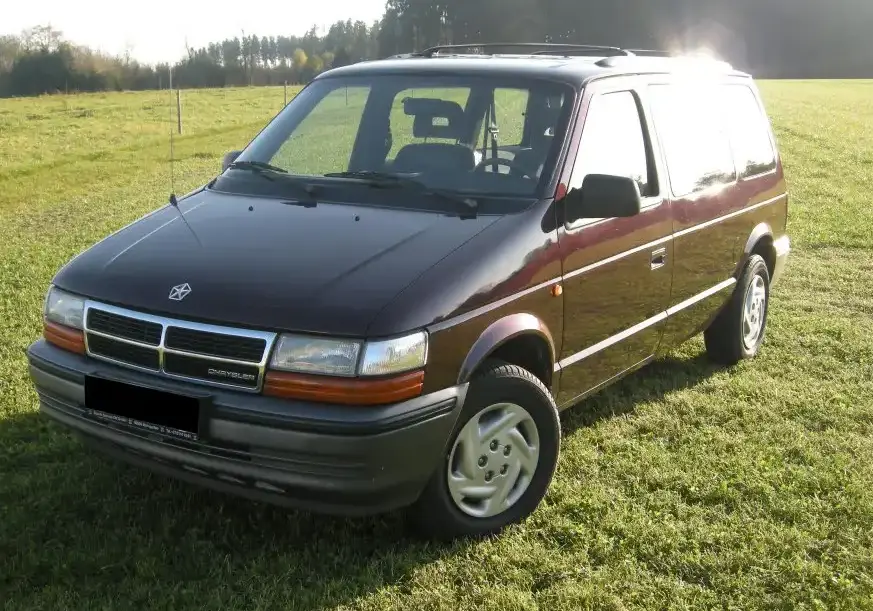
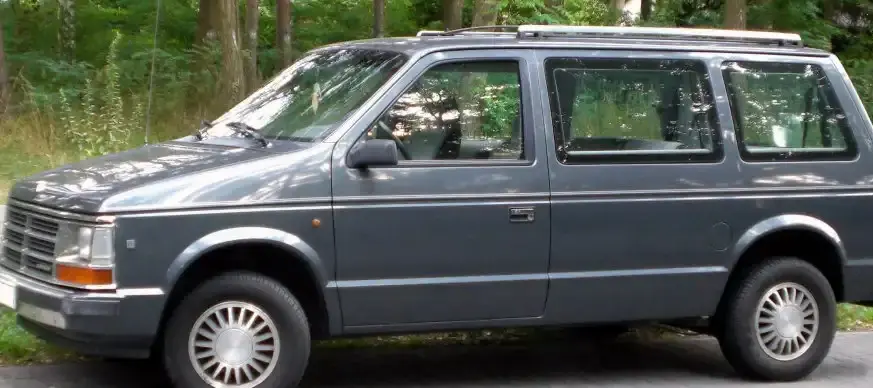
The Chrysler Voyager I 3.0 V6 Automatic, produced between 1988 and 1990, represents the initial offering in the first generation of Chrysler’s popular minivan. This model, built on the NS platform, was a key player in establishing the modern minivan segment in North America, offering a spacious and practical alternative to station wagons and larger vehicles. The Voyager I, with its 3.0-liter V6 engine and automatic transmission, was positioned as a comfortable and family-oriented option, though not the performance leader within the broader Voyager lineup. It served as the entry point into the Voyager range, offering a balance of features and affordability.
Powertrain & Engine Architecture
The heart of the Voyager I 3.0 was the Chrysler 3.0-liter V6 engine, internally designated as the 3.0L. This engine, part of the Chrysler LA engine family, was a 60-degree V6 featuring a cast iron block and aluminum cylinder heads. It utilized a multi-port fuel injection system, providing improved fuel efficiency and smoother operation compared to earlier carbureted designs. The engine produced 144 horsepower at 5000 rpm and 170 lb-ft of torque at 2400 rpm. The overhead camshaft (OHC) design, with two valves per cylinder, contributed to its relatively efficient operation. Paired with this engine was a three-speed automatic transmission, a Torqueflite A727 variant, chosen for its reliability and ease of use. This transmission was a common choice for Chrysler vehicles of the era and was known for its durability, though it lacked the sophistication of more modern automatic gearboxes.
Driving Characteristics
The Voyager I 3.0 V6 Automatic offered adequate, but not exhilarating, performance. Acceleration from 0 to 60 mph took around 12.2 seconds, and top speed was limited to 105.63 mph. The three-speed automatic transmission, while smooth, resulted in noticeable gear changes and a lack of the responsiveness found in manual transmission or later, more sophisticated automatic options. The gear ratios were optimized for fuel economy and cruising comfort rather than outright acceleration. Compared to the later, more powerful 3.3L V6 or the turbocharged variants, the 3.0L felt noticeably slower, particularly when fully loaded with passengers and cargo. However, for everyday driving and family transportation, the 3.0L provided sufficient power and a comfortable driving experience.
Equipment & Trim Levels
The Voyager I 3.0 Automatic was generally equipped with a modest level of standard features. Interior upholstery typically consisted of cloth seating, with options for upgraded velour or leather available. Standard features included air conditioning, an AM/FM stereo, and power steering. Optional extras included power windows and locks, cruise control, and a rear window wiper. The dashboard layout was functional and straightforward, prioritizing practicality over luxury. The Voyager I was designed to be a value-oriented minivan, so many features considered standard on higher trim levels were offered as optional packages.
Chassis & Braking
The Voyager I featured a front-wheel-drive layout, contributing to its relatively stable handling. The front suspension utilized an independent wishbone design, while the rear suspension employed a leaf spring setup. This combination provided a comfortable ride, though it wasn’t particularly sporty. Braking duties were handled by ventilated discs at the front and solid discs at the rear. An anti-lock braking system (ABS) was available as an option, enhancing safety in emergency braking situations. The steering system was a rack-and-pinion setup with hydraulic power assistance, providing relatively light and easy steering.
Market Reception & Comparison
The Chrysler Voyager I 3.0 V6 Automatic was generally well-received by critics as a practical and affordable family vehicle. However, the 3.0L engine and automatic transmission combination was often criticized for its lack of performance compared to other engine options in the Voyager lineup, such as the 3.3L V6. Fuel economy was considered average for the time, with combined figures around 22.6 US mpg. Reliability was generally good, though the automatic transmission could be prone to issues if not properly maintained. The Voyager I offered a compelling alternative to traditional station wagons and larger SUVs, and its spacious interior and comfortable ride made it a popular choice for families.
Legacy
The Chrysler Voyager I 3.0 V6 Automatic, while not the most powerful or technologically advanced version of the Voyager, played a significant role in establishing the minivan segment. The 3.0L engine and A727 automatic transmission proved to be reasonably durable, and many examples remain on the road today. In the used car market, these Voyagers are often sought after by those looking for an affordable and reliable family vehicle. While maintenance costs can increase with age, the relatively simple mechanical design makes them accessible for DIY repairs. The Voyager I represents a pivotal moment in automotive history, marking the beginning of the modern minivan era.