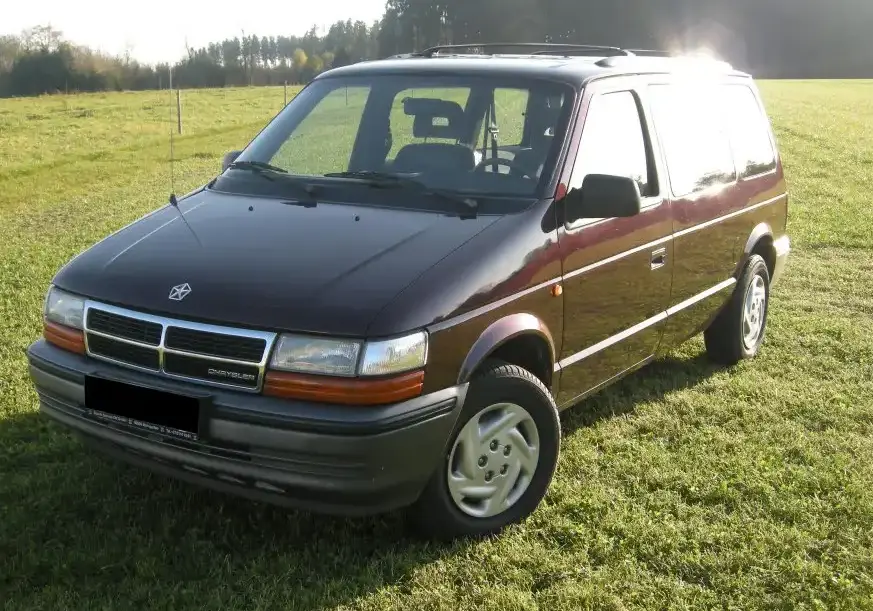
The Chrysler Voyager II 2.5i, producing 99 horsepower, was a key variant of the second-generation Chrysler Voyager minivan produced between 1990 and 1995. Positioned as an entry-level offering within the Voyager II range, it provided affordable family transportation with a focus on practicality rather than outright performance. This model was primarily sold in European and other international markets, where smaller displacement engines were favored due to taxation and fuel economy considerations. The Voyager II, built upon the Chrysler’s ‘NS’ platform, represented a significant step forward in minivan design, offering increased space and improved features compared to its predecessor.
Technical Specifications
| Brand | Chrysler |
| Model | Voyager |
| Generation | Voyager II |
| Type (Engine) | 2.5 i (99 Hp) |
| Start of production | 1990 |
| End of production | 1995 |
| Powertrain Architecture | Internal Combustion engine |
| Body type | Minivan |
| Seats | 7 |
| Doors | 3 |
| Fuel consumption (urban) | 15 l/100 km (15.7 US mpg, 18.8 UK mpg, 6.7 km/l) |
| Fuel consumption (extra urban) | 7.1 l/100 km (33.1 US mpg, 39.8 UK mpg, 14.1 km/l) |
| Fuel consumption (combined) | 9.6 l/100 km (24.5 US mpg, 29.4 UK mpg, 10.4 km/l) |
| Fuel Type | Petrol (Gasoline) |
| Acceleration 0 – 100 km/h | 15.2 sec |
| Acceleration 0 – 62 mph | 15.2 sec |
| Acceleration 0 – 60 mph | 14.4 sec |
| Maximum speed | 154 km/h (95.69 mph) |
| Weight-to-power ratio | 15.9 kg/Hp (63.1 Hp/tonne) |
| Weight-to-torque ratio | 8.8 kg/Nm (114 Nm/tonne) |
| Power | 99 Hp @ 4700 rpm |
| Power per litre | 39.6 Hp/l |
| Torque | 179 Nm @ 2800 rpm (132.02 lb.-ft. @ 2800 rpm) |
| Engine layout | Front, Transverse |
| Engine displacement | 2501 cm3 (152.62 cu. in.) |
| Number of cylinders | 4 |
| Engine configuration | Inline |
| Cylinder Bore | 87.5 mm (3.44 in.) |
| Piston Stroke | 104 mm (4.09 in.) |
| Compression ratio | 8.9:1 |
| Number of valves per cylinder | 2 |
| Fuel injection system | Single-point injection |
| Engine aspiration | Naturally aspirated engine |
| Valvetrain | OHC |
| Engine oil capacity | 3.8 l (4.02 US qt | 3.34 UK qt) |
| Coolant | 9 l (9.51 US qt | 7.92 UK qt) |
| Kerb Weight | 1570 kg (3461.26 lbs.) |
| Max. weight | 2395 kg (5280.07 lbs.) |
| Max load | 825 kg (1818.81 lbs.) |
| Trunk (boot) space – minimum | 671 l (23.7 cu. ft.) |
| Trunk (boot) space – maximum | 3250 l (114.77 cu. ft.) |
| Fuel tank capacity | 76 l (20.08 US gal | 16.72 UK gal) |
| Length | 4525 mm (178.15 in.) |
| Width | 1830 mm (72.05 in.) |
| Height | 1707 mm (67.2 in.) |
| Wheelbase | 2853 mm (112.32 in.) |
| Front track | 1522 mm (59.92 in.) |
| Rear (Back) track | 1578 mm (62.13 in.) |
| Drivetrain Architecture | The Internal combustion engine (ICE) drives the front wheels of the vehicle. |
| Drive wheel | Front wheel drive |
| Number of gears and type of gearbox | 5 gears, manual transmission |
| Front suspension | Wishbone |
| Rear suspension | Leaf spring |
| Front brakes | Ventilated discs |
| Rear brakes | Drum |
| Assisting systems | ABS (Anti-lock braking system) |
| Steering type | Steering rack and pinion |
| Power steering | Hydraulic Steering |
| Tires size | 195/75 R14 |
INTRODUCTION
The Chrysler Voyager II 2.5i (99 hp) was produced from 1990 to 1995 as part of the second generation of the Voyager minivan. This generation, known internally as the NS platform, was a collaborative effort with Renault and Peugeot, resulting in the shared production of several similar minivans. The 2.5i variant served as the entry point to the Voyager II lineup, offering a more affordable option for families seeking a spacious and practical vehicle. It was designed to appeal to buyers prioritizing fuel efficiency and lower running costs over outright performance. The Voyager II was a significant seller in Europe, where the minivan segment was gaining popularity, and it competed with models like the Renault Espace and Volkswagen Sharan.
Powertrain & Engine Architecture
The heart of the Voyager II 2.5i is the 2.5-liter inline-four cylinder engine. This engine, often identified by engine codes such as 5288232, is a naturally aspirated unit featuring a single overhead camshaft (OHC) design and two valves per cylinder. The fuel delivery system utilizes single-point fuel injection, a relatively simple system compared to multi-point injection, contributing to its lower cost. The engine produces 99 horsepower at 4700 rpm and 179 Nm (132 lb-ft) of torque at 2800 rpm. The engine’s bore and stroke are 87.5mm x 104mm, resulting in a compression ratio of 8.9:1. The engine is transversely mounted in the front of the vehicle. The standard transmission for this variant was a five-speed manual gearbox, although a three-speed automatic transmission was also available as an option, albeit less common. The automatic transmission, a Chrysler-built unit, was known for its smooth operation but contributed to slightly reduced fuel economy and acceleration.
Driving Characteristics
The Voyager II 2.5i with the 99 hp engine and manual transmission offered adequate, but not exhilarating, performance. Acceleration from 0-60 mph took approximately 14.4 seconds, and the top speed was around 95.69 mph. The engine felt strained when fully loaded with passengers and luggage, particularly on inclines. The five-speed manual transmission helped to keep the engine in its optimal power band, but the relatively low horsepower output meant that frequent downshifts were necessary. The automatic transmission further diminished acceleration, making the vehicle feel even slower. The steering was light and easy, making it maneuverable in urban environments, but lacked feedback at higher speeds. The suspension, tuned for comfort, provided a reasonably smooth ride, absorbing bumps and imperfections in the road surface effectively.
Equipment & Trim Levels
The 2.5i Voyager II was typically equipped with a basic level of standard features. These included cloth upholstery, a simple dashboard layout, and manual windows and door locks. Air conditioning was often an optional extra, as were power steering and central locking. The interior was designed with practicality in mind, offering ample storage space and a flexible seating arrangement. The rear seats could be folded flat or removed entirely to create a larger cargo area. Higher trim levels, such as the LE or SE, offered additional features like upgraded upholstery, alloy wheels, and a more comprehensive audio system. However, the base 2.5i model focused on providing essential transportation at an affordable price point.
Chassis & Braking
The Voyager II utilized a front-wheel-drive layout with an independent wishbone suspension at the front and a leaf spring suspension at the rear. The leaf spring setup, while cost-effective, was less sophisticated than the independent suspension found on some competitors and contributed to a slightly less refined ride quality. The braking system consisted of ventilated discs at the front and drum brakes at the rear. Anti-lock braking system (ABS) was available as an option, enhancing safety by preventing wheel lockup during hard braking. The steering was a rack-and-pinion system with hydraulic power assistance, providing relatively light and easy steering feel.
Market Reception & Comparison
The Voyager II 2.5i was generally well-received as an affordable and practical family vehicle. Critics praised its spacious interior, flexible seating arrangement, and relatively low running costs. However, the 99 hp engine was often criticized for being underpowered, particularly when the vehicle was fully loaded. Compared to the higher-output 2.0-liter and 2.6-liter engine options, the 2.5i offered significantly less performance. The 2.0-liter engine, while still not particularly powerful, provided a noticeable improvement in acceleration. The 2.6-liter engine, often paired with an automatic transmission, offered the best performance but came at a higher price. In terms of fuel economy, the 2.5i offered a reasonable compromise, achieving around 24.5 US mpg on the combined cycle.
Legacy
The Chrysler Voyager II 2.5i, while not the most powerful or technologically advanced minivan of its era, remains a popular choice among budget-conscious buyers in the used car market. The 2.5-liter engine is generally considered to be reliable, although regular maintenance is essential to prevent issues such as oil leaks and coolant loss. The availability of spare parts is generally good, and the relatively simple mechanical design makes it relatively easy to repair. However, potential buyers should be aware of potential corrosion issues, particularly in vehicles that have spent time in areas with harsh winters. Today, the Voyager II 2.5i represents a practical and affordable option for those seeking a spacious and reliable family vehicle.