Technical Specifications
| Brand | Citroen |
| Model | C4 |
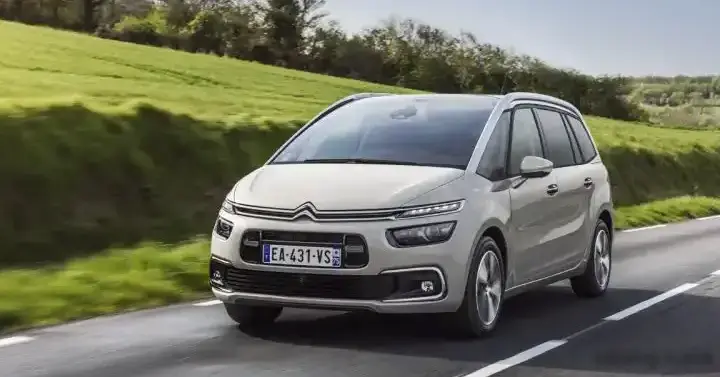
| Generation | C4 II Grand Picasso (Phase II, 2016) |
| Type (Engine) | 2.0 BlueHDI (150 Hp) S&S Automatic |
| Start of production | 2016 |
| End of production | 2018 |
| Powertrain Architecture | Internal Combustion engine |
| Body type | Minivan, MPV |
| Seats | 7 |
| Doors | 5 |
| Fuel consumption (urban) | 5.0-5.1 l/100 km (47 – 46.1 US mpg) |
| Fuel consumption (extra urban) | 3.9-4.0 l/100 km (60.3 – 58.8 US mpg) |
| Fuel consumption (combined) | 4.3-4.4 l/100 km (54.7 – 53.5 US mpg) |
| CO2 emissions | 112-115 g/km |
| Fuel Type | Diesel |
| Acceleration 0 – 100 km/h | 10.2 sec |
| Acceleration 0 – 62 mph | 10.2 sec |
| Acceleration 0 – 60 mph | 9.7 sec |
| Maximum speed | 207 km/h (128.62 mph) |
| Emission standard | Euro 6 |
| Weight-to-power ratio | 9.8 kg/Hp |
| Weight-to-torque ratio | 4 kg/Nm |
| Power | 150 Hp @ 4000 rpm |
| Torque | 370 Nm @ 2000 rpm (272.9 lb.-ft. @ 2000 rpm) |
| Engine layout | Front, Transverse |
| Engine Model/Code | AHX DW10FD |
| Engine displacement | 1997 cm3 (121.86 cu. in.) |
| Number of cylinders | 4 |
| Engine configuration | Inline |
| Cylinder Bore | 85 mm (3.35 in.) |
| Piston Stroke | 88 mm (3.46 in.) |
| Compression ratio | 16.7:1 |
| Number of valves per cylinder | 4 |
| Fuel injection system | Diesel Commonrail |
| Engine aspiration | Turbocharger, Intercooler |
| Engine oil capacity | 6 l (6.34 US qt | 5.28 UK qt) |
| Kerb Weight | 1476 kg (3254.02 lbs.) |
| Max. weight | 2280 kg (5026.54 lbs.) |
| Max load | 804 kg (1772.52 lbs.) |
| Trunk (boot) space – minimum | 165 l (5.83 cu. ft.) |
| Trunk (boot) space – maximum | 2181 l (77.02 cu. ft.) |
| Fuel tank capacity | 55 l (14.53 US gal | 12.1 UK gal) |
| AdBlue tank | 17 l (4.49 US gal | 3.74 UK gal) |
| Max. roof load | 80 kg (176.37 lbs.) |
| Permitted trailer load with brakes (12%) | 1300 kg (2866.01 lbs.) |
| Permitted trailer load without brakes | 750 kg (1653.47 lbs.) |
| Permitted towbar download | 70 kg (154.32 lbs.) |
| Length | 4602 mm (181.18 in.) |
| Width | 1826 mm (71.89 in.) |
| Width with mirrors folded | 1971 mm (77.6 in.) |
| Width including mirrors | 2117 mm (83.35 in.) |
| Height | 1638-1644 mm (64.49 – 64.72 in.) |
| Wheelbase | 2840 mm (111.81 in.) |
| Front track | 1573-1587 mm (61.93 – 62.48 in.) |
| Rear (Back) track | 1576-1590 mm (62.05 – 62.6 in.) |
| Front overhang | 889 mm (35 in.) |
| Rear overhang | 873 mm (34.37 in.) |
| Minimum turning circle | 11.3 m (37.07 ft.) |
| Drivetrain Architecture | Front wheel drive |
| Number of gears and type of gearbox | 6 gears, automatic transmission |
| Front suspension | Independent, type McPherson with coil spring and anti-roll bar |
| Rear suspension | Semi-independent, coil spring |
| Front brakes | Ventilated discs |
| Rear brakes | Disc |
| Assisting systems | ABS (Anti-lock braking system) |
| Steering type | Steering rack and pinion |
| Power steering | Electric Steering |
| Tires size | 205/55 R17; 225/45 R18 |
| Wheel rims size | 17; 18 |
The Citroen C4 II Grand Picasso (Phase II), specifically the 2.0 BlueHDI 150 horsepower (Hp) S&S Automatic variant, was produced from 2016 to 2018. This model represents a mid-life refresh of the second-generation C4 Picasso, a popular seven-seat minivan (MPV) designed to compete in the European family vehicle market. The Phase II updates included styling revisions, enhanced technology, and refinements to the engine lineup. This particular configuration – the 2.0 BlueHDI with an automatic transmission – occupied a mid-range position within the C4 Grand Picasso lineup, offering a balance between fuel efficiency, performance, and convenience. It aimed to appeal to families seeking a practical and comfortable vehicle for long journeys.
Powertrain & Engine Architecture
The heart of this C4 Grand Picasso variant is the 2.0-liter BlueHDI engine, identified by the code AHX DW10FD. This engine is a four-cylinder, inline diesel powerplant featuring a turbocharger and intercooler for enhanced performance and efficiency. The BlueHDI technology incorporates a Selective Catalytic Reduction (SCR) system utilizing AdBlue (Diesel Exhaust Fluid) to significantly reduce nitrogen oxide (NOx) emissions, ensuring compliance with stringent Euro 6 emission standards. The engine employs a common rail direct fuel injection system, delivering precise fuel metering for optimal combustion. The valvetrain utilizes four valves per cylinder, contributing to improved breathing and power output. Paired with this engine is a six-speed automatic transmission, designed to provide smooth and convenient gear changes. This transmission is electronically controlled, adapting shift points based on driving conditions and throttle input.
Driving Characteristics
The 150 horsepower and 370 Nm (272.9 lb-ft) of torque offered by this engine and transmission combination provided adequate performance for a seven-seat MPV. Acceleration from 0-60 mph took approximately 9.7 seconds, and top speed was around 128.62 mph. While not particularly sporty, the engine delivered sufficient power for comfortable highway cruising and overtaking maneuvers. The automatic transmission, while smooth, wasn’t known for its particularly quick shifts. Compared to the manual transmission versions of the same engine, the automatic offered less driver engagement but greater ease of use, especially in urban traffic. Higher-output versions of the 2.0 BlueHDI (typically 180 hp) provided noticeably quicker acceleration, but at the expense of fuel economy. The gear ratios were tuned for fuel efficiency and relaxed cruising, rather than outright performance.
Equipment & Trim Levels
The 2.0 BlueHDI 150 Hp S&S Automatic trim typically included a generous level of standard equipment. This often featured automatic climate control, a touchscreen infotainment system with navigation, Bluetooth connectivity, rear parking sensors, and cruise control. Interior upholstery was usually a comfortable cloth, with options for leather upgrades. Higher trim levels added features like panoramic sunroofs, advanced driver-assistance systems (ADAS) such as lane departure warning and automatic emergency braking, and premium audio systems. The “S&S” designation indicates the inclusion of a Start & Stop system, which automatically shuts off the engine when the vehicle is stationary to save fuel.
Chassis & Braking
The C4 Grand Picasso utilized an independent McPherson strut suspension at the front, providing a comfortable ride and decent handling. The rear suspension was a semi-independent coil spring setup. Braking consisted of ventilated discs at the front and solid discs at the rear, equipped with ABS (Anti-lock Braking System). The steering was electrically assisted, offering light and precise control. Stabilizer bars were fitted to both the front and rear axles to reduce body roll during cornering.
Market Reception & Comparison
The Citroen C4 Grand Picasso was generally well-received by critics for its spacious interior, comfortable ride, and practical features. The 2.0 BlueHDI 150 Hp Automatic variant was praised for its fuel efficiency and smooth operation. However, some reviewers noted that the automatic transmission could feel sluggish at times. Compared to rivals like the Renault Scenic and Volkswagen Touran, the C4 Grand Picasso offered a distinctive design and a focus on comfort. The fuel economy of this variant was competitive, typically achieving between 53.5 and 54.7 US mpg on the combined cycle. Reliability was generally good, although some owners reported minor issues with the electronic systems.
Legacy
The 2.0 BlueHDI engine proved to be a durable and reliable powerplant, and examples of this powertrain continue to be found in good working order today. The C4 Grand Picasso remains a popular choice in the used car market, particularly for families seeking a spacious and practical MPV. While not known for its sporting prowess, the 2.0 BlueHDI 150 Hp Automatic variant offers a compelling blend of fuel efficiency, comfort, and practicality, making it a sensible and affordable option for those needing a versatile family vehicle.