Technical Specifications
| Brand | Citroen |
| Model | C4 |
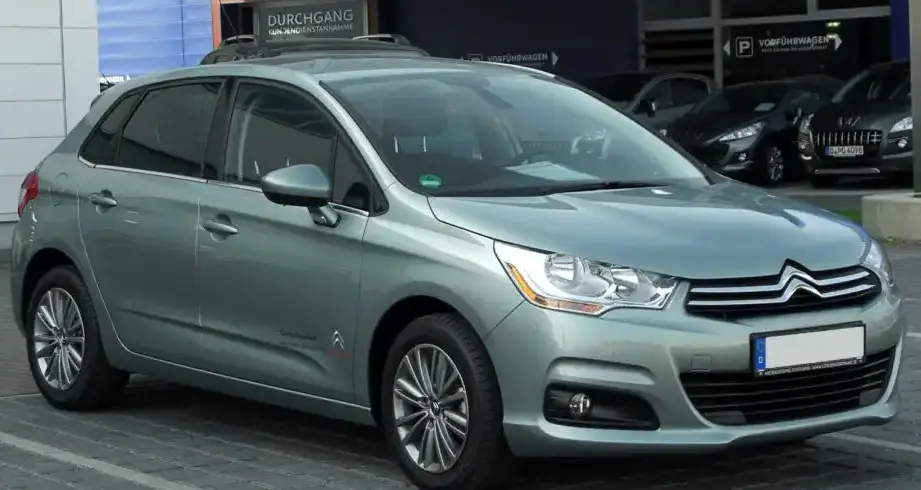
| Generation | C4 II Hatchback (Phase I, 2010) |
| Type (Engine) | 1.6 e-HDI (114 Hp) Airdream EGS |
| Start of production | 2013 |
| End of production | 2015 |
| Powertrain Architecture | Internal Combustion engine |
| Body type | Hatchback |
| Seats | 5 |
| Doors | 5 |
| Fuel consumption (urban) | 4.9 l/100 km (48 US mpg, 57.6 UK mpg, 20.4 km/l) |
| Fuel consumption (extra urban) | 3.8 l/100 km (61.9 US mpg, 74.3 UK mpg, 26.3 km/l) |
| Fuel consumption (combined) | 4.2 l/100 km (56 US mpg, 67.3 UK mpg, 23.8 km/l) |
| CO2 emissions | 109 g/km |
| Fuel Type | Diesel |
| Acceleration 0 – 100 km/h | 11.2 sec |
| Acceleration 0 – 62 mph | 11.2 sec |
| Acceleration 0 – 60 mph | 10.6 sec |
| Maximum speed | 190 km/h (118.06 mph) |
| Emission standard | Euro 5 |
| Weight-to-power ratio | 10.6 kg/Hp, 94.6 Hp/tonne |
| Weight-to-torque ratio | 4.5 kg/Nm, 224.1 Nm/tonne |
| Power | 114 Hp @ 3600 rpm |
| Power per litre | 73.1 Hp/l |
| Torque | 270 Nm @ 1750 rpm (199.14 lb.-ft. @ 1750 rpm) |
| Engine layout | Front, Transverse |
| Engine Model/Code | 9HD DV6C |
| Engine displacement | 1560 cm3 (95.2 cu. in.) |
| Number of cylinders | 4 |
| Engine configuration | Inline |
| Cylinder Bore | 75 mm (2.95 in.) |
| Piston Stroke | 88.3 mm (3.48 in.) |
| Compression ratio | 16:1 |
| Number of valves per cylinder | 2 |
| Fuel injection system | Diesel Commonrail |
| Engine aspiration | Turbocharger, Intercooler |
| Engine oil capacity | 3.75 l (3.96 US qt | 3.3 UK qt) |
| Kerb Weight | 1205 kg (2656.57 lbs.) |
| Max. weight | 1825 kg (4023.44 lbs.) |
| Max load | 620 kg (1366.87 lbs.) |
| Trunk (boot) space – minimum | 380 l (13.42 cu. ft.) |
| Trunk (boot) space – maximum | 1183 l (41.78 cu. ft.) |
| Fuel tank capacity | 60 l (15.85 US gal | 13.2 UK gal) |
| Permitted trailer load with brakes (8%) | 1550 kg (3417.17 lbs.) |
| Permitted trailer load without brakes | 635 kg (1399.94 lbs.) |
| Permitted towbar download | 75 kg (165.35 lbs.) |
| Length | 4329 mm (170.43 in.) |
| Width | 1789 mm (70.43 in.) |
| Width including mirrors | 2050 mm (80.71 in.) |
| Height | 1489-1502 mm (58.62 – 59.13 in.) |
| Wheelbase | 2608 mm (102.68 in.) |
| Front track | 1522-1536 mm (59.92 – 60.47 in.) |
| Rear (Back) track | 1515-1529 mm (59.65 – 60.2 in.) |
| Front overhang | 935 mm (36.81 in.) |
| Rear overhang | 786 mm (30.94 in.) |
| Drag coefficient (Cd) | 0.30 |
| Minimum turning circle | 10.7 m (35.1 ft.) |
| Drivetrain Architecture | The Internal combustion engine (ICE) drives the front wheels. |
| Drive wheel | Front wheel drive |
| Number of gears and type of gearbox | 6 gears, automatic transmission EGS |
| Front suspension | Independent, type McPherson with coil spring and anti-roll bar |
| Rear suspension | Semi-independent, coil spring |
| Front brakes | Ventilated discs |
| Rear brakes | Disc |
| Assisting systems | ABS (Anti-lock braking system) |
| Steering type | Steering rack and pinion |
| Tires size | 205/55 R16; 225/45 R17 |
| Wheel rims size | 16; 17 |
The Citroen C4 II Hatchback, specifically the 1.6 e-HDI (114 hp) Airdream EGS variant, was produced between 2013 and 2015. This model represents a key offering within the second generation of the C4 (B7 platform), aimed at the European market as a fuel-efficient and comfortable family hatchback. Positioned as a mid-range option, it bridged the gap between the lower-powered diesel engines and the more potent petrol variants. The “e-HDI” designation signified Citroen’s efforts to improve fuel economy and reduce emissions through advanced diesel technology, while the “Airdream” branding highlighted the vehicle’s aerodynamic efficiency and overall eco-friendliness. The EGS (Electronically Controlled Gearbox) transmission was a semi-automatic system designed to offer the convenience of an automatic with improved fuel consumption compared to traditional torque converter automatics.
Powertrain & Engine Architecture
The heart of this C4 variant is the 1.6-liter, four-cylinder diesel engine, specifically the 9HD DV6C code. This engine belongs to the PSA Group’s DV6 family, known for its compact size and relatively efficient operation. It features a common rail direct injection system, delivering fuel at extremely high pressure for optimized combustion. A turbocharger with an intercooler is employed to boost power and torque, providing a reasonable level of performance for everyday driving. The engine utilizes a single overhead camshaft (SOHC) design with two valves per cylinder. The EGS (Electronically Controlled Gearbox) transmission is a six-speed automated manual transmission. Unlike a traditional automatic with a torque converter, the EGS uses actuators to shift gears, offering quicker shifts and improved fuel economy. However, it can sometimes exhibit less smoothness than a conventional automatic.
Driving Characteristics
The 114 hp output and 270 Nm (199 lb-ft) of torque provide adequate, though not exhilarating, performance. Acceleration from 0 to 60 mph takes around 10.6 seconds, making it suitable for commuting and general driving. The EGS transmission, while efficient, can feel slightly jerky at low speeds or during stop-start traffic. Compared to the more powerful 1.6 HDi variants (typically around 130-136 hp) or the petrol engines, this version prioritizes fuel economy over outright speed. The gear ratios are tuned for efficiency, meaning the engine doesn’t rev as high as in the more performance-oriented models. The power delivery is relatively linear, with the peak torque available from 1750 rpm, providing good responsiveness in everyday driving situations.
Equipment & Trim Levels
The 1.6 e-HDI Airdream EGS trim typically included standard features such as air conditioning, electric front windows, a CD/radio player with USB connectivity, and ABS brakes. Higher trim levels, often denoted by names like “VTR+” or “Exclusive,” added features like alloy wheels, rear parking sensors, automatic headlights and wipers, and a more sophisticated infotainment system. Interior upholstery was generally cloth, with options for upgraded materials on higher trims. Optional extras could include a panoramic sunroof, navigation system, and leather upholstery.
Chassis & Braking
The C4 II utilizes a McPherson strut front suspension and a semi-independent torsion beam rear suspension. This setup provides a comfortable ride quality, prioritizing passenger comfort over sporty handling. The front brakes are ventilated discs, while the rear brakes are solid discs. ABS (Anti-lock Braking System) is standard, providing enhanced braking performance and stability. Stabilizer bars are fitted to both the front and rear axles to reduce body roll during cornering.
Market Reception & Comparison
The 1.6 e-HDI Airdream EGS variant was generally well-received by critics for its impressive fuel economy and low CO2 emissions. It was seen as a practical and economical choice for families and commuters. Compared to the higher-powered diesel versions, it offered a lower purchase price but sacrificed some performance. The EGS transmission received mixed reviews, with some praising its efficiency and others criticizing its occasional lack of smoothness. Against competitors like the Ford Focus, Volkswagen Golf, and Peugeot 308, the C4 offered a distinctive design and a comfortable ride.
Legacy
The 9HD DV6C engine, while generally reliable, is known to have potential issues with the diesel particulate filter (DPF) if not properly maintained, particularly with frequent short journeys. The EGS transmission can also require more specialized maintenance than a traditional automatic. However, with regular servicing and careful driving, this powertrain can prove durable. In the used car market, the 1.6 e-HDI Airdream EGS C4 represents a good value proposition for buyers seeking a fuel-efficient and affordable family hatchback. Its low running costs and comfortable ride continue to make it a popular choice.