Technical Specifications
| Brand | Citroen |
| Model | C4 |
| Generation | C4 II Hatchback (Phase I, 2010) |
| Type (Engine) | 1.6 HDI (114 Hp) |
| Start of production | 2013 |
| End of production | 2014 |
| Powertrain Architecture | Internal Combustion engine |
| Body type | Hatchback |
| Seats | 5 |
| Doors | 5 |
| Fuel consumption (urban) | 5.8 l/100 km (40.6 US mpg, 48.7 UK mpg, 17.2 km/l) |
| Fuel consumption (extra urban) | 3.9 l/100 km (60.3 US mpg, 72.4 UK mpg, 25.6 km/l) |
| Fuel consumption (combined) | 4.6 l/100 km (51.1 US mpg, 61.4 UK mpg, 21.7 km/l) |
| CO2 emissions | 119 g/km |
| Fuel Type | Diesel |
| Acceleration 0 – 100 km/h | 11.3 sec |
| Acceleration 0 – 62 mph | 11.3 sec |
| Acceleration 0 – 60 mph | 10.7 sec |
| Maximum speed | 190 km/h (118.06 mph) |
| Emission standard | Euro 5 |
| Weight-to-power ratio | 10.6 kg/Hp, 94.6 Hp/tonne |
| Weight-to-torque ratio | 4.5 kg/Nm, 224.1 Nm/tonne |
| Power | 114 Hp @ 3600 rpm |
| Power per litre | 73.1 Hp/l |
| Torque | 270 Nm @ 1750 rpm (199.14 lb.-ft. @ 1750 rpm) |
| Engine layout | Front, Transverse |
| Engine Model/Code | 9HR DV6C |
| Engine displacement | 1560 cm3 (95.2 cu. in.) |
| Number of cylinders | 4 |
| Engine configuration | Inline |
| Cylinder Bore | 75 mm (2.95 in.) |
| Piston Stroke | 88.3 mm (3.48 in.) |
| Compression ratio | 16:1 |
| Number of valves per cylinder | 2 |
| Fuel injection system | Diesel Commonrail |
| Engine aspiration | Turbocharger, Intercooler |
| Engine oil capacity | 3.8 l (4.02 US qt | 3.34 UK qt) |
| Kerb Weight | 1205 kg (2656.57 lbs.) |
| Max. weight | 1810 kg (3990.37 lbs.) |
| Max load | 605 kg (1333.8 lbs.) |
| Trunk (boot) space – minimum | 380 l (13.42 cu. ft.) |
| Trunk (boot) space – maximum | 1183 l (41.78 cu. ft.) |
| Fuel tank capacity | 60 l (15.85 US gal | 13.2 UK gal) |
| Permitted trailer load with brakes (8%) | 1550 kg (3417.17 lbs.) |
| Permitted trailer load without brakes | 675 kg (1488.12 lbs.) |
| Permitted towbar download | 75 kg (165.35 lbs.) |
| Length | 4329 mm (170.43 in.) |
| Width | 1789 mm (70.43 in.) |
| Width including mirrors | 2050 mm (80.71 in.) |
| Height | 1489-1502 mm (58.62 – 59.13 in.) |
| Wheelbase | 2608 mm (102.68 in.) |
| Front track | 1522-1536 mm (59.92 – 60.47 in.) |
| Rear (Back) track | 1515-1529 mm (59.65 – 60.2 in.) |
| Front overhang | 935 mm (36.81 in.) |
| Rear overhang | 786 mm (30.94 in.) |
| Drag coefficient (Cd) | 0.30 |
| Minimum turning circle (turning diameter) | 10.7 m (35.1 ft.) |
| Drivetrain Architecture | The Internal combustion engine (ICE) drives the front wheels of the vehicle. |
| Drive wheel | Front wheel drive |
| Number of gears and type of gearbox | 6 gears, manual transmission |
| Front suspension | Independent, type McPherson with coil spring and anti-roll bar |
| Rear suspension | Semi-independent, coil spring |
| Front brakes | Ventilated discs |
| Rear brakes | Disc |
| Assisting systems | ABS (Anti-lock braking system) |
| Steering type | Steering rack and pinion |
| Tires size | 205/55 R16; 225/45 R17 |
| Wheel rims size | 16; 17 |
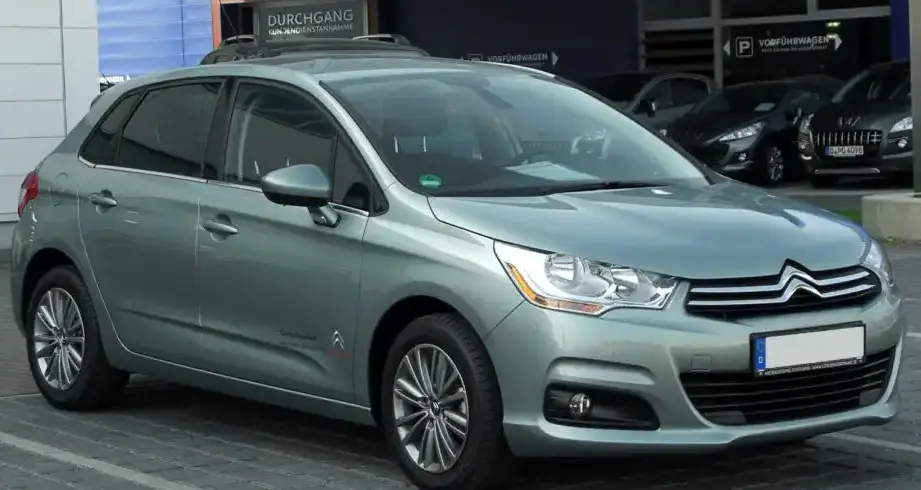
The Citroen C4 II Hatchback, specifically the 1.6 HDI variant producing 114 horsepower, was a significant model in Citroen’s European lineup from 2013 to 2014. Positioned as a mid-range offering within the second generation C4 (launched in 2010, internally designated as the B7 platform), this version aimed to strike a balance between fuel efficiency and acceptable performance for everyday driving. It was a popular choice in European markets, where diesel engines were favored for their economy and torque. This model represented Citroen’s effort to modernize the compact hatchback segment with a focus on comfort and practicality.
Powertrain & Engine Architecture
The core of this C4 variant is the 1.6-liter, four-cylinder diesel engine, identified by the engine code 9HR (DV6C). This engine is a widely used design within the PSA Group (Peugeot-Citroen) and was recognized for its relatively compact size and fuel-saving capabilities. It employs a common rail direct injection system, injecting fuel directly into the cylinders at high pressure for optimized combustion. A turbocharger with an intercooler further enhances power output by forcing more air into the cylinders. The valvetrain utilizes two valves per cylinder (SOHC). The engine generates 114 horsepower at 3600 rpm, with peak torque of 270 Nm (199 lb-ft) available from a low 1750 rpm, providing good responsiveness in typical driving scenarios. The engine is mounted transversely at the front of the vehicle. A 6-speed manual transmission was the standard configuration, chosen for its blend of fuel economy and driver engagement.
Driving Characteristics
The 1.6 HDI 114 hp C4 delivered a comfortable and practical driving experience. While not particularly sporty, the engine provided sufficient power for everyday commuting and highway travel. The relatively high torque output at low engine speeds meant the car felt responsive in urban environments, minimizing the need for frequent gear changes. The 6-speed manual transmission was well-suited to the engine’s characteristics, offering a good range of ratios. Compared to higher-output C4 models, such as those with more powerful diesel engines or gasoline variants, this version felt less eager to accelerate, and overtaking required more forethought. However, it excelled in fuel economy, consistently achieving figures close to the official combined consumption of 4.6 l/100km (51.1 US mpg). The gear ratios were optimized for efficiency rather than outright performance.
Equipment & Trim Levels
The 1.6 HDI 114 hp C4 typically included a reasonable array of standard features. These generally encompassed air conditioning, power windows, central locking, and an audio system with USB connectivity. Safety features such as ABS, electronic brakeforce distribution, and front airbags were also standard. Higher trim levels, like Exclusive or Sport, added features like alloy wheels, automatic headlights and wipers, rear parking sensors, and upgraded interior trim. Interior upholstery was typically cloth, with leather options available on higher-spec models. The dashboard layout was functional and user-friendly, featuring a clear instrument cluster and logically arranged controls.
Chassis & Braking
The C4 II employed a McPherson strut front suspension setup with a coil spring and anti-roll bar, providing a comfortable ride and predictable handling. The rear suspension utilized a semi-independent torsion beam arrangement, a cost-effective solution that offered a good balance of comfort and stability. The braking system consisted of ventilated discs on the front wheels and solid discs on the rear. ABS (Anti-lock Braking System) was standard, enhancing braking performance and safety. The suspension tuning prioritized comfort, resulting in a slightly softer ride compared to more performance-focused hatchbacks. Stabilizer bar thickness was moderate, contributing to reduced body roll during cornering.
Market Reception & Comparison
The Citroen C4 II 1.6 HDI 114 hp was generally well-received by automotive critics as a practical and economical family hatchback. It was praised for its comfortable ride, spacious interior, and fuel efficiency. However, some reviewers noted that the engine lacked the performance of some competitors. Compared to other engines in the C4 lineup, such as the 1.6 petrol or the more powerful 2.0 HDI diesel, this variant offered the best fuel economy but the slowest acceleration. Its main competitors included the Ford Focus, Volkswagen Golf, and Peugeot 308, all of which offered similar levels of practicality and economy.
Legacy
The 9HR DV6C engine, found in this C4 variant, proved to be a relatively reliable unit when properly maintained. Common issues included potential problems with the diesel particulate filter (DPF), particularly on vehicles used primarily for short trips. The turbocharger could also be a potential failure point over time. However, with regular servicing and preventative maintenance, these engines could achieve high mileages. In the used car market, the C4 II 1.6 HDI 114 hp remains a popular choice for buyers seeking an affordable and economical hatchback. Its reputation for fuel efficiency and practicality continues to make it a viable option for those prioritizing value and low running costs.