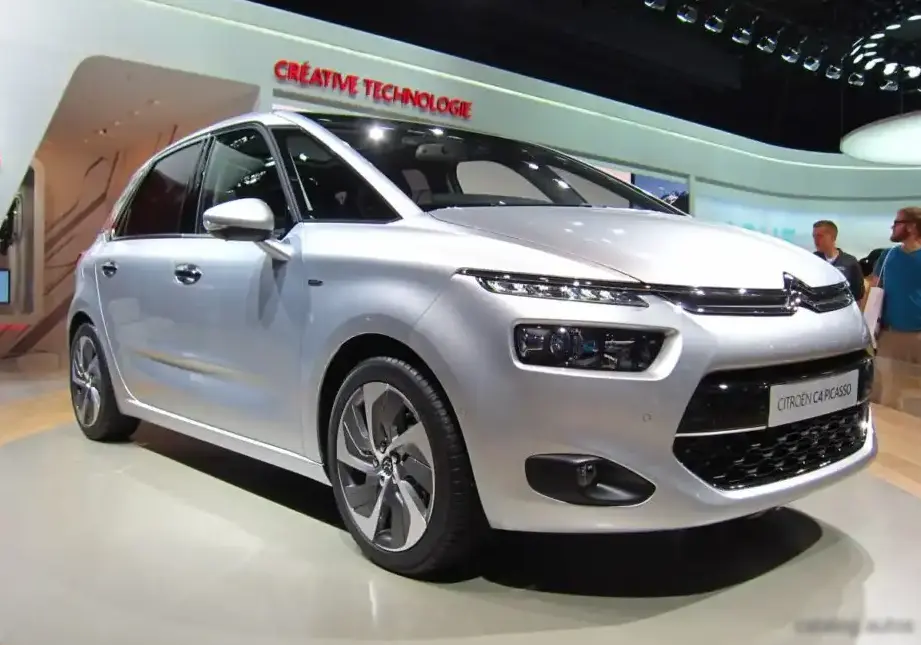
The Citroen C4 II Picasso 1.6 BlueHDi 99 S&S, produced between 2014 and 2016, represents a key variant within the second generation of Citroen’s popular compact MPV. Positioned as an entry-level diesel option, it aimed to deliver fuel efficiency and practicality to a broad customer base. This model falls within the Phase I refresh of the C4 Picasso (internally designated as B78), built on the EMP2 platform shared with Peugeot and other Stellantis brands. It was primarily marketed in Europe, where demand for efficient diesel-powered family vehicles remained strong. The “S&S” designation indicates the inclusion of Citroen’s Stop & Start system, further enhancing fuel economy.
Technical Specifications
| Brand | Citroen |
| Model | C4 |
| Generation | C4 II Picasso (Phase I, 2013) |
| Type (Engine) | 1.6 BlueHDi (99 Hp) S&S |
| Start of production | 2014 |
| End of production | 2016 |
| Powertrain Architecture | Internal Combustion engine |
| Body type | Minivan, MPV |
| Seats | 5 |
| Doors | 5 |
| Fuel consumption (urban) | 4.4-4.5 l/100 km (53.5 – 52.3 US mpg, 64.2 – 62.8 UK mpg, 22.7 – 22.2 km/l) |
| Fuel consumption (extra urban) | 3.5 l/100 km (67.2 US mpg, 80.7 UK mpg, 28.6 km/l) |
| Fuel consumption (combined) | 3.8 l/100 km (61.9 US mpg, 74.3 UK mpg, 26.3 km/l) |
| CO2 emissions | 99-100 g/km |
| Fuel Type | Diesel |
| Acceleration 0 – 100 km/h | 12.7 sec |
| Acceleration 0 – 62 mph | 12.7 sec |
| Acceleration 0 – 60 mph | 12.1 sec |
| Maximum speed | 176 km/h (109.36 mph) |
| Emission standard | Euro 6 |
| Weight-to-power ratio | 13.1 kg/Hp, 76.4 Hp/tonne |
| Weight-to-torque ratio | 5.1 kg/Nm, 196 Nm/tonne |
| Power | 99 Hp @ 3500 rpm |
| Power per litre | 63.5 Hp/l |
| Torque | 254 Nm @ 1750 rpm (187.34 lb.-ft. @ 1750 rpm) |
| Engine layout | Front, Transverse |
| Engine Model/Code | DV6FD |
| Engine displacement | 1560 cm3 (95.2 cu. in.) |
| Number of cylinders | 4 |
| Engine configuration | Inline |
| Cylinder Bore | 75 mm (2.95 in.) |
| Piston Stroke | 88.3 mm (3.48 in.) |
| Number of valves per cylinder | 2 |
| Fuel injection system | Diesel Commonrail |
| Engine aspiration | Turbocharger, Intercooler |
| Engine oil capacity | 3.75 l (3.96 US qt | 3.3 UK qt) |
| Coolant | 6.5 l (6.87 US qt | 5.72 UK qt) |
| Kerb Weight | 1296 kg (2857.19 lbs.) |
| Max. weight | 1950 kg (4299.01 lbs.) |
| Max load | 654 kg (1441.82 lbs.) |
| Trunk (boot) space – minimum | 537 l (18.96 cu. ft.) |
| Trunk (boot) space – maximum | 1710 l (60.39 cu. ft.) |
| Fuel tank capacity | 55 l (14.53 US gal | 12.1 UK gal) |
| Permitted trailer load with brakes (12%) | 1200 kg (2645.55 lbs.) |
| Permitted trailer load without brakes | 654 kg (1441.82 lbs.) |
| Permitted towbar download | 70 kg (154.32 lbs.) |
| Length | 4428 mm (174.33 in.) |
| Width | 1826 mm (71.89 in.) |
| Width with mirrors folded | 1971 mm (77.6 in.) |
| Width including mirrors | 2117 mm (83.35 in.) |
| Height | 1610-1625 mm (63.39 – 63.98 in.) |
| Wheelbase | 2785 mm (109.65 in.) |
| Front track | 1573-1587 mm (61.93 – 62.48 in.) |
| Rear (Back) track | 1576-1590 mm (62.05 – 62.6 in.) |
| Front overhang | 879 mm (34.61 in.) |
| Rear overhang | 764 mm (30.08 in.) |
| Minimum turning circle | 11.1 m (36.42 ft.) |
| Drivetrain Architecture | Front wheel drive |
| Drive wheel | Front wheel drive |
| Number of gears and type of gearbox | 5 gears, manual transmission |
| Front suspension | Independent, type McPherson with coil spring and anti-roll bar |
| Rear suspension | Semi-independent, coil spring |
| Front brakes | Ventilated discs |
| Rear brakes | Disc |
| Assisting systems | ABS (Anti-lock braking system) |
| Steering type | Steering rack and pinion |
| Power steering | Electric Steering |
| Tires size | 205/60 R16; 205/55 R17 |
| Wheel rims size | 16; 17 |
Powertrain & Engine Architecture
The heart of this C4 Picasso variant is the DV6FD engine, a 1.6-liter inline-four cylinder diesel. This engine is part of the PSA Group’s (now Stellantis) BlueHDi family, known for its focus on reducing particulate matter and NOx emissions through the use of a Diesel Particulate Filter (DPF) and Selective Catalytic Reduction (SCR) systems. The DV6FD utilizes a common rail direct injection system, delivering fuel at extremely high pressures for optimized combustion. It features a turbocharger with an intercooler to boost power and efficiency. The engine produces 99 horsepower at 3500 rpm and 254 Nm (187 lb-ft) of torque at 1750 rpm. The five-speed manual transmission was the standard offering, chosen for its simplicity and cost-effectiveness. The engine’s architecture prioritizes low-end torque, making it well-suited for everyday driving and carrying passengers.
Driving Characteristics
The 1.6 BlueHDi 99 hp engine, paired with the five-speed manual gearbox, delivers adequate, but not exhilarating, performance. Acceleration from 0-60 mph takes around 12.1 seconds, and top speed is 176 km/h (109 mph). The engine feels most comfortable in the mid-range, providing sufficient power for overtaking and highway cruising. The gear ratios are tuned for fuel economy, meaning the engine can feel strained when pushed hard. Compared to higher-output versions of the C4 Picasso, such as those with the 1.6 BlueHDi 115 hp or the 2.0 BlueHDi engines, this variant offers a more relaxed driving experience, prioritizing efficiency over outright performance. The Stop & Start system, while contributing to fuel savings, can sometimes feel intrusive in stop-and-go traffic.
Equipment & Trim Levels
The 1.6 BlueHDi 99 S&S typically came equipped as a mid-range trim level. Standard features generally included air conditioning, a touchscreen infotainment system with Bluetooth connectivity, electric front windows, and remote central locking. Safety features such as ABS, ESP (Electronic Stability Program), and multiple airbags were also standard. Optional extras included rear parking sensors, a panoramic sunroof, and upgraded upholstery. Interior trim was typically cloth, with a focus on practicality and durability. Higher trim levels offered features like automatic climate control, leather seats, and a more advanced infotainment system.
Chassis & Braking
The C4 II Picasso utilizes a McPherson strut front suspension and a semi-independent coil spring rear suspension. This setup provides a comfortable ride quality, absorbing bumps and imperfections in the road effectively. The front brakes are ventilated discs, while the rear brakes are solid discs. ABS (Anti-lock Braking System) is standard, providing enhanced braking performance in emergency situations. The suspension is tuned for comfort rather than sporty handling, prioritizing a smooth and stable ride for passengers.
Market Reception & Comparison
The Citroen C4 II Picasso 1.6 BlueHDi 99 S&S was generally well-received by critics for its fuel efficiency and practicality. It offered a compelling value proposition for families seeking an affordable and economical MPV. Compared to the more powerful diesel variants, it was seen as a more sensible choice for drivers who primarily used the vehicle for commuting and everyday errands. Fuel economy figures of around 3.8 l/100 km (61.9 US mpg) were highly competitive in its class. However, some reviewers noted that the engine could feel underpowered when fully loaded or driving uphill.
Legacy
The DV6FD engine, while generally reliable, is known to require regular maintenance, particularly regarding the DPF system. Proper servicing and the use of high-quality diesel fuel are crucial to prevent DPF blockages. The C4 II Picasso 1.6 BlueHDi 99 S&S remains a popular choice in the used car market, offering a good balance of practicality, fuel efficiency, and affordability. Its relatively simple mechanicals and readily available parts contribute to its ongoing appeal. However, potential buyers should be aware of the potential for DPF-related issues and ensure the vehicle has been properly maintained.