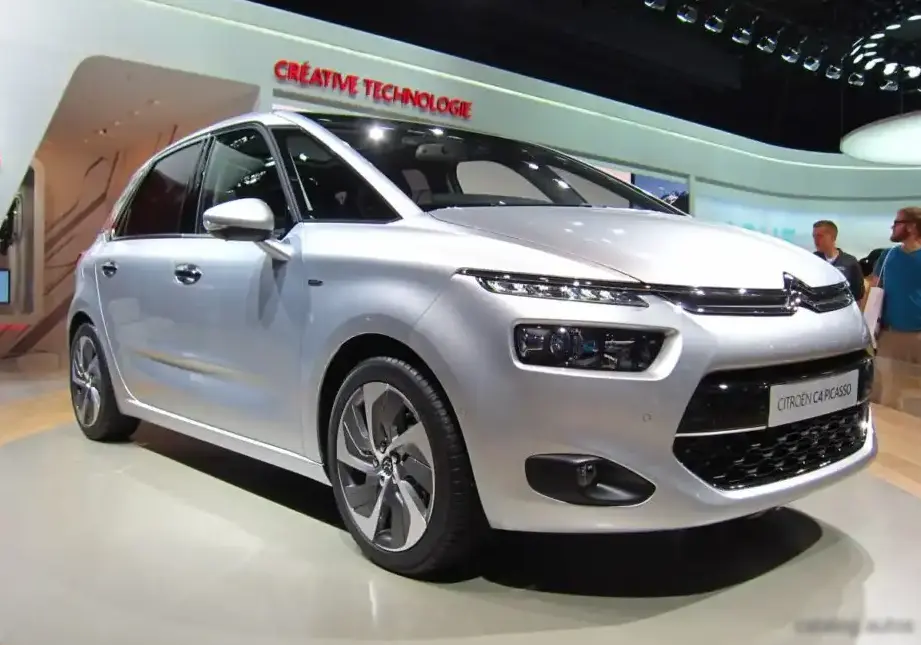
The Citroen C4 II Picasso 1.6 e-HDi AirDream EGS, produced between 2013 and 2014, represented an entry-level diesel option within the second generation of Citroen’s popular compact MPV. Positioned as a fuel-efficient and practical family vehicle, this variant aimed to provide accessible diesel technology to a broader customer base. It was part of the Phase I refresh of the C4 Picasso, built on the EMP2 platform (also known as the 1HX0/A3 platform) shared with Peugeot and other Stellantis brands. The AirDream trim level signified a focus on comfort and efficiency, and the EGS (Electronically Controlled Gearbox) transmission was a key differentiator from the standard manual options.
Technical Specifications
| Brand | Citroen |
| Model | C4 |
| Generation | C4 II Picasso (Phase I, 2013) |
| Type (Engine) | 1.6 e-HDi (92 Hp) AirDream EGS |
| Start of production | 2013 |
| End of production | 2014 |
| Powertrain Architecture | Internal Combustion engine |
| Body type | Minivan, MPV |
| Seats | 5 |
| Doors | 5 |
| Fuel consumption (urban) | 4.2 l/100 km (56 US mpg, 67.3 UK mpg, 23.8 km/l) |
| Fuel consumption (extra urban) | 3.5 l/100 km (67.2 US mpg, 80.7 UK mpg, 28.6 km/l) |
| Fuel consumption (combined) | 3.8 l/100 km (61.9 US mpg, 74.3 UK mpg, 26.3 km/l) |
| CO2 emissions | 98 g/km |
| Fuel Type | Diesel |
| Acceleration 0 – 100 km/h | 13.7 sec |
| Acceleration 0 – 62 mph | 13.7 sec |
| Acceleration 0 – 60 mph | 13 sec |
| Maximum speed | 175 km/h (108.74 mph) |
| Emission standard | Euro 6 |
| Weight-to-power ratio | 14 kg/Hp, 71.4 Hp/tonne |
| Weight-to-torque ratio | 5.6 kg/Nm, 178.4 Nm/tonne |
| Power | 92 Hp @ 4000 rpm |
| Power per litre | 59 Hp/l |
| Torque | 230 Nm @ 1750 rpm (169.64 lb.-ft. @ 1750 rpm) |
| Engine layout | Front, Transverse |
| Engine Model/Code | 9HP DV6DTED |
| Engine displacement | 1560 cm3 (95.2 cu. in.) |
| Number of cylinders | 4 |
| Engine configuration | Inline |
| Cylinder Bore | 75 mm (2.95 in.) |
| Piston Stroke | 88.3 mm (3.48 in.) |
| Compression ratio | 16:1 |
| Number of valves per cylinder | 2 |
| Fuel injection system | Diesel Commonrail |
| Engine aspiration | Turbocharger, Intercooler |
| Engine oil capacity | 3.75 l (3.96 US qt | 3.3 UK qt) |
| Kerb Weight | 1289 kg (2841.76 lbs.) |
| Max. weight | 1940 kg (4276.97 lbs.) |
| Max load | 651 kg (1435.21 lbs.) |
| Trunk (boot) space – minimum | 537 l (18.96 cu. ft.) |
| Trunk (boot) space – maximum | 1710 l (60.39 cu. ft.) |
| Fuel tank capacity | 55 l (14.53 US gal | 12.1 UK gal) |
| Permitted trailer load with brakes (12%) | 1200 kg (2645.55 lbs.) |
| Permitted trailer load without brakes | 680 kg (1499.14 lbs.) |
| Permitted towbar download | 70 kg (154.32 lbs.) |
| Length | 4428 mm (174.33 in.) |
| Width | 1826 mm (71.89 in.) |
| Width with mirrors folded | 1971 mm (77.6 in.) |
| Width including mirrors | 1971 mm (77.6 in.) |
| Height | 1610-1625 mm (63.39 – 63.98 in.) |
| Wheelbase | 2785 mm (109.65 in.) |
| Front track | 1573-1587 mm (61.93 – 62.48 in.) |
| Rear (Back) track | 1576-1590 mm (62.05 – 62.6 in.) |
| Front overhang | 879 mm (34.61 in.) |
| Rear overhang | 764 mm (30.08 in.) |
| Minimum turning circle (turning diameter) | 11.1 m (36.42 ft.) |
| Drivetrain Architecture | The Internal combustion engine (ICE) drives the front wheels of the vehicle. |
| Drive wheel | Front wheel drive |
| Number of gears and type of gearbox | 6 gears, automatic transmission EGS |
| Front suspension | Independent, type McPherson with coil spring and anti-roll bar |
| Rear suspension | Semi-independent, coil spring |
| Front brakes | Ventilated discs |
| Rear brakes | Disc |
| Assisting systems | ABS (Anti-lock braking system) |
| Steering type | Steering rack and pinion |
| Power steering | Electric Steering |
| Tires size | 205/60 R16 |
| Wheel rims size | 16 |
Powertrain & Engine Architecture
The heart of this C4 Picasso variant is the 1.6-liter DV6DTED engine, a member of the PSA Group’s (now Stellantis) well-established diesel family. This engine, designated as 9HP, utilizes a common-rail direct injection system, delivering fuel at extremely high pressure for optimized combustion. A turbocharger with an intercooler is employed to boost power and torque, mitigating turbo lag and improving overall responsiveness. The engine produces 92 horsepower at 4000 rpm and 230 Nm (169.64 lb-ft) of torque at 1750 rpm. The e-HDi designation indicates the inclusion of Stop & Start technology, designed to improve fuel economy by automatically shutting off the engine when the vehicle is stationary. The EGS (Electronically Controlled Gearbox) is a semi-automatic transmission, essentially a conventional manual gearbox with automated clutch and gear shifting. It differs from a traditional torque converter automatic, offering quicker shifts but sometimes exhibiting less smoothness.
Driving Characteristics
The 1.6 e-HDi with the EGS transmission delivers a driving experience focused on economy rather than outright performance. Acceleration from 0-100 km/h (0-62 mph) takes 13.7 seconds, and the top speed is 175 km/h (108.74 mph). The EGS transmission, while efficient, can feel somewhat jerky during low-speed maneuvers and gear changes compared to a conventional automatic. The relatively low power output necessitates careful planning when overtaking or merging onto highways. However, the engine’s strong low-end torque makes it suitable for everyday driving, providing adequate pulling power for loaded vehicles. Compared to the more powerful 1.6 BlueHDi or 2.0 BlueHDi variants, this 92 hp version feels noticeably slower, but it offers significantly better fuel economy.
Equipment & Trim Levels
The AirDream trim level, as standard, included features such as air conditioning, electric front windows, a CD/radio player with USB connectivity, and height-adjustable front seats. Safety features included ABS, ESP (Electronic Stability Program), and multiple airbags. Optional extras available for this trim included rear parking sensors, a panoramic sunroof, and upgraded upholstery. The interior typically featured cloth upholstery and a functional, if somewhat basic, dashboard layout. The focus was on practicality and durability rather than luxurious appointments.
Chassis & Braking
The C4 II Picasso’s chassis utilizes an independent McPherson strut suspension at the front and a semi-independent coil spring suspension at the rear. This setup provides a comfortable ride quality, absorbing bumps and imperfections in the road surface effectively. The front brakes are ventilated discs, while the rear brakes are solid discs. The steering is electrically assisted, providing light and precise control. Stabilizer bars are fitted to both the front and rear axles to reduce body roll during cornering.
Market Reception & Comparison
The Citroen C4 II Picasso 1.6 e-HDi AirDream EGS was generally well-received by critics for its fuel efficiency and practicality. However, the EGS transmission received mixed reviews, with some testers finding it clunky and unresponsive. Compared to the manual transmission versions of the same engine, the EGS offered convenience but sacrificed some driving enjoyment. Against competitors like the Renault Scenic and Volkswagen Touran, the C4 Picasso offered a compelling combination of space, comfort, and fuel economy, particularly in this entry-level diesel guise. Fuel economy figures of around 3.8 l/100 km (61.9 US mpg) were highly competitive for its class.
Legacy
The 1.6 e-HDi engine, while superseded by the newer BlueHDi variants, proved to be a relatively reliable unit when properly maintained. The EGS transmission, however, is known to be more prone to issues than conventional automatics, requiring careful servicing and attention to clutch wear. In the used car market, this variant represents an affordable entry point into C4 Picasso ownership, appealing to buyers prioritizing fuel economy and practicality. However, potential buyers should be aware of the potential maintenance costs associated with the EGS transmission and ensure a thorough inspection before purchase.