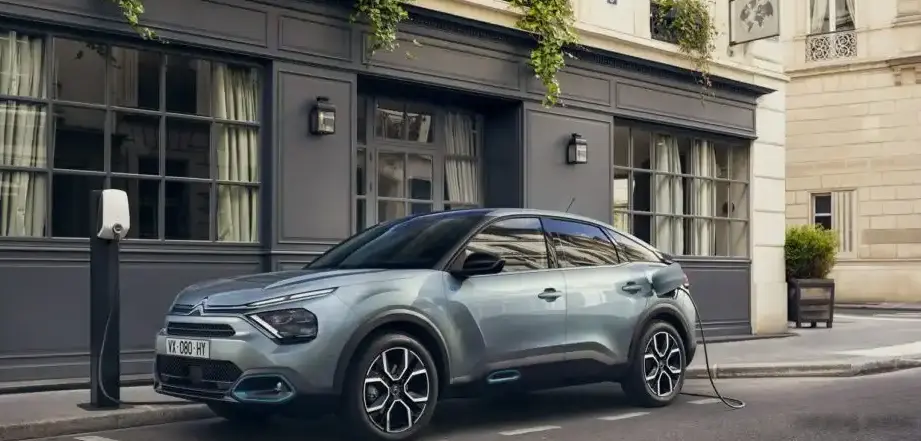
The Citroën e-C4 50 kWh (136 hp) represents Citroën’s initial foray into the all-electric compact vehicle segment, launched in December 2020 as part of the third generation (C4 III, Phase I) of the C4 model line. Positioned as an accessible entry point into electric motoring, the e-C4 aimed to blend the comfort Citroën is known for with the practicality of a compact crossover. Production continued through October 2024. The e-C4 utilizes the Common Modular Platform (CMP) shared with other Stellantis brands, allowing for both internal combustion engine (ICE) and fully electric variants to be built on the same production line. This particular 50 kWh variant served as the base model for the e-C4 range, offering a balance between range, performance, and affordability.
Technical Specifications
| Brand | Citroen |
| Model | C4 |
| Generation | C4 III (Phase I, 2020) |
| Type (Engine) | e-C4 50 kWh (136 Hp) |
| Start of production | December, 2020 |
| End of production | October, 2024 |
| Powertrain Architecture | BEV (Electric Vehicle) |
| Body type | Coupe, SUV |
| Seats | 5 |
| Doors | 5 |
| Fuel Type | Electricity |
| Acceleration 0 – 100 km/h | 9.4 sec |
| Acceleration 0 – 62 mph | 9.4 sec |
| Acceleration 0 – 60 mph | 8.9 sec |
| Maximum speed | 150 km/h (93.21 mph) |
| Weight-to-power ratio | 11.3 kg/Hp |
| Weight-to-torque ratio | 5.9 kg/Nm |
| Gross battery capacity | 50 kWh |
| Net (usable) battery capacity | 45 kWh |
| Battery technology | Lithium-ion (Li-Ion) |
| Battery location | Below the floor |
| All-electric range (WLTP) | 350 km (217.48 mi) |
| Average Energy consumption (WLTP) | 16.6 kWh/100 km (26.72 kWh/100 mi) |
| Electric motor power | 136 Hp @ 3700-10000 rpm |
| Electric motor Torque | 260 Nm @ 300-3700 rpm (191.77 lb.-ft. @ 300-3700 rpm) |
| Electric motor model/code | ZK01 |
| Electric motor location | Front axle, Transverse |
| Electric motor type | Synchronous |
| Kerb Weight | 1541 kg (3397.32 lbs) |
| Max. weight | 2000 kg (4409.25 lbs) |
| Max load | 459 kg (1011.92 lbs) |
| Trunk (boot) space – minimum | 380 l (13.42 cu. ft.) |
| Trunk (boot) space – maximum | 1250 l (44.14 cu. ft.) |
| Length | 4360 mm (171.65 in) |
| Width | 1800 mm (70.87 in) |
| Width with mirrors folded | 1834 mm (72.2 in) |
| Width including mirrors | 2032 mm (80 in) |
| Height | 1520 mm (59.84 in) |
| Wheelbase | 2670 mm (105.12 in) |
| Front track | 1545-1560 mm (60.83 – 61.42 in) |
| Rear (Back) track | 1545-1560 mm (60.83 – 61.42 in) |
| Front overhang | 880 mm (34.65 in) |
| Rear overhang | 810 mm (31.89 in) |
| Ride height (ground clearance) | 197 mm (7.76 in) |
| Minimum turning circle | 10.9 m (35.76 ft) |
| Drivetrain Architecture | One electric motor drives the front wheels |
| Drive wheel | Front wheel drive |
| Number of gears and type of gearbox | 1 gears, automatic transmission |
| Front suspension | Independent, type McPherson with coil spring and anti-roll bar |
| Rear suspension | Coil spring, Torsion |
| Front brakes | Ventilated discs |
| Rear brakes | Disc |
| Assisting systems | ABS (Anti-lock braking system) |
| Steering type | Steering rack and pinion |
| Power steering | Electric Steering |
| Tires size | 195/60 R18 |
| Wheel rims size | 18 |
Powertrain & Engine Architecture
The e-C4 50 kWh is powered by a single electric motor, designated ZK01, producing 136 horsepower and 260 Nm (191.77 lb-ft) of torque. This synchronous motor is mounted transversely at the front axle, driving the front wheels. The motor operates within a voltage range optimized for the 50 kWh lithium-ion battery pack located under the vehicle floor. The battery pack provides a usable capacity of 45 kWh. The e-C4 utilizes a single-speed automatic transmission, typical of electric vehicles, providing seamless acceleration. The charging system supports both AC and DC fast charging, allowing for convenient replenishment of the battery at home or on the go. The vehicle does not have a traditional multi-gear transmission as the electric motor delivers peak torque across a broad RPM range.
Driving Characteristics
The e-C4 50 kWh offers a smooth and quiet driving experience, characteristic of electric vehicles. Acceleration from 0-60 mph takes approximately 8.9 seconds, and 0-100 km/h in 9.4 seconds, making it competitive within its segment. The instant torque delivery of the electric motor provides brisk acceleration in urban environments. Compared to potential ICE-powered C4 variants, the e-C4 prioritizes refinement and ease of driving over outright performance. The single-speed transmission simplifies the driving experience, while the regenerative braking system allows for energy recovery and contributes to increased range. The weight distribution, influenced by the underfloor battery pack, contributes to a stable and predictable handling characteristic.
Equipment & Trim Levels
The base-level e-C4 50 kWh typically included standard features such as a touchscreen infotainment system with Apple CarPlay and Android Auto compatibility, automatic climate control, and a suite of safety features including automatic emergency braking, lane keeping assist, and traffic sign recognition. Interior upholstery was generally cloth, with options for upgraded materials available on higher trim levels. Optional extras included a panoramic sunroof, advanced driver-assistance systems (ADAS), and premium audio systems. The dashboard layout was consistent with other C4 III models, featuring a modern and minimalist design.
Chassis & Braking
The e-C4 utilizes a McPherson strut front suspension with a coil spring and anti-roll bar, providing a comfortable ride and responsive handling. The rear suspension employs a torsion beam setup, balancing cost-effectiveness with adequate ride quality. The braking system consists of ventilated discs at the front and solid discs at the rear, coupled with an Anti-lock Braking System (ABS) and Electronic Brakeforce Distribution (EBD). The electric powertrain incorporates regenerative braking, which helps to slow the vehicle and recover energy, extending the driving range.
Market Reception & Comparison
The Citroën e-C4 50 kWh was generally well-received by critics for its comfortable ride, quiet cabin, and practical range. However, some reviewers noted that the range of 350 km (217 miles) WLTP was somewhat limited compared to some competitors. Compared to other C4 variants, the e-C4 offered a significantly different driving experience, prioritizing efficiency and refinement over performance. Fuel economy, expressed as energy consumption, was rated at 16.6 kWh/100 km (26.72 kWh/100 mi), translating to approximately 126 MPGe. Reliability reports have been generally positive, with the electric powertrain proving to be relatively robust.
Legacy
The e-C4 50 kWh played a crucial role in establishing Citroën as a player in the electric vehicle market. While later iterations of the e-C4 offered increased battery capacity and range, the 50 kWh variant remains a popular choice in the used car market due to its affordability and practicality. The powertrain has proven to be durable, and the availability of spare parts is generally good. The e-C4’s success paved the way for Citroën to expand its electric vehicle lineup, contributing to the broader adoption of electric mobility.