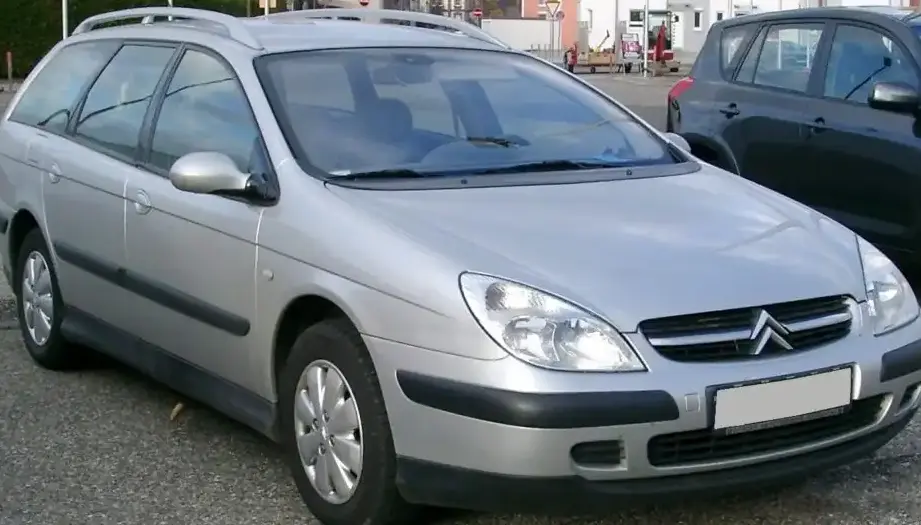
The Citroën C5 I Break 2.0i 16V Automatic, produced between 2001 and 2004, represents a significant offering within the first generation (X4/X5) of Citroën’s large family car. Positioned as a mid-range variant within the Break (estate/station wagon) body style, it aimed to provide a comfortable and practical vehicle for families prioritizing space and ease of driving over outright performance. This model falls within the Phase I refresh of the C5 I, characterized by subtle styling updates and refinements to the interior. It was primarily marketed in Europe, where the station wagon body style remained highly popular, offering a compelling alternative to more sporting or economy-focused trims.
Technical Specifications
| Brand | Citroen |
| Model | C5 |
| Generation | C5 I Break (Phase I, 2000) |
| Type (Engine) | 2.0i 16V (136 Hp) Automatic |
| Start of production | 2001 |
| End of production | 2004 |
| Powertrain Architecture | Internal Combustion engine |
| Body type | Station wagon (estate) |
| Seats | 5 |
| Doors | 5 |
| Fuel consumption (urban) | 11.9 l/100 km (19.8 US mpg, 23.7 UK mpg, 8.4 km/l) |
| Fuel consumption (extra urban) | 6.4 l/100 km (36.8 US mpg, 44.1 UK mpg, 15.6 km/l) |
| Fuel consumption (combined) | 8.4 l/100 km (28 US mpg, 33.6 UK mpg, 11.9 km/l) |
| CO2 emissions | 200 g/km |
| Fuel Type | Petrol (Gasoline) |
| Acceleration 0 – 100 km/h | 13.2 sec |
| Acceleration 0 – 62 mph | 13.2 sec |
| Acceleration 0 – 60 mph | 12.5 sec |
| Maximum speed | 194 km/h (120.55 mph) |
| Weight-to-power ratio | 10.1 kg/Hp, 99 Hp/tonne |
| Weight-to-torque ratio | 7.2 kg/Nm, 138.3 Nm/tonne |
| Power | 136 Hp @ 6000 rpm |
| Power per litre | 68.1 Hp/l |
| Torque | 190 Nm @ 4100 rpm (140.14 lb.-ft. @ 4100 rpm) |
| Engine layout | Front, Transverse |
| Engine Model/Code | RFN EW10J4 |
| Engine displacement | 1997 cm3 (121.86 cu. in.) |
| Number of cylinders | 4 |
| Engine configuration | Inline |
| Cylinder Bore | 85 mm (3.35 in.) |
| Piston Stroke | 88 mm (3.46 in.) |
| Compression ratio | 10.8:1 |
| Number of valves per cylinder | 4 |
| Fuel injection system | Multi-port manifold injection |
| Engine aspiration | Naturally aspirated engine |
| Valvetrain | DOHC |
| Engine oil capacity | 4.3 l (4.54 US qt, 3.78 UK qt) |
| Coolant | 9.3 l (9.83 US qt, 8.18 UK qt) |
| Kerb Weight | 1374 kg (3029.15 lbs.) |
| Max. weight | 1974 kg (4351.93 lbs.) |
| Max load | 600 kg (1322.77 lbs.) |
| Trunk (boot) space – minimum | 563 l (19.88 cu. ft.) |
| Trunk (boot) space – maximum | 1658 l (58.55 cu. ft.) |
| Fuel tank capacity | 66 l (17.44 US gal, 14.52 UK gal) |
| Max. roof load | 75 kg (165.35 lbs.) |
| Permitted trailer load with brakes (8%) | 1600 kg (3527.4 lbs.) |
| Permitted trailer load with brakes (12%) | 1500 kg (3306.93 lbs.) |
| Permitted trailer load without brakes | 720 kg (1587.33 lbs.) |
| Permitted towbar download | 75 kg (165.35 lbs.) |
| Length | 4760 mm (187.4 in.) |
| Width | 1770 mm (69.69 in.) |
| Width including mirrors | 2100 mm (82.68 in.) |
| Height | 1520-1560 mm (59.84 – 61.42 in.) |
| Wheelbase | 2750 mm (108.27 in.) |
| Front track | 1540 mm (60.63 in.) |
| Rear (Back) track | 1510 mm (59.45 in.) |
| Front overhang | 970 mm (38.19 in.) |
| Rear overhang | 1040 mm (40.94 in.) |
| Minimum turning circle | 12.46 m (40.88 ft.) |
| Drivetrain Architecture | ICE, Front wheel drive |
| Number of gears and type of gearbox | 4 gears, automatic transmission |
| Front suspension | Independent type McPherson |
| Rear suspension | Semi-independent, coil spring |
| Front brakes | Ventilated discs |
| Rear brakes | Disc |
| Assisting systems | ABS (Anti-lock braking system) |
| Steering type | Steering rack and pinion |
| Power steering | Hydraulic Steering |
| Tires size | 205/65 R15 |
| Wheel rims size | 6.5J x 15 |
INTRODUCTION
The Citroën C5 I Break 2.0i 16V Automatic, launched in 2001, was a key component of Citroën’s strategy to offer a modern and comfortable large family car. Built on the PSA Group’s 1HX0/A3 platform (shared with the Peugeot 607), the C5 aimed to blend traditional Citroën values of comfort and innovation with a more contemporary design and improved build quality. The Break (estate) version, in particular, catered to buyers needing substantial cargo capacity without sacrificing the refined driving experience. This 2.0-liter engine paired with an automatic transmission was positioned as a sensible choice for those prioritizing convenience and ease of use over sporty performance.
Powertrain & Engine Architecture
At the heart of this C5 variant lies the PSA EW10J4 engine, a 1997cc inline-four cylinder petrol engine. Designated with the RFN engine code, this unit features a double overhead camshaft (DOHC) valvetrain with four valves per cylinder, contributing to its respectable power output. The engine utilizes multi-point fuel injection, a common setup for the era, delivering fuel directly to the intake ports. The 2.0i 16V produces 136 horsepower at 6000 rpm and 190 Nm (140 lb-ft) of torque at 4100 rpm. Paired with this engine is a four-speed automatic transmission, offering smooth gear changes but lacking the efficiency of more modern automatic gearboxes. This transmission was chosen for its ease of use and suitability for drivers who preferred not to operate a manual gearbox, particularly in urban environments.
Driving Characteristics
The C5 I Break 2.0i Automatic delivers a comfortable, if not particularly exhilarating, driving experience. The four-speed automatic transmission, while smooth, contributes to a somewhat leisurely acceleration time of 13.2 seconds to 62 mph. The engine feels adequate for everyday driving, providing sufficient power for overtaking maneuvers on open roads, but it lacks the punch of higher-output variants like the V6 models. The automatic gearbox’s gear ratios are geared towards fuel efficiency and comfort rather than outright performance. Compared to the manual transmission versions of the 2.0i, the automatic suffers a slight performance penalty and reduced fuel economy. However, the comfortable suspension and well-insulated cabin contribute to a relaxed and refined ride quality, typical of Citroën vehicles.
Equipment & Trim Levels
The 2.0i 16V Automatic trim typically included features such as air conditioning, central locking, electric front windows, and an RDS stereo. Higher trim levels, often denoted by additions like ‘Exclusive’ or ‘SX’, added features like alloy wheels, rear parking sensors, automatic headlights and rain-sensing wipers, and upgraded interior trim materials. Interior upholstery was generally cloth, with leather options available as an extra. The dashboard layout was functional and ergonomically designed, prioritizing ease of use. Optional extras included a sunroof, a navigation system (a relatively new feature at the time), and upgraded audio systems.
Chassis & Braking
The C5 I Break features an independent McPherson strut front suspension and a semi-independent coil spring rear suspension. This setup prioritizes ride comfort and stability. The front brakes are ventilated discs, providing good stopping power, while the rear brakes are solid discs. ABS (Anti-lock Braking System) was standard, enhancing safety. The steering is hydraulic power-assisted rack and pinion, offering a light and responsive feel. The suspension tuning was generally softer, reflecting Citroën’s emphasis on comfort, although stabilizer bars were included to minimize body roll during cornering.
Market Reception & Comparison
The C5 I Break 2.0i Automatic was generally well-received by automotive critics as a comfortable and practical family car. However, the automatic transmission was sometimes criticized for its lack of responsiveness and relatively few gears compared to competitors. Fuel economy, while acceptable, wasn’t a standout feature. Compared to the 2.0i manual version, the automatic offered less fuel efficiency and slightly slower acceleration. Against rivals like the Ford Mondeo Estate and Volkswagen Passat Variant, the C5 offered a unique blend of comfort and style, but often lagged behind in terms of outright performance and brand prestige.
Legacy
The Citroën C5 I Break 2.0i Automatic has proven to be a relatively reliable vehicle, with the EW10J4 engine generally considered durable. However, like many cars of this era, maintenance is key to longevity. Common issues include corrosion, particularly on older examples, and potential problems with the automatic transmission if not serviced regularly. In the used car market, these C5s represent an affordable and spacious option for those seeking a comfortable estate car. While not a performance icon, the 2.0i Automatic variant remains a testament to Citroën’s commitment to providing a refined and practical driving experience.