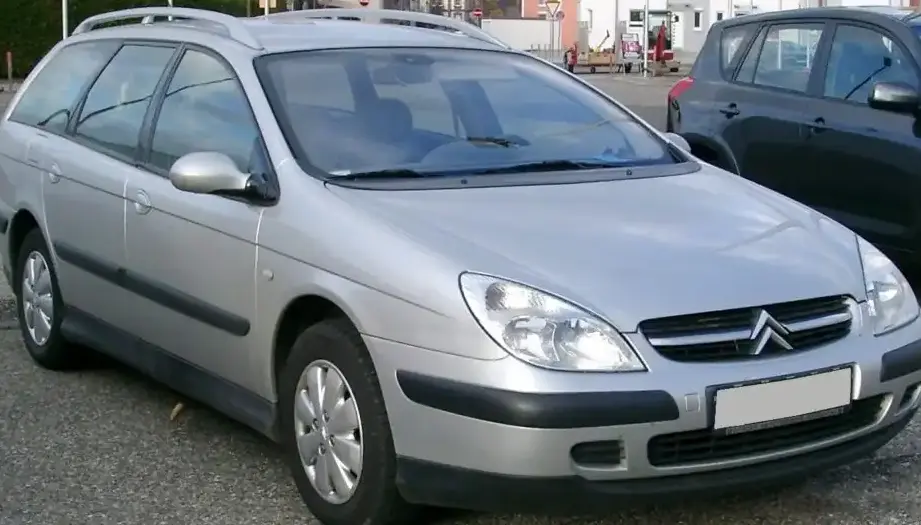
The Citroën C5 I Break 2.2 HDi 136 FAP, produced between 2001 and 2008, represents a significant offering in the mid-size station wagon segment. Part of the first generation (X3/X4) C5 range, the Break (estate) body style prioritized practicality and comfort, appealing to families and those requiring substantial cargo space. This particular variant, equipped with the 2.2-liter HDi diesel engine and a particulate filter (FAP), was positioned as a mid-range option, balancing fuel efficiency with reasonable performance. It played a key role in Citroën’s strategy to offer a modern, technologically advanced vehicle that challenged established European competitors like the Ford Mondeo and Volkswagen Passat.
Technical Specifications
| Brand | Citroën |
| Model | C5 |
| Generation | C5 I Break (Phase I, 2000) |
| Type (Engine) | 2.2 HDi (136 Hp) FAP |
| Start of production | 2001 |
| End of production | 2008 |
| Powertrain Architecture | Internal Combustion engine |
| Body type | Station wagon (estate) |
| Seats | 5 |
| Doors | 5 |
| Fuel consumption (urban) | 8.7 l/100 km (27 US mpg, 32.5 UK mpg, 11.5 km/l) |
| Fuel consumption (extra urban) | 5 l/100 km (47 US mpg, 56.5 UK mpg, 20 km/l) |
| Fuel consumption (combined) | 6.4 l/100 km (36.8 US mpg, 44.1 UK mpg, 15.6 km/l) |
| CO2 emissions | 169 g/km |
| Fuel Type | Diesel |
| Acceleration 0 – 100 km/h | 11.9 sec |
| Acceleration 0 – 62 mph | 11.9 sec |
| Acceleration 0 – 60 mph | 11.3 sec |
| Maximum speed | 201 km/h (124.9 mph) |
| Emission standard | Euro 3 |
| Weight-to-power ratio | 11.2 kg/Hp, 89.6 Hp/tonne |
| Weight-to-torque ratio | 4.7 kg/Nm, 212.1 Nm/tonne |
| Power | 136 Hp @ 4000 rpm |
| Power per litre | 62.4 Hp/l |
| Torque | 322 Nm @ 2000 rpm (237.5 lb.-ft. @ 2000 rpm) |
| Engine layout | Front, Transverse |
| Engine Model/Code | 4HX DW12TED4 |
| Engine displacement | 2179 cm3 (132.97 cu. in.) |
| Number of cylinders | 4 |
| Engine configuration | Inline |
| Cylinder Bore | 85 mm (3.35 in.) |
| Piston Stroke | 96 mm (3.78 in.) |
| Compression ratio | 18:1 |
| Number of valves per cylinder | 4 |
| Fuel injection system | Diesel Commonrail |
| Engine aspiration | Turbocharger, Intercooler |
| Valvetrain | DOHC |
| Engine oil capacity | 4.8 l (5.07 US qt, 4.22 UK qt) |
| Coolant | 8.8 l (9.3 US qt, 7.74 UK qt) |
| Kerb Weight | 1518 kg (3346.62 lbs.) |
| Max. weight | 2148 kg (4735.53 lbs.) |
| Max load | 630 kg (1388.91 lbs.) |
| Trunk (boot) space – minimum | 563 l (19.88 cu. ft.) |
| Trunk (boot) space – maximum | 1658 l (58.55 cu. ft.) |
| Fuel tank capacity | 66 l (17.44 US gal, 14.52 UK gal) |
| Max. roof load | 75 kg (165.35 lbs.) |
| Permitted trailer load with brakes (8%) | 1650 kg (3637.63 lbs.) |
| Permitted trailer load with brakes (12%) | 1450 kg (3196.7 lbs.) |
| Permitted trailer load without brakes | 750 kg (1653.47 lbs.) |
| Permitted towbar download | 75 kg (165.35 lbs.) |
| Length | 4756 mm (187.24 in.) |
| Width | 1770 mm (69.69 in.) |
| Height | 1516 mm (59.69 in.) |
| Wheelbase | 2750 mm (108.27 in.) |
| Front track | 1544 mm (60.79 in.) |
| Rear (Back) track | 1509 mm (59.41 in.) |
| Minimum turning circle | 12.46 m (40.88 ft.) |
| Drivetrain Architecture | Front wheel drive |
| Number of gears and type of gearbox | 5 gears, manual transmission |
| Front suspension | Independent type McPherson |
| Rear suspension | Semi-independent, coil spring |
| Front brakes | Ventilated discs |
| Rear brakes | Disc |
Powertrain & Engine Architecture
The heart of this C5 variant is the 4HX (DW12TED4) 2.2-liter inline-four cylinder diesel engine. This engine, developed by PSA (Peugeot Citroën) and utilizing technology licensed from Ford, was a mainstay of their diesel offerings in the early 2000s. It features a common rail direct injection system, delivering fuel at extremely high pressure for improved combustion efficiency and reduced emissions. The engine is turbocharged and intercooled, boosting power output to 136 horsepower and 322 Nm (237.5 lb-ft) of torque. The FAP (Filtre à Particules) or diesel particulate filter, was a key feature, designed to trap soot particles and reduce harmful emissions, becoming increasingly important to meet stricter European emission standards. The engine’s DOHC (Double Overhead Camshaft) valvetrain contributes to its relatively efficient operation. The engine is transversely mounted, driving the front wheels through a five-speed manual transmission.
Driving Characteristics
The 2.2 HDi 136 FAP offered a comfortable and refined driving experience, prioritizing ease of use over outright performance. Acceleration from 0-60 mph took around 11.3 seconds, and top speed was approximately 125 mph. While not particularly sporty, the engine provided ample torque for everyday driving and overtaking maneuvers. The five-speed manual transmission was well-matched to the engine’s characteristics, offering smooth gear changes. Compared to the more powerful 2.0 HDi or petrol variants, this version felt less eager to rev, but it compensated with superior fuel economy and a more relaxed cruising experience. The gear ratios were optimized for fuel efficiency and mid-range pull, making it a suitable choice for long-distance journeys.
Equipment & Trim Levels
The C5 I Break 2.2 HDi 136 FAP typically came equipped with a reasonable level of standard features. These included power windows, central locking, air conditioning, and an RDS stereo. Higher trim levels, such as Exclusive, added features like automatic climate control, alloy wheels, rain-sensing wipers, and a more luxurious interior trim. Interior upholstery was typically cloth, with leather options available as an upgrade. The dashboard layout was functional and ergonomically designed, with a focus on ease of use. Optional extras included a navigation system, parking sensors, and a panoramic sunroof.
Chassis & Braking
The C5 I Break featured a comfortable and compliant suspension setup. The front suspension utilized independent McPherson struts, while the rear employed a semi-independent coil spring arrangement. This setup prioritized ride comfort over sharp handling. The braking system consisted of ventilated discs on the front wheels and solid discs on the rear. ABS (Anti-lock Braking System) was standard, providing enhanced braking performance and stability. The steering was hydraulic power-assisted, offering a light and responsive feel.
Market Reception & Comparison
The Citroën C5 I Break 2.2 HDi 136 FAP was generally well-received by critics for its comfort, practicality, and fuel efficiency. It was seen as a strong competitor to other mid-size station wagons, offering a unique blend of French flair and practicality. Compared to the petrol-powered versions, the diesel variant offered significantly better fuel economy, making it a popular choice for high-mileage drivers. However, some critics noted that the engine could be somewhat noisy and lacked the refinement of some of its competitors. Reliability was generally good, although the FAP system could be prone to issues if not properly maintained.
Legacy
The 2.2 HDi engine, while eventually superseded by more modern designs, proved to be a durable and reliable powerplant. The C5 I Break 2.2 HDi 136 FAP remains a relatively common sight on European roads today, testament to its longevity. In the used car market, these models are often sought after for their practicality, comfort, and fuel efficiency. However, potential buyers should be aware of the potential maintenance costs associated with the FAP system and ensure that it has been regularly serviced. The C5 I Break, in general, established Citroën’s reputation for building comfortable and practical family cars, paving the way for future generations of the C5.