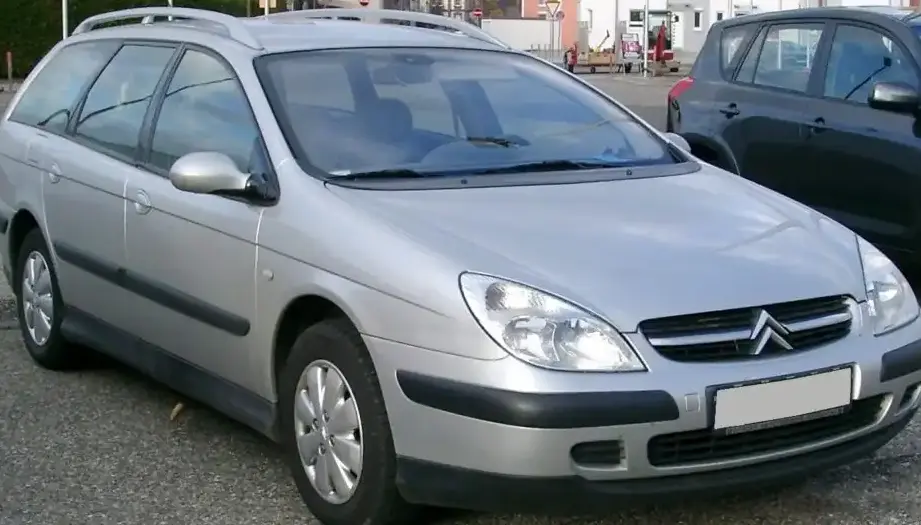
The Citroën C5 I Break 2.2 HDi 136 Automatic, produced between 2001 and 2004, represents a significant offering within the first generation (X3/X4) of Citroën’s large family car. Positioned as a mid-range variant within the Break (estate/station wagon) body style, it aimed to provide a blend of comfort, practicality, and reasonable performance for buyers seeking a spacious and refined diesel-powered vehicle. This model was primarily marketed in Europe, capitalizing on the growing demand for diesel engines and the popularity of station wagons for family transport. It utilized the PSA Group’s DW12TED4 engine, coupled with a four-speed automatic transmission, and incorporated a Diesel Particulate Filter (DPF), denoted by the “FAP” designation, to meet increasingly stringent emissions standards.
Technical Specifications
| Brand | Citroen |
| Model | C5 |
| Generation | C5 I Break (Phase I, 2000) |
| Type (Engine) | 2.2 HDi (136 Hp) FAP Automatic |
| Start of production | 2001 |
| End of production | 2004 |
| Powertrain Architecture | Internal Combustion engine |
| Body type | Station wagon (estate) |
| Seats | 5 |
| Doors | 5 |
| Fuel consumption (urban) | 9.9 l/100 km (23.8 US mpg, 28.5 UK mpg, 10.1 km/l) |
| Fuel consumption (extra urban) | 5.4 l/100 km (43.6 US mpg, 52.3 UK mpg, 18.5 km/l) |
| Fuel consumption (combined) | 7.1 l/100 km (33.1 US mpg, 39.8 UK mpg, 14.1 km/l) |
| CO2 emissions | 187 g/km |
| Fuel Type | Diesel |
| Acceleration 0 – 100 km/h | 12.5 sec |
| Acceleration 0 – 62 mph | 12.5 sec |
| Acceleration 0 – 60 mph | 11.9 sec |
| Maximum speed | 198 km/h (123.03 mph) |
| Emission standard | Euro 3 |
| Weight-to-power ratio | 11.5 kg/Hp, 87.3 Hp/tonne |
| Weight-to-torque ratio | 4.8 kg/Nm, 206.7 Nm/tonne |
| Power | 136 Hp @ 4000 rpm |
| Power per litre | 62.4 Hp/l |
| Torque | 322 Nm @ 2000 rpm (237.5 lb.-ft. @ 2000 rpm) |
| Engine layout | Front, Transverse |
| Engine Model/Code | 4HX DW12TED4 |
| Engine displacement | 2179 cm3 (132.97 cu. in.) |
| Number of cylinders | 4 |
| Engine configuration | Inline |
| Cylinder Bore | 85 mm (3.35 in.) |
| Piston Stroke | 96 mm (3.78 in.) |
| Compression ratio | 18:1 |
| Number of valves per cylinder | 4 |
| Fuel injection system | Diesel Commonrail |
| Engine aspiration | Turbocharger, Intercooler |
| Valvetrain | DOHC |
| Engine oil capacity | 4.8 l (5.07 US qt, 4.22 UK qt) |
| Coolant | 8.8 l (9.3 US qt, 7.74 UK qt) |
| Kerb Weight | 1558 kg (3434.8 lbs.) |
| Max. weight | 2175 kg (4795.05 lbs.) |
| Max load | 617 kg (1360.25 lbs.) |
| Trunk (boot) space – minimum | 563 l (19.88 cu. ft.) |
| Trunk (boot) space – maximum | 1658 l (58.55 cu. ft.) |
| Fuel tank capacity | 68 l (17.96 US gal, 14.96 UK gal) |
| Max. roof load | 75 kg (165.35 lbs.) |
| Permitted trailer load with brakes (8%) | 1050 kg (2314.85 lbs.) |
| Permitted trailer load with brakes (12%) | 1000 kg (2204.62 lbs.) |
| Permitted trailer load without brakes | 750 kg (1653.47 lbs.) |
| Permitted towbar download | 75 kg (165.35 lbs.) |
| Length | 4760 mm (187.4 in.) |
| Width | 1770 mm (69.69 in.) |
| Width including mirrors | 2100 mm (82.68 in.) |
| Height | 1520-1560 mm (59.84 – 61.42 in.) |
| Wheelbase | 2750 mm (108.27 in.) |
| Front track | 1540 mm (60.63 in.) |
| Rear track | 1510 mm (59.45 in.) |
| Front overhang | 970 mm (38.19 in.) |
| Rear overhang | 1040 mm (40.94 in.) |
| Minimum turning circle | 12.46 m (40.88 ft.) |
| Drivetrain Architecture | Front wheel drive |
| Number of gears and type of gearbox | 4 gears, automatic transmission |
| Front suspension | Independent type McPherson |
| Rear suspension | Semi-independent, coil spring |
| Front brakes | Ventilated discs |
| Rear brakes | Disc |
| Assisting systems | ABS (Anti-lock braking system) |
| Steering type | Steering rack and pinion |
| Power steering | Hydraulic Steering |
| Tires size | 205/65 R15; 215/65 R16 |
| Wheel rims size | 6.5J x 15; 6.5J x 16 |
INTRODUCTION
The Citroën C5 I Break 2.2 HDi 136 Automatic, launched in 2001 as part of the Phase I refresh of the C5 range, was designed to appeal to families and individuals needing a practical and comfortable vehicle. Built on the PSA Group’s 1HX0/A3 platform, shared with the Peugeot 607, it offered a spacious interior and a large cargo area. The 2.2 HDi engine, coupled with a four-speed automatic transmission, was intended to provide a balance between fuel efficiency and acceptable performance. This variant occupied a middle ground in the C5 Break lineup, offering more power and refinement than the lower-spec 1.8 and 2.0-liter petrol engines, but remaining more affordable than the flagship 3.0-liter V6 models.
Powertrain & Engine Architecture
The heart of this C5 variant is the PSA Group’s 4HX (DW12TED4) 2.2-liter inline-four cylinder diesel engine. This engine utilizes a common rail direct injection system, delivering fuel at extremely high pressure for improved combustion efficiency and reduced emissions. The DW12TED4 features a single turbocharger with an intercooler, boosting power output to 136 horsepower at 4000 rpm and 322 Nm (237.5 lb-ft) of torque at 2000 rpm. The engine also incorporates a Diesel Particulate Filter (DPF) – the “FAP” in the model designation – to trap soot particles, reducing harmful emissions. The four-speed automatic transmission, while providing convenience, is a relatively dated design compared to more modern automatic gearboxes. It features a torque converter and traditional planetary gearsets. Gear ratios are geared towards fuel economy and smooth cruising rather than outright acceleration.
Driving Characteristics
The C5 I Break 2.2 HDi 136 Automatic delivers a comfortable and relaxed driving experience. The engine provides adequate power for everyday driving and highway cruising, but acceleration is not particularly brisk. The 0-60 mph time of around 11.9 seconds reflects this. The automatic transmission shifts smoothly, but can feel somewhat sluggish, especially during quick overtaking maneuvers. Compared to the manual transmission versions of the same engine, the automatic suffers a slight performance penalty due to the transmission’s inherent efficiency losses. The higher-output 2.2 HDi variants (often found in later models) offer noticeably more performance. The focus is on providing a comfortable ride, and the C5’s hydropneumatic suspension (depending on trim level) contributes significantly to this, absorbing bumps and imperfections in the road surface effectively.
Equipment & Trim Levels
The C5 I Break 2.2 HDi 136 Automatic typically came equipped with a reasonable level of standard features. These included power windows, central locking, air conditioning, and an RDS stereo. Higher trim levels, such as Exclusive, added features like leather upholstery, automatic climate control, rain-sensing wipers, and a more sophisticated audio system. Optional extras included a navigation system, parking sensors, and a panoramic sunroof. Interior upholstery was typically cloth on lower trims, with leather available as an upgrade. The dashboard layout is functional and ergonomically designed, with a clear instrument cluster and logically placed controls.
Chassis & Braking
The C5 I Break features a front-wheel-drive layout. The front suspension utilizes an independent McPherson strut design, while the rear suspension is a semi-independent torsion beam setup. This configuration provides a good balance between ride comfort and handling. Braking duties are handled by ventilated discs at the front and solid discs at the rear. Anti-lock Braking System (ABS) is standard. The C5’s weight (approximately 1558 kg / 3434.8 lbs) contributes to its stable and planted feel on the road. Stabilizer bars are fitted to both the front and rear axles to reduce body roll during cornering.
Market Reception & Comparison
The Citroën C5 I Break 2.2 HDi 136 Automatic was generally well-received by automotive critics. It was praised for its comfortable ride, spacious interior, and fuel efficiency. However, the four-speed automatic transmission was often criticized for its lack of responsiveness. Compared to the petrol-powered C5 variants, the 2.2 HDi offered significantly better fuel economy. Against competitors like the Ford Mondeo Estate and Volkswagen Passat Estate, the C5 offered a unique blend of French comfort and practicality. The 2.2 HDi provided a good compromise between performance and economy, although the more powerful V6 models offered a more refined driving experience.
Legacy
The DW12TED4 engine, while generally reliable, can be prone to issues with the turbocharger and fuel injectors if not properly maintained. The DPF can also require periodic cleaning or replacement, particularly on vehicles that primarily cover short distances. The four-speed automatic transmission is known to be durable, but can exhibit wear and tear over time. Today, the C5 I Break 2.2 HDi 136 Automatic represents an affordable and practical option in the used car market. Its spacious interior, comfortable ride, and reasonable fuel economy continue to appeal to buyers seeking a versatile family vehicle. However, potential buyers should be aware of the potential maintenance costs associated with the diesel engine and DPF system.